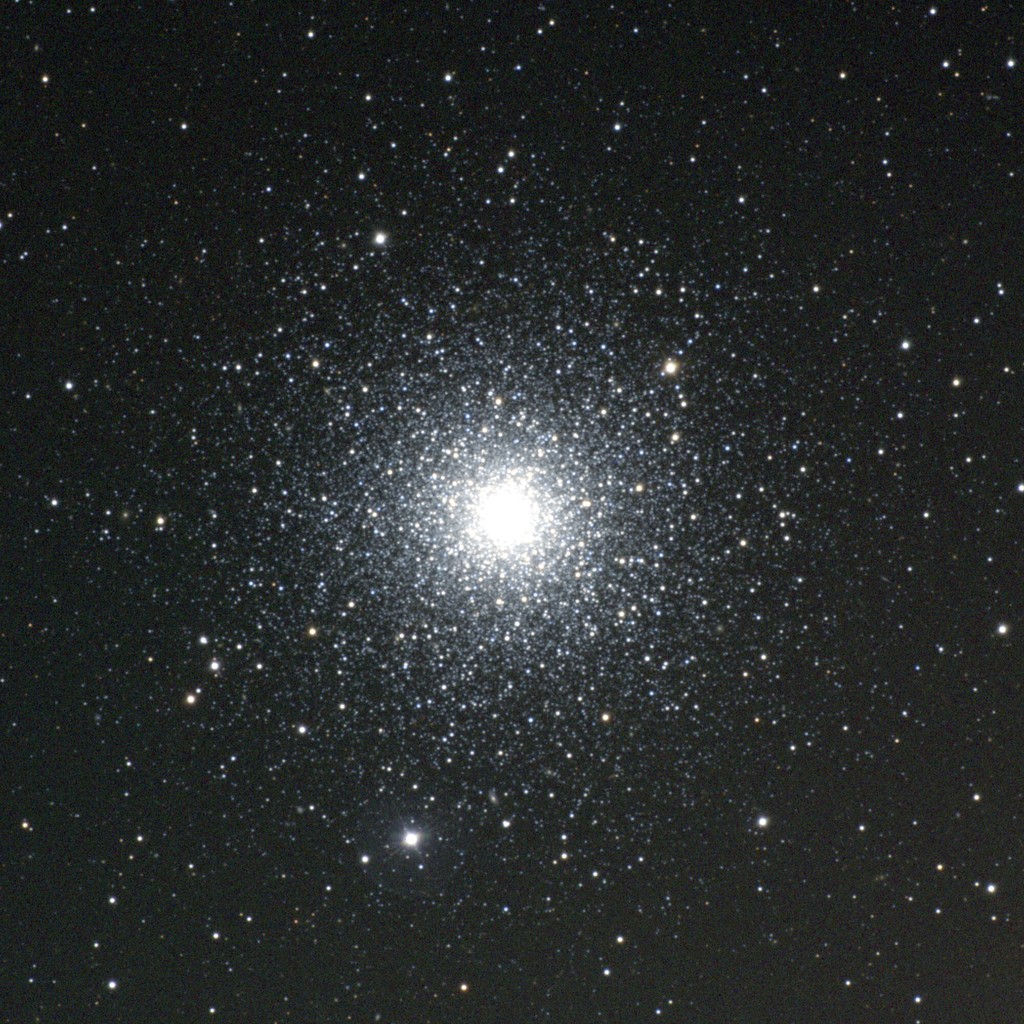
S.Kafka and K.Honeycutt, Indiana University/WIYN/NOIRLab/ NSF
| Type | Globular Cluster | Constellation | CVn |
|---|---|---|---|
| Magnitude | 6.2 | Size | 18.0′ |
| Distance | 33,900 light-years | Best Month | May |
| Visibility | Northern | Difficulty | Easy (level 2/4) |
| Min. Aperture | binoculars | RA / Dec | 13h 42m 10.8s · +28° 22' 48" |
| Discovered by | Charles Messier, 1764 | ||
S.Kafka and K.Honeycutt, Indiana University/WIYN/NOIRLab/ NSF
Messier 3 (NGC 5272) is regarded by many observers as the finest globular cluster in the northern sky, a magnificent sphere of roughly 500,000 stars spanning approximately 160 light-years in the constellation Canes Venatici. Charles Messier discovered it on May 3, 1764, cataloguing it as a "round, brilliant nebula" with no visible stars. William Herschel was the first to resolve NGC 5272 into stars in 1784, and the cluster has fascinated observers ever since. It lies about 34,000 light-years from Earth — close enough to show fine structural detail but far enough to appear as a stunning concentrated ball of ancient light.
NGC 5272 is estimated to be around 11–12 billion years old and is particularly rich in variable stars — over 270 have been identified, more than in almost any other globular cluster. The majority are RR Lyrae variables, pulsating stars that served as crucial "standard candles" for measuring galactic distances in the early 20th century. The cluster's outer regions gradually thin into a sparse halo, while the core is highly concentrated and bright. M3 represents the class of ancient halo globulars that predate the formation of the Milky Way's disk, carrying records of the galaxy's earliest chemistry.
In binoculars M3 is visible as a fuzzy star on clear nights; a small telescope reveals a glowing spherical glow, and larger apertures resolve it into a breathtaking cascade of stars. This image is a combination of B-band and Z-band exposures taken on March 22, 2003, at the WIYN 3.5-meter telescope on Kitt Peak using the WIYN Tip-Tilt Module (WTTM), which achieved extraordinary 0.4 arc-second seeing — among the sharpest ground-based views of M3 ever obtained.
From Arcturus: From Arcturus, sweep 12° northwest — M3 lies roughly between Arcturus and Cor Caroli.
| Star | Bayer | Mag | Spectral Type | Distance | Meaning |
|---|---|---|---|---|---|
| Arcturus | α Boo | -0.05 | K2 · Orange giant | 37 ly | Greek Arktouros, 'Guardian of the Bear' — it follows Ursa Major across the sky. The brightest star in the northern hemisphere. |
| Izar | ε Boo | 2.35 | A0 · Orange giant + blue companion | 203 ly | Arabic Al-Izār, 'The Veil' or 'The Loincloth.' One of the finest double stars visible in small telescopes — orange and blue-green. |
| Mufrid | β Boo | 2.68 | G0 · Yellow subgiant | 37 ly | Arabic Al-Mufrid, 'The Solitary Star of the Lancer' — close companion to brilliant Arcturus in the sky, though not physically related. |
| Cor Caroli | — | 2.89 | A0 · White main sequence | 110 ly | Latin for 'Heart of Charles' — named to honor King Charles II of England. The brightest star in Canes Venatici. |