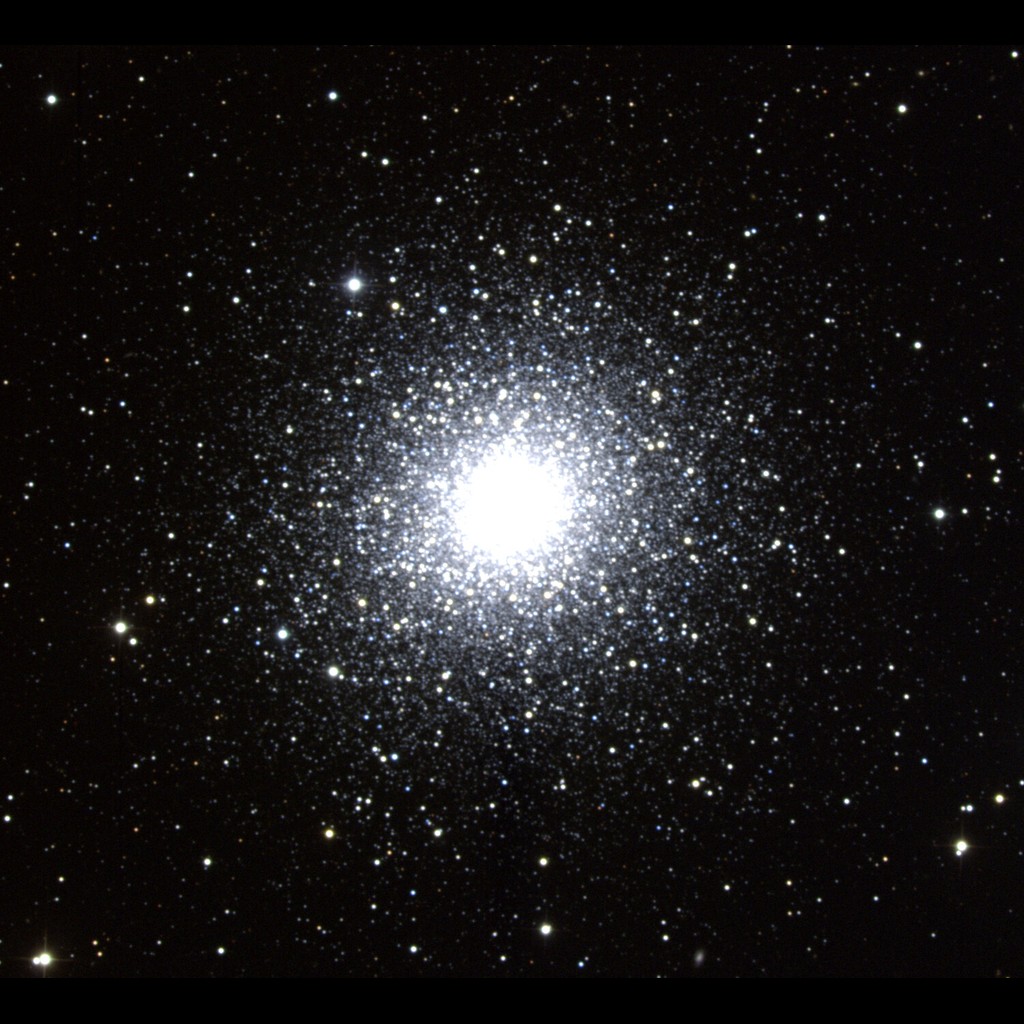
Doug Williams, REU Program/NOIRLab/ NSF /AURA
| Type | Globular Cluster | Constellation | Aqr |
|---|---|---|---|
| Magnitude | 6.5 | Size | 16.0′ |
| Distance | 37,500 light-years | Best Month | September |
| Visibility | Global | Difficulty | Easy (level 2/4) |
| Min. Aperture | binoculars | RA / Dec | 21h 33m 28.8s · -00° 49' 12" |
| Discovered by | Jean-Dominique Maraldi, 1746 | ||
Doug Williams, REU Program/NOIRLab/ NSF /AURA
Messier 2 (NGC 7089) is one of the largest and richest globular clusters in the northern sky, lying approximately 47,000 light-years away in the constellation Aquarius. It was first recorded by Jean-Dominique Maraldi in 1746 while observing a comet, and independently discovered by Charles Messier in 1760 — though Messier could not resolve it into stars and logged it as a "nebula without stars." William Herschel was the first to resolve NGC 7089 into its individual members in 1783. The cluster spans more than 150 light-years across and contains upward of 100,000 stars, making it a spectacular sight even through a modest telescope.
NGC 7089 belongs to the galactic halo, positioned almost directly beneath the Milky Way's southern pole. Like all globular clusters, its stars are ancient — roughly 13 billion years old — and formed together from the same primordial cloud of gas in the early Universe. The brightest members are red and yellow giants of considerable luminosity; overall, M2 shines at absolute magnitude −9, though interstellar distance dims it to apparent magnitude 6.3 as seen from Earth. The cluster contains both RR Lyrae and Population II Cepheid variables, giving astronomers valuable laboratories for studying stellar evolution and testing methods of cosmic distance measurement.
In binoculars, M2 appears as a softly glowing ball; a telescope of 150 mm or more begins to resolve a glittering haze of stars at the edges. This image was assembled from six exposures taken in July 1997 at the Kitt Peak National Observatory 0.9-meter telescope during the Research Experiences for Undergraduates (REU) program.
From Enif: From Enif (Epsilon Pegasi), sweep 5° south into Aquarius.
| Star | Bayer | Mag | Spectral Type | Distance | Meaning |
|---|---|---|---|---|---|
| Enif | — | 2.38 | K2 · Orange supergiant | 690 ly | Arabic Al-Anf, 'The Nose' of the horse — marks the muzzle of Pegasus. A supergiant that varies irregularly in brightness. |
| Sadalsuud | α Aqr | 2.90 | G0 · Yellow supergiant | 610 ly | Arabic Sa'd al-Su'ūd, 'Luckiest of the Lucky' — the brightest star in Aquarius, heralding the spring season in ancient Babylonian and Arabian astronomy. |
| Sadalmelik | β Aqr | 2.95 | G2 · Yellow supergiant | 520 ly | Arabic Sa'd al-Malik, 'Lucky Stars of the King' — one of several 'lucky star' names in Aquarius, associated with the spring rains in ancient Arabia. |