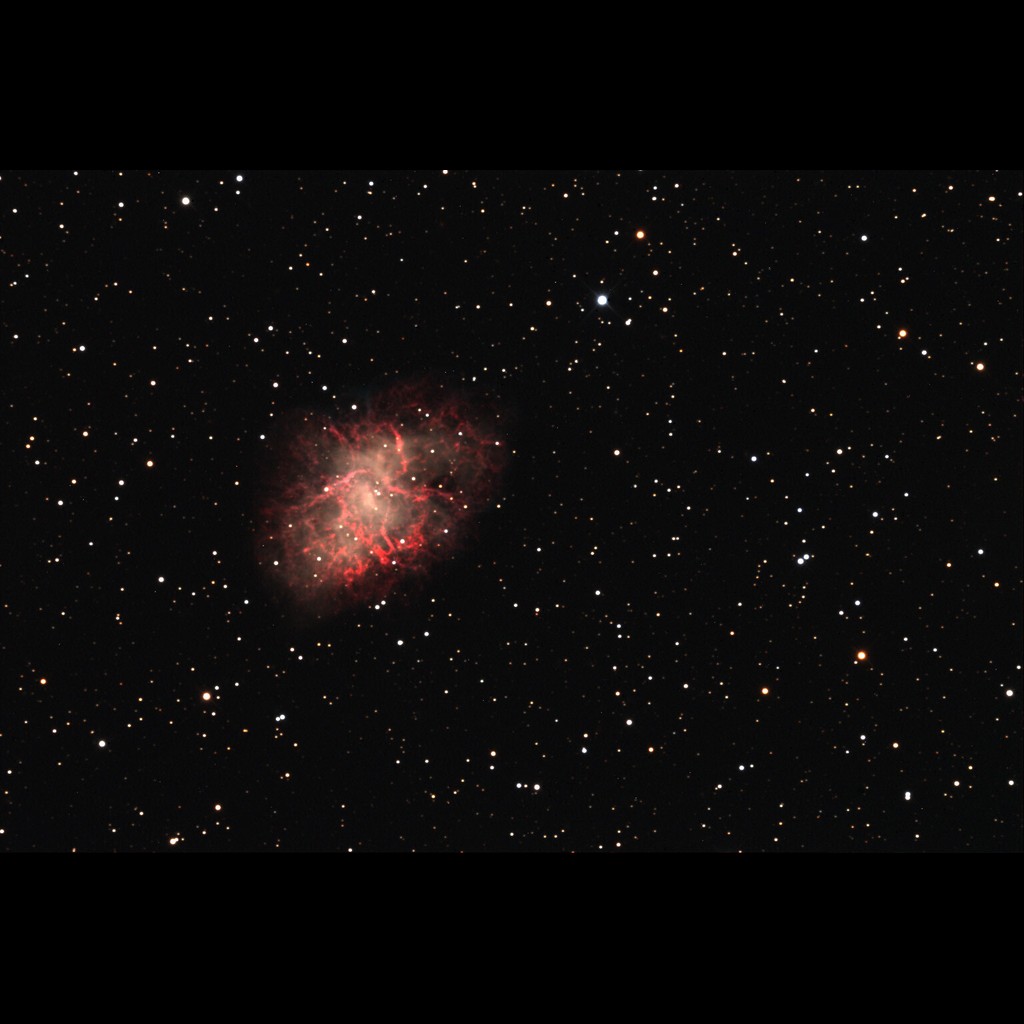
KPNO/NOIRLab/NSF/AURA/Yoshikawa Yoshihiko/Blythe Guvenen
| Type | Supernova Remnant | Constellation | Tau |
|---|---|---|---|
| Magnitude | 8.4 | Size | 7.0′ |
| Distance | 6,500 light-years | Best Month | January |
| Visibility | Northern | Difficulty | Easy (level 2/4) |
| Min. Aperture | binoculars | RA / Dec | 05h 34m 30.0s · +22° 00' 36" |
| Discovered by | John Bevis, 1731 | ||
KPNO/NOIRLab/NSF/AURA/Yoshikawa Yoshihiko/Blythe Guvenen
Messier 1 (NGC 1952), the Crab Nebula, is the expanding remnant of a massive star that ended its life in a catastrophic supernova explosion. The event was recorded on July 4, 1054 AD by Chinese court astronomers, and was likely observed by Arab and Native American sky-watchers as well — bright enough to be visible in full daylight for 23 days and in the night sky for nearly two years. John Bevis first recorded it telescopically in 1731; Charles Messier rediscovered it in 1758 while searching for a comet, and frustrated by its resemblance to one, placed it first on his list of things to avoid. It has since become one of the most studied objects in the sky. The nebula lies approximately 6,500 light-years away in the constellation Taurus and spans roughly 11 light-years of space.
At the heart of NGC 1952 lies the Crab Pulsar — a neutron star roughly 28 kilometers across yet containing more mass than the Sun, spinning 30 times per second. The pulsar converts its enormous rotational energy into a continuous wind of high-energy particles that powers the entire nebula, causing the surrounding gas to glow. The tangled filaments of hydrogen, helium, oxygen, and sulphur visible in the image are the actual stellar material ejected in the explosion, still expanding outward at approximately 1,500 kilometers per second. The Crab is classified as a plerion, or wind nebula — one of a small class of remnants whose energy comes primarily from a central pulsar rather than the shock of the original explosion.
In a small telescope M1 appears as a faint, featureless oval glow — deceptively quiet for one of the most energetic objects in the sky. Long-exposure photographs begin to reveal the twisted filamentary structure that gives the nebula its name. This image was taken as part of the Advanced Observing Program (AOP) at the Kitt Peak Visitor Center in 2014, with contributions from Yoshikawa Yoshihiko and Blythe Guvenen.
From Aldebaran: From Aldebaran, sweep 4° east-northeast to Zeta Tauri (the southern horn of Taurus), then 1° northwest.
| Star | Bayer | Mag | Spectral Type | Distance | Meaning |
|---|---|---|---|---|---|
| Aldebaran | α Tau | 0.87 | K5 · Red giant | 65 ly | Arabic Al-Dabarān, 'The Follower' — it follows the Pleiades star cluster across the sky. The fiery eye of Taurus the Bull. |
| Alnath | θ Aur | 1.65 | B7 · Blue-white giant | 134 ly | Arabic Al-Nath, 'The Butting One' — shared with Taurus, marking the tip of the Bull's horn and the foot of Auriga's charioteer. |
| Alnath | θ Aur | 1.65 | B7 · Blue-white giant | 134 ly | Arabic Al-Nath, 'The Butting One' — marks the tip of Taurus's northern horn. It is also shared with Auriga as its foot. |
| Alhena | — | 1.93 | A0 · White giant | 109 ly | Arabic Al-Han'ah, 'The Brand' or 'The Mark on a camel's neck.' Marks the foot of Pollux in the Gemini twins. |
| Hassaleh | ι Aur | 2.69 | K3 · Yellow supergiant | 870 ly | Arabic Al-Hasalah, possibly 'The Tortoise' — marks the foot of Auriga the Charioteer, a luminous yellow supergiant. |