NOIRLab/ NSF /AURA
| Type | Planetary Nebula | Constellation | UMa |
|---|---|---|---|
| Magnitude | 9.9 | Size | 3.4′ |
| Distance | 2,600 light-years | Best Month | April |
| Visibility | Northern | Difficulty | Challenging (level 4/4) |
| Min. Aperture | 6in | RA / Dec | 11h 14m 52.8s · +55° 01' 12" |
| Discovered by | Pierre Méchain, 1781 | ||
NOIRLab/ NSF /AURA
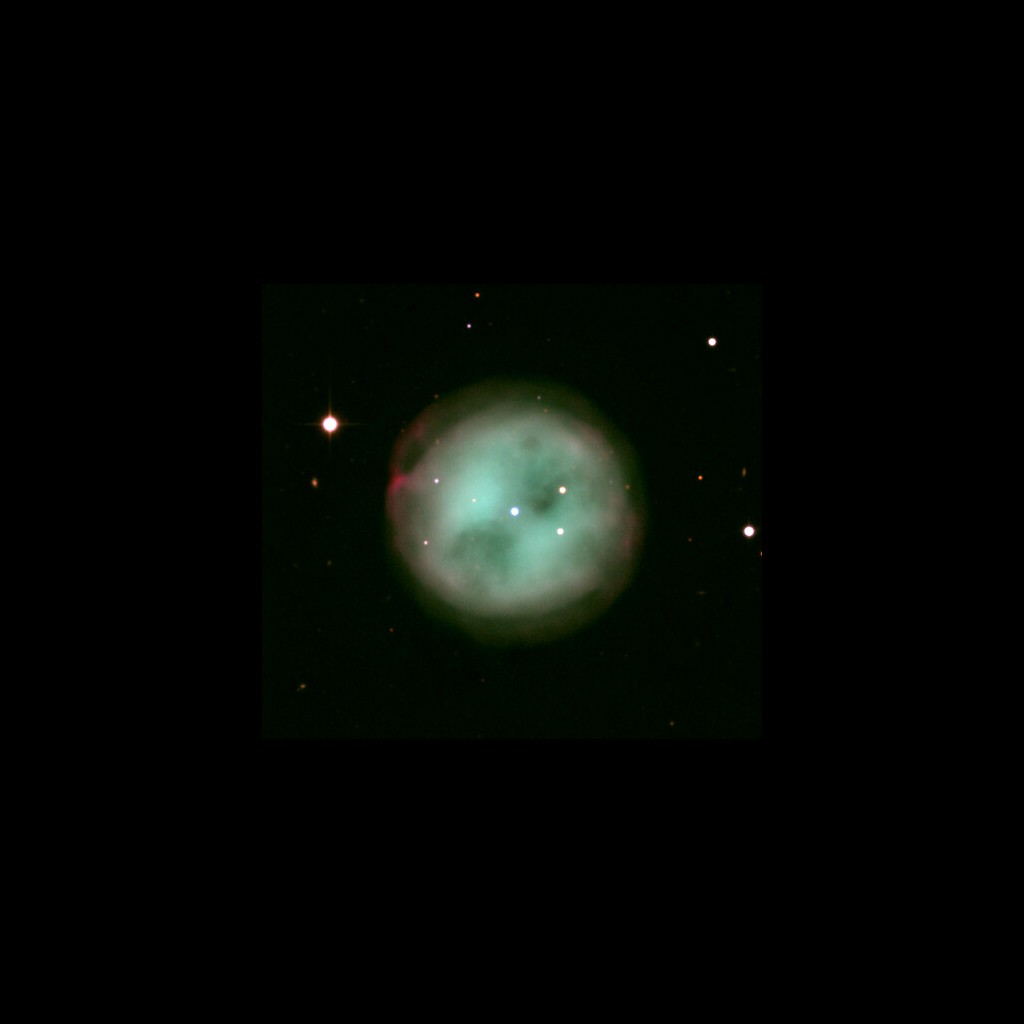
Messier 97 (NGC 3587), the Owl Nebula, is one of the larger and more complex planetary nebulae in the sky, appearing in the constellation Ursa Major — unusual for a Messier object, since most of his nebulae are concentrated toward the galactic plane. It was discovered by Pierre Méchain on February 16, 1781, and catalogued by Charles Messier three days later. At approximately 2,600 light-years away, the Owl Nebula spans about 2 light-years across, making it one of the physically larger planetary nebulae in Messier's catalog. Its apparent diameter is nearly 3 arcminutes — noticeably larger than the Ring Nebula (M57) or the Dumbbell's main body.
The Owl Nebula gets its name from the two darker, roughly circular patches visible in moderate-aperture telescopes that resemble the wide, staring eyes of an owl. These "eyes" are regions of slightly lower ionization and emissivity within an otherwise fairly uniform, spherical nebular shell — created by the geometry of the expanding gas and the particular density structure of the ejected envelope. The central white dwarf star, which once powered this now-dying nebula, is a faint 15th-magnitude object visible in deep images. M97 is one of the fainter Messier objects, at magnitude 9.9, because its large angular size distributes its light over a broad area, resulting in low surface brightness.
In binoculars M97 is barely detectable; a 100 mm telescope shows a round, dim, diffuse disk; the characteristic owl "eye" markings become visible in apertures of 200–250 mm under good transparency. This image was made at the Kitt Peak National Observatory 0.9-meter telescope.
From Merak: In Ursa Major, just 2° southeast of Merak (one of the Pointers in the Big Dipper).
| Star | Bayer | Mag | Spectral Type | Distance | Meaning |
|---|---|---|---|---|---|
| Alioth | — | 1.76 | A0 · White giant | 83 ly | Arabic origin uncertain, possibly from 'fat tail of a sheep.' The brightest star in Ursa Major and the handle of the Big Dipper. |
| Dubhe | α UMa | 1.81 | F7 · Orange giant | 124 ly | Arabic Zahr al-Dubb al-Akbar, 'Back of the Greater Bear' — one of the two pointer stars that lead to Polaris, the North Star. |
| Merak | δ UMa | 2.34 | A1 · Blue-white main sequence | 79 ly | Arabic Al-Maraqq, 'The Loins of the Bear' — one of the two pointer stars of the Big Dipper that guide observers to Polaris. |
| Phad | γ UMa | 2.41 | A0 · White main sequence | 84 ly | Arabic Al-Fakhdhah, 'The Thigh of the Bear' — marks the hip of Ursa Major, one of the four bowl stars of the Big Dipper. |
| Megrez | β UMa | 3.32 | A3 · White main sequence | 81 ly | Arabic Al-Maghriz, 'Root of the Bear's Tail' — the faintest of the seven Big Dipper stars, where the handle meets the bowl. |