NOIRLab/ NSF /AURA
| Type | Galaxy | Constellation | Leo |
|---|---|---|---|
| Magnitude | 9.2 | Size | 7.8′ |
| Distance | 35.0 million light-years | Best Month | April |
| Visibility | Northern | Difficulty | Moderate (level 3/4) |
| Min. Aperture | 3in | RA / Dec | 10h 44m 49.2s · +11° 49' 12" |
| Discovered by | Pierre Méchain, 1781 | ||
NOIRLab/ NSF /AURA
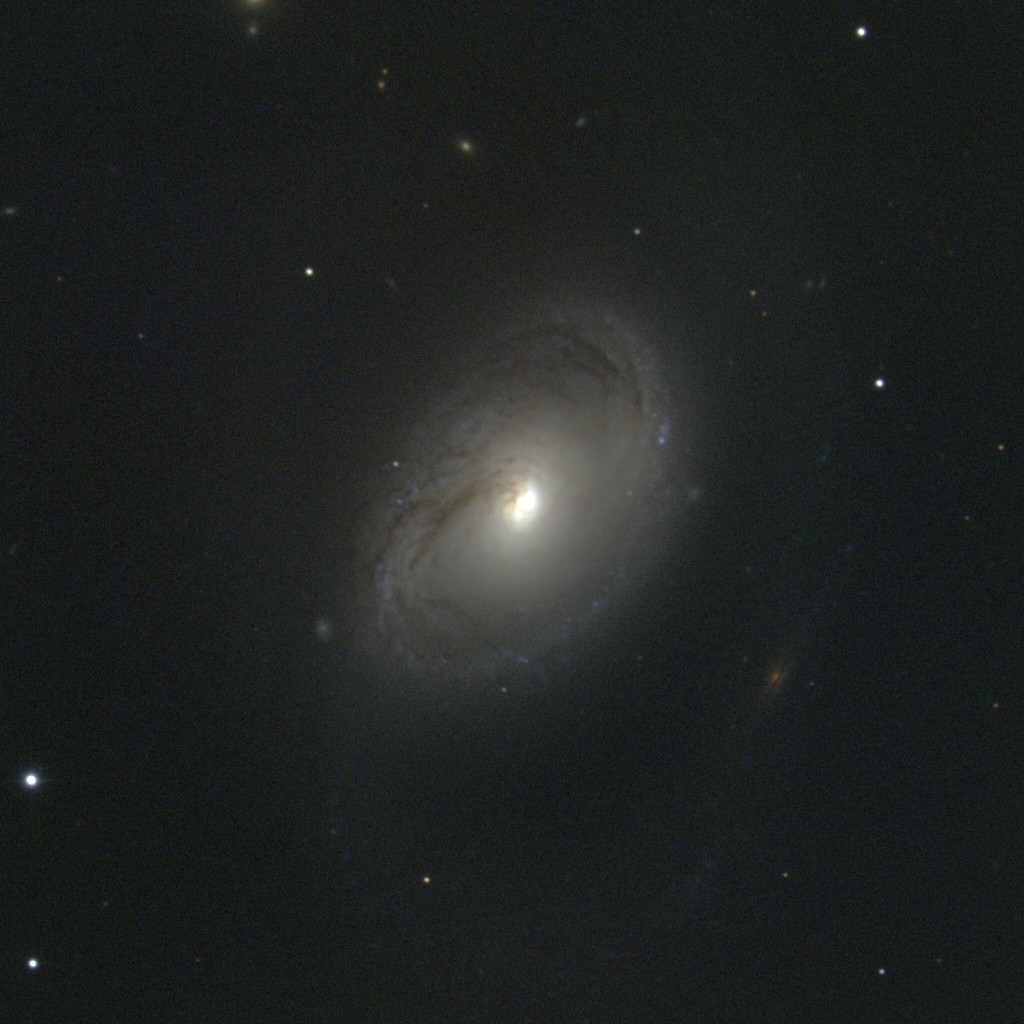
Messier 96 (NGC 3368) is the brightest member of the Leo I galaxy group, lying approximately 38 million light-years away in the constellation Leo. It was discovered by Pierre Méchain on March 20, 1781, and catalogued by Charles Messier shortly after. NGC 3368 is classified as type Sa — an early-type spiral with tightly wound, faint arms and a large, prominent central bulge — and is part of the same galaxy group as M95 and M105, all at similar distances. Despite its Sa classification, deep images reveal surprisingly extensive faint outer regions, giving NGC 3368 a total diameter of over 100,000 light-years — comparable to the Milky Way.
NGC 3368 shows a complex inner structure: the nuclear region contains an unusual mix of old and intermediate-age stellar populations, and there is evidence for a past episode of mild star formation in the inner disk. The galaxy's outer disk and halo fade gradually into the background sky and require careful image processing to reveal, as shown here where both the inner nuclear structure and the faint outer regions are visible simultaneously. M96 is the dominant galaxy of the Leo I Group, whose other principal members include the barred spiral M95 and the group of elliptical and lenticular galaxies near M105, all bound together gravitationally into a small cluster of galaxies.
In a small telescope M96 appears as an oval, slightly concentrated glow, brighter than its Leo I companions M95 and M105; larger apertures show a brighter, slightly elongated nucleus. This image was made in February 1996 at the Kitt Peak National Observatory 0.9-meter telescope, with significant image processing to simultaneously show the bright inner regions and the very faint outer halo.
From Regulus: In Leo, 0.7° east of M95 — both visible in the same binocular field with M105.
| Star | Bayer | Mag | Spectral Type | Distance | Meaning |
|---|---|---|---|---|---|
| Regulus | α Leo | 1.36 | B7 · Blue-white main sequence | 79 ly | Latin for 'Little King' — one of the four Royal Stars of antiquity, the heart of Leo the Lion. It spins so fast it is noticeably oblate. |
| Algieba | ζ Leo | 2.01 | K0 · Orange giant binary | 130 ly | Arabic Al-Jabhah, 'The Forehead' or 'The Mane' of the Lion. A beautiful golden double star visible in small telescopes. |
| Denebola | — | 2.14 | A3 · White main sequence | 36 ly | Arabic Dhanab al-Asad, 'Tail of the Lion' — marks the lion's tail. One of the few stars where infrared excess suggests a debris disk. |
| Zosma | β Leo | 2.56 | A4 · White subgiant | 58 ly | Greek for 'Girdle' — marks the hip of Leo the Lion. An aging star beginning to expand into a subgiant, slowly leaving the main sequence. |
| Ras Elased Australis | ε Leo | 2.97 | G0 · Orange giant | 247 ly | Arabic Ra's al-Asad al-Janūbī, 'Southern Head of the Lion' — marks the lion's mane, one of the sickle stars that form Leo's head. |