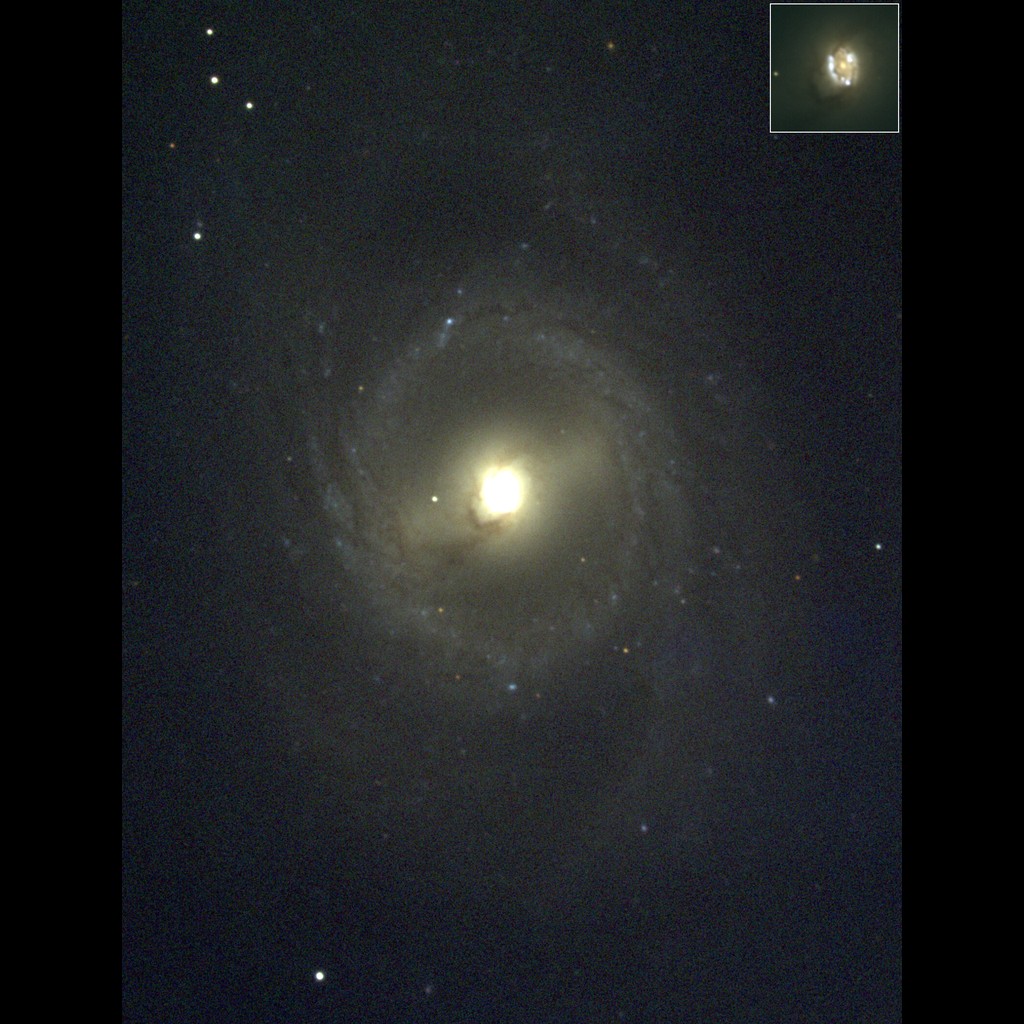
Hillary Mathis, N.A.Sharp/NOIRLab/ NSF /AURA/
| Type | Galaxy | Constellation | Leo |
|---|---|---|---|
| Magnitude | 9.7 | Size | 7.4′ |
| Distance | 38.0 million light-years | Best Month | April |
| Visibility | Northern | Difficulty | Moderate (level 3/4) |
| Min. Aperture | 3in | RA / Dec | 10h 41m 49.2s · +11° 41' 60" |
| Discovered by | Pierre Méchain, 1781 | ||
Hillary Mathis, N.A.Sharp/NOIRLab/ NSF /AURA/
Messier 95 (NGC 3351) is a barred spiral galaxy in the constellation Leo, approximately 38 million light-years away and a member of the Leo I galaxy group, which also includes M96 and M105. It was discovered by Pierre Méchain on March 20, 1781, and catalogued by Charles Messier shortly after. NGC 3351 is classified as type SBb, with a well-defined central bar and moderately wound spiral arms. The galaxy is particularly notable for a complex ring structure: a prominent inner ring of star formation encircles the central bar, and faint outer ring features are detectable in deep exposures. This ringed morphology makes M95 one of the clearest examples of a "ringed barred spiral" in Messier's catalog.
The inner star-forming ring of NGC 3351 is one of the most studied such structures in any nearby galaxy. Gas driven inward by the gravitational influence of the bar accumulates at a resonance radius, where it is compressed and triggers bursts of star formation — producing the bright, blue ring of young stellar clusters and HII regions visible in the image inset. The galaxy's very center is relatively quiescent and hosts a nuclear stellar cluster and a small supermassive black hole. In 2012, a supernova (SN 2012aw) was observed in M95, briefly reaching magnitude 12.0 and making it one of the more prominent supernovae in a nearby spiral in recent decades.
In a small telescope M95 appears as a round, faint oval with a brighter nucleus and a slight central condensation; the bar and ring structures require larger apertures and longer exposures to detect visually. This image was made in February 1996 at the Kitt Peak National Observatory 0.9-meter telescope.
From Regulus: In Leo, part of the M96 Group with M96 and M105 all visible in the same wide field.
| Star | Bayer | Mag | Spectral Type | Distance | Meaning |
|---|---|---|---|---|---|
| Regulus | α Leo | 1.36 | B7 · Blue-white main sequence | 79 ly | Latin for 'Little King' — one of the four Royal Stars of antiquity, the heart of Leo the Lion. It spins so fast it is noticeably oblate. |
| Algieba | ζ Leo | 2.01 | K0 · Orange giant binary | 130 ly | Arabic Al-Jabhah, 'The Forehead' or 'The Mane' of the Lion. A beautiful golden double star visible in small telescopes. |
| Denebola | — | 2.14 | A3 · White main sequence | 36 ly | Arabic Dhanab al-Asad, 'Tail of the Lion' — marks the lion's tail. One of the few stars where infrared excess suggests a debris disk. |
| Zosma | β Leo | 2.56 | A4 · White subgiant | 58 ly | Greek for 'Girdle' — marks the hip of Leo the Lion. An aging star beginning to expand into a subgiant, slowly leaving the main sequence. |
| Ras Elased Australis | ε Leo | 2.97 | G0 · Orange giant | 247 ly | Arabic Ra's al-Asad al-Janūbī, 'Southern Head of the Lion' — marks the lion's mane, one of the sickle stars that form Leo's head. |