Hillary Mathis, N.A.Sharp/NOIRLab/ NSF /AURA/
| Type | Galaxy | Constellation | CVn |
|---|---|---|---|
| Magnitude | 8.2 | Size | 11.2′ |
| Distance | 16.0 million light-years | Best Month | May |
| Visibility | Northern | Difficulty | Easy (level 2/4) |
| Min. Aperture | binoculars | RA / Dec | 12h 50m 52.8s · +41° 07' 12" |
| Discovered by | Pierre Méchain, 1781 | ||
Hillary Mathis, N.A.Sharp/NOIRLab/ NSF /AURA/
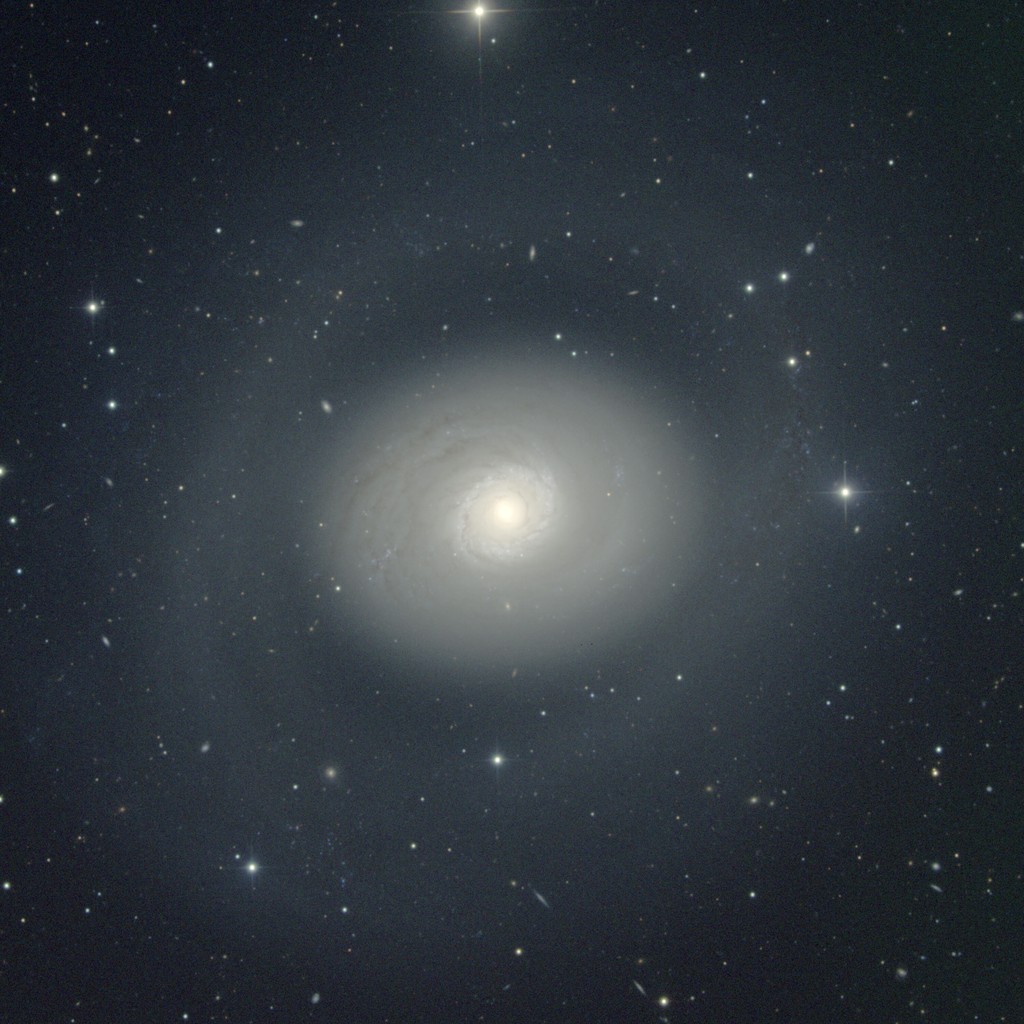
Messier 94 (NGC 4736) is a spiral galaxy of type Sab in the constellation Canes Venatici, approximately 16 million light-years from Earth — relatively close by extragalactic standards — and spanning about 50,000 light-years across. It was discovered by Pierre Méchain in 1781 and catalogued by Charles Messier on March 22, 1781. NGC 4736 is a visually striking galaxy with an unusually complex concentric ring structure: at the center is an intensely bright nuclear region; surrounding it is a prominent blue ring of young star clusters and HII regions where active star formation is concentrated; beyond that lies a fainter yellowish zone of older stars; and further out still a much fainter outer ring is visible in deep images. All of these nested structures are visible in this image, revealed by a carefully stretched intensity scale.
The inner star-forming ring of NGC 4736 is one of the most prominent such features in any nearby galaxy, and represents a "starburst ring" — a zone where gas is funneled by the galaxy's own structure (possibly a bar or oval distortion in the disk) and compressed into new stars. The outer ring, by contrast, is primarily an older stellar population. The combination of vigorous inner star formation and a quiescent outer disk makes M94 an interesting case study in how spiral structure and gas flows regulate star formation in galaxy disks. NGC 4736 is thought by some astronomers to be a loosely associated group member with the Black Eye Galaxy (M64).
In a small telescope M94 appears as a bright, round, compact object with a dazzling nucleus; larger apertures begin to reveal the inner ring structure surrounding the bright core. This image was made in May 1998 at the Kitt Peak National Observatory 0.9-meter telescope.
Navigate from Arcturus toward Canes Venatici. In Canes Venatici, between Cor Caroli and Chara.
| Star | Bayer | Mag | Spectral Type | Distance | Meaning |
|---|---|---|---|---|---|
| Alkaid | η UMa | 1.85 | B3 · Blue-white main sequence | 101 ly | Arabic Al-Qa'id, 'The Leader of the Daughters of the Bier' — the tip of the Big Dipper's handle, representing the chief mourner in an Arabic funeral procession. |
| Cor Caroli | — | 2.89 | A0 · White main sequence | 110 ly | Latin for 'Heart of Charles' — named to honor King Charles II of England. The brightest star in Canes Venatici. |