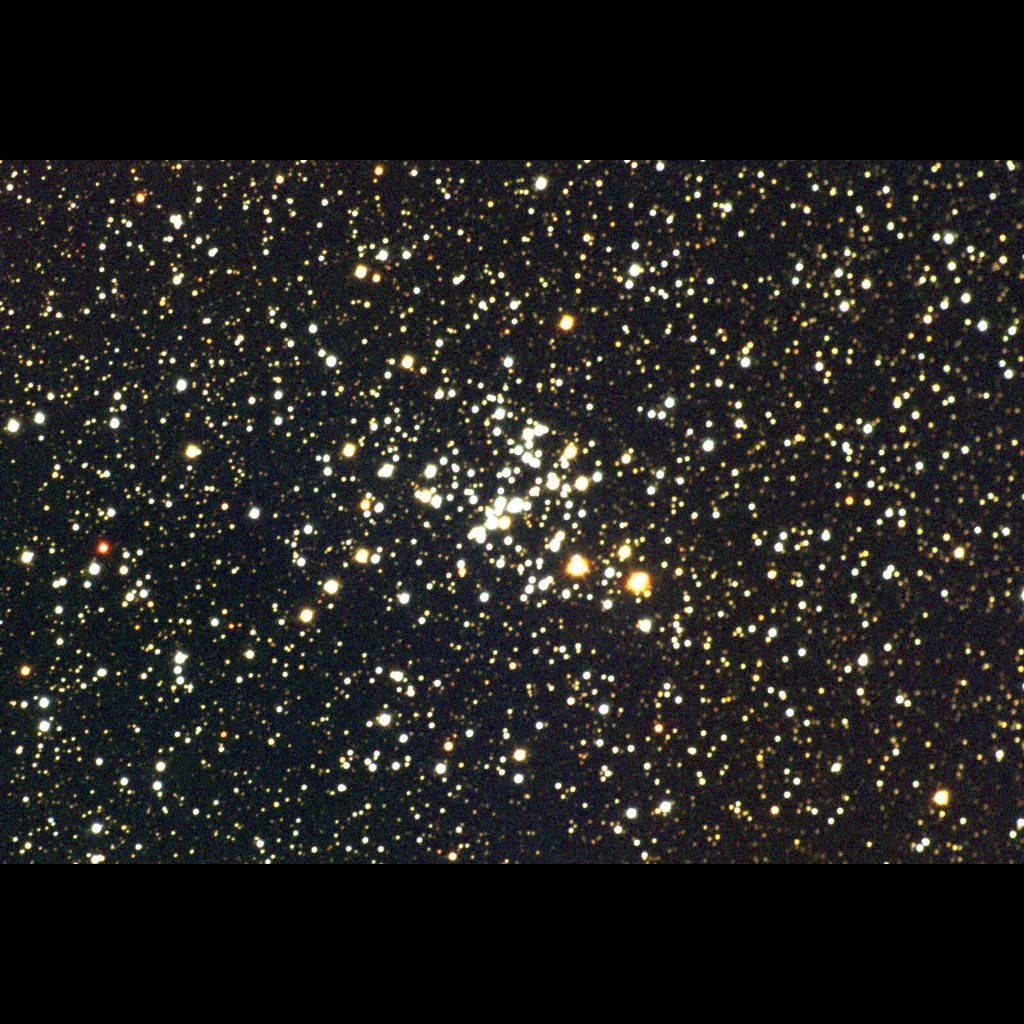
NOIRLab/ NSF /AURA
| Type | Open Cluster | Constellation | Pup |
|---|---|---|---|
| Magnitude | 6.0 | Size | 22.0′ |
| Distance | 3,600 light-years | Best Month | February |
| Visibility | Global | Difficulty | Easy (level 2/4) |
| Min. Aperture | binoculars | RA / Dec | 07h 44m 31.2s · -23° 52' 12" |
| Discovered by | Charles Messier, 1781 | ||
NOIRLab/ NSF /AURA
Messier 93 (NGC 2447) is a bright, compact open star cluster in the constellation Puppis, approximately 3,500 light-years from Earth and spanning about 25 light-years across. Charles Messier discovered it on March 20, 1781. NGC 2447 contains around 100 confirmed members and is estimated to be between 100 and 300 million years old — old enough to have lost its most luminous blue supergiants but still young enough to be dominated by hot A and B-type stars. At magnitude 6.2, it is visible to the naked eye under good conditions, and in binoculars or a small telescope it presents a rich, attractive gathering of stars.
NGC 2447 has a distinctive appearance: the brighter members form a pattern that some observers describe as a butterfly or arrowhead pointing northward. The cluster is reasonably well concentrated, with a denser core fading into a more scattered outer region. It sits in a fairly rich section of the winter Milky Way in Puppis — a constellation once part of the much larger ancient Greek constellation Argo Navis (the Ship of the Argonauts), which was subdivided by Nicolas Louis de Lacaille in the 18th century into Puppis (the Stern), Carina (the Keel), and Vela (the Sails). M93 lies in the celestial equivalent of the ship's stern, in a region rich with clusters and nebulae.
In binoculars M93 is a clear concentration above the surrounding Milky Way background; a small telescope shows a compact gathering of about 30 bright stars with a distinctly richer center. This CCD color composite was made from data taken on the nights of September 20–21, 1997, at the Burrell Schmidt telescope of Case Western Reserve University's Warner and Swasey Observatory on Kitt Peak.
Navigate from Alhena toward Puppis. In Puppis, southeast of the M46/M47 pair.
| Star | Bayer | Mag | Spectral Type | Distance | Meaning |
|---|---|---|---|---|---|
| Sirius | α CMa | -1.44 | A0 · Blue-white main sequence | 8.6 ly | Greek for 'Glowing' or 'Scorching' — the brightest star in the night sky. The ancient Egyptians timed the Nile flood by its heliacal rising. |
| Adhara | ε CMa | 1.50 | B2 · Blue-white supergiant | 430 ly | Arabic for 'Virgins' — part of a group of stars once seen as a constellation of maidens guarding the sky. |
| Wezen | η CMa | 1.83 | F8 · Yellow-white supergiant | 1600 ly | Arabic Al-Wazn, 'The Weight' — a yellow-white supergiant so massive that it barely moves across the sky, giving rise to its name. |
| Aludra | — | 2.45 | B5 · Blue supergiant | 3190 ly | Arabic Al-'Adhārā, 'The Virgins' — one of a group of stars in Canis Major representing maidens. An enormous blue supergiant. |