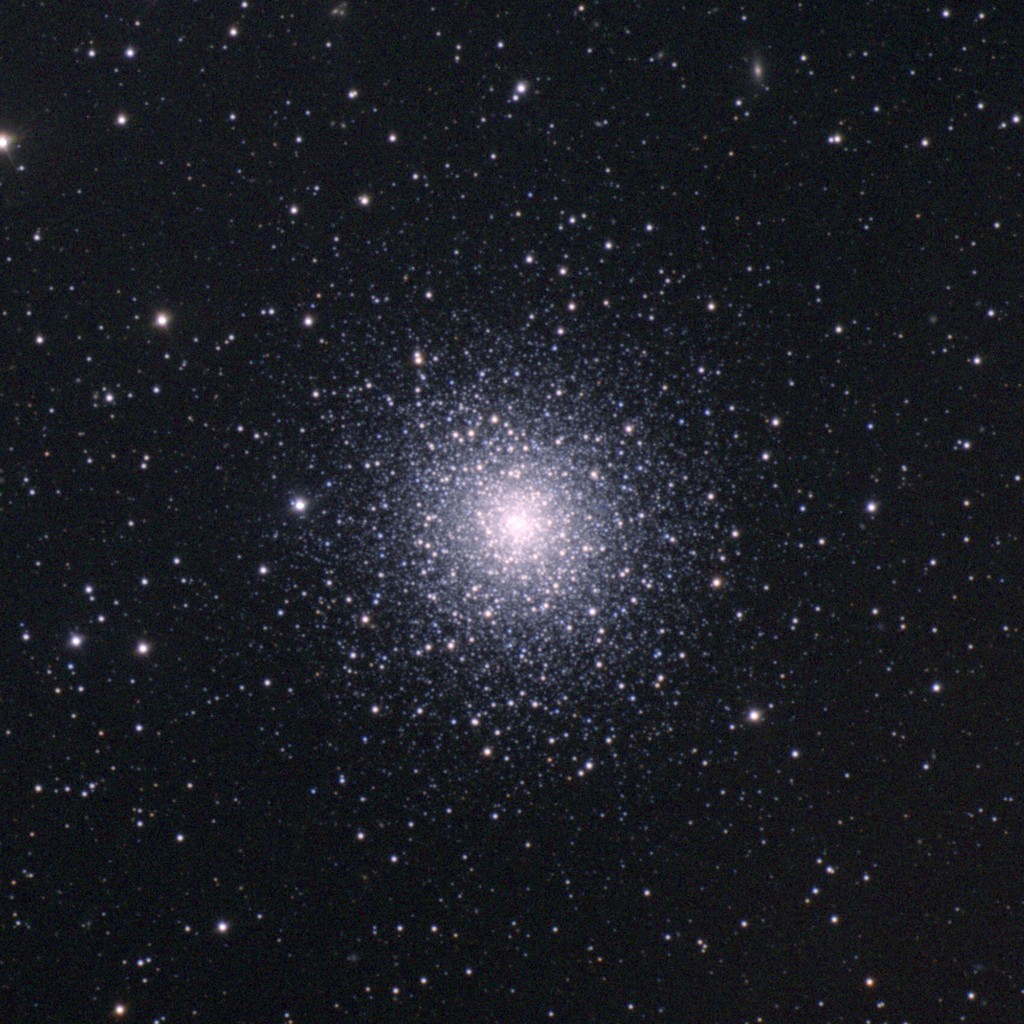
Hillary Mathis, REU program/NOIRLab/ NSF /AURA
| Type | Globular Cluster | Constellation | Her |
|---|---|---|---|
| Magnitude | 6.5 | Size | 14.0′ |
| Distance | 26,700 light-years | Best Month | July |
| Visibility | Northern | Difficulty | Easy (level 2/4) |
| Min. Aperture | binoculars | RA / Dec | 17h 17m 06.0s · +43° 07' 48" |
| Discovered by | Johann Elert Bode, 1777 | ||
Hillary Mathis, REU program/NOIRLab/ NSF /AURA
Messier 92 (NGC 6341) is a rich, ancient globular cluster in the constellation Hercules, approximately 28,000 light-years from Earth and spanning over 100 light-years across. It was discovered by Johann Elert Bode in 1777 and independently catalogued by Charles Messier on March 18, 1781. NGC 6341 lies just 9 degrees from the magnificent M13 — the Great Hercules Cluster — and is often overshadowed by its more celebrated neighbor; yet M92 is a genuinely magnificent globular in its own right, bright enough to be visible to the naked eye under excellent conditions and one of the finest globulars in the northern sky. In most annual Messier observing lists it ranks among the top ten most rewarding objects.
NGC 6341 is one of the oldest globular clusters known, with age estimates ranging from 13.8 to 14.2 billion years — so old that some estimates place it as old as the Universe itself, within measurement uncertainties. Its ancient age gives it a highly metal-poor stellar population dominated by old red giants and horizontal branch stars, a deep color signature of the earliest stellar generations. Unlike M13, which has a more loosely scattered core, M92 has a notably concentrated, bright nucleus surrounded by a well-defined halo — giving it a slightly more compact appearance at the telescope. The cluster contains several dozen RR Lyrae variable stars useful for distance determination.
M92 is sometimes overlooked in the rush to observe M13, but a sweep from one to the other on a clear summer night rewards the observer with a revealing comparison of two of the northern sky's finest globular clusters. This approximately true-color image was assembled from BVR exposures taken in June 1996 at the Burrell Schmidt telescope of Case Western Reserve University's Warner and Swasey Observatory on Kitt Peak, as part of the Research Experiences for Undergraduates (REU) program supported by the National Science Foundation.
From Vega: In northern Hercules, just north of the Keystone asterism — 6° north of M13.
| Star | Bayer | Mag | Spectral Type | Distance | Meaning |
|---|---|---|---|---|---|
| Vega | α Lyr | 0.03 | A0 · Blue-white main sequence | 25 ly | Arabic Wāqi', 'The Swooping Eagle' — the fifth brightest star and anchor of the Summer Triangle. Will become the North Star around 13,727 CE. |
| Etamin | α Dra | 2.24 | K5 · Orange giant | 148 ly | Arabic Al-Tinnīn, 'The Dragon' — the brightest star in Draco, marking the dragon's head. The North Star around 4000 BCE. |
| Rastaban | β Dra | 2.79 | G2 · Yellow giant | 380 ly | Arabic Ra's al-Thubbān, 'Head of the Dragon' — marks the dragon's eye in Draco, forming a small quadrilateral with Etamin and two fainter stars. |
| Sheliak | γ Lyr | 3.52 | A8 · Blue-white eclipsing binary | 960 ly | Arabic Al-Sheliak, 'The Tortoise' or 'The Lyre' — an eclipsing binary in Lyra that was one of the first variable stars discovered, in 1784. |