NOIRLab/ NSF /AURA
| Type | Galaxy | Constellation | Com |
|---|---|---|---|
| Magnitude | 10.2 | Size | 5.4′ |
| Distance | 63.0 million light-years | Best Month | May |
| Visibility | Northern | Difficulty | Challenging (level 4/4) |
| Min. Aperture | 6in | RA / Dec | 12h 35m 31.2s · +14° 30' 00" |
| Discovered by | Charles Messier, 1781 | ||
NOIRLab/ NSF /AURA
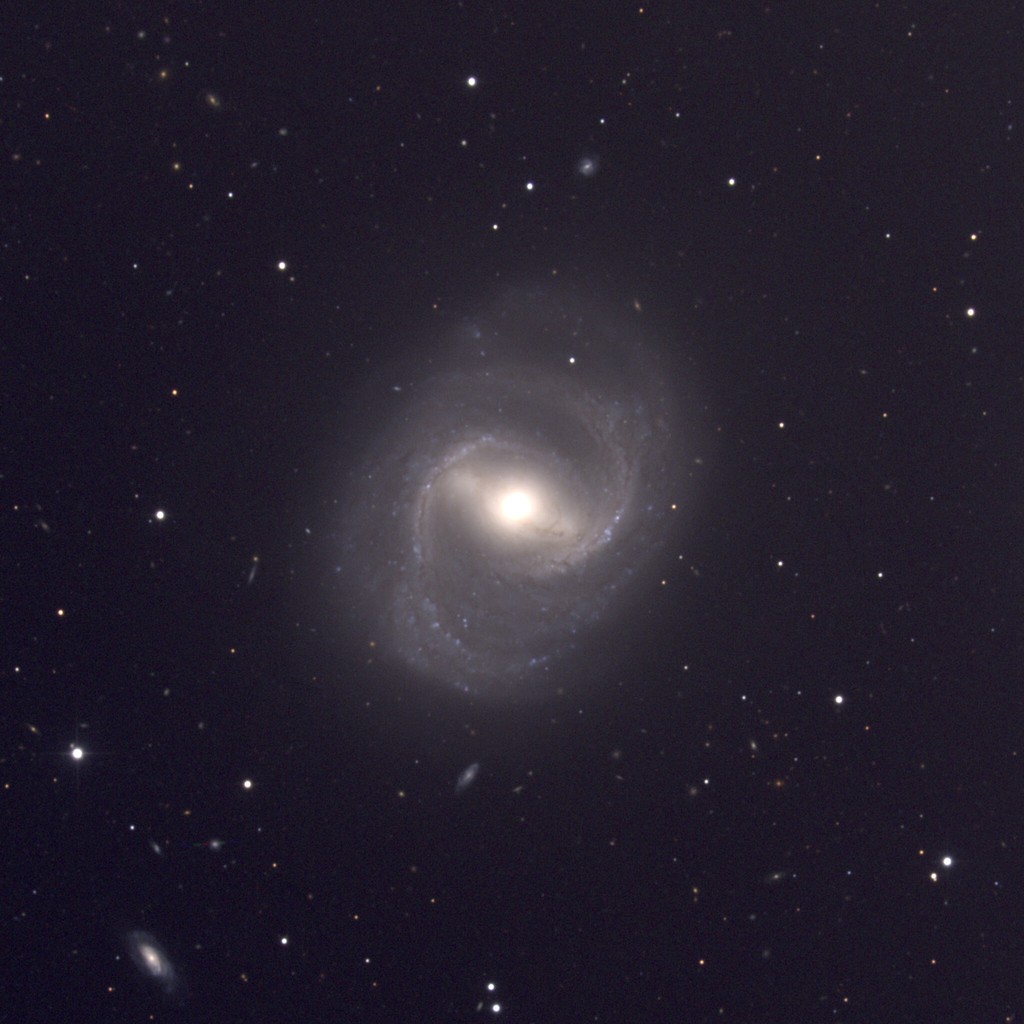
Messier 91 (NGC 4548) is a barred spiral galaxy of type SBb in the constellation Coma Berenices, approximately 60 million light-years away as a member of the Virgo Cluster of galaxies. Charles Messier catalogued it on March 18, 1781. NGC 4548 holds the distinction of being the long-sought "lost Messier object": for nearly two centuries, astronomers could not identify what celestial object Messier had observed, as his recorded position matched no obvious object. In 1969, William C. Williams proposed that Messier had made a small position error and that M91 corresponded to NGC 4548, a solution now broadly accepted. The confusion arose partly because the bar and overall appearance of NGC 4548 were subtle enough that early identification was uncertain.
NGC 4548 has a conspicuous central bar — one of the more prominent bars among the barred spirals in Messier's catalog — with relatively tightly wound arms extending from the bar ends. Barred spirals are thought to develop their bars through internal gravitational instabilities over time, and the bar in turn can funnel gas toward the central regions, potentially fueling star formation or nuclear activity. M91 is a relatively quiescent galaxy with modest star formation; it is mildly affected by the tidal environment of the Virgo Cluster, though less dramatically stripped than some other Virgo spirals.
In a small telescope M91 appears as a faint, slightly elongated oval glow with a brighter center; the bar is not easily distinguished visually. This CCD composite was made in April 1998 at the Kitt Peak National Observatory 0.9-meter telescope.
Navigate from Arcturus toward Coma Berenices. In Coma Berenices, near M88 in the northern Virgo Cluster.
| Star | Bayer | Mag | Spectral Type | Distance | Meaning |
|---|---|---|---|---|---|
| Denebola | — | 2.14 | A3 · White main sequence | 36 ly | Arabic Dhanab al-Asad, 'Tail of the Lion' — marks the lion's tail. One of the few stars where infrared excess suggests a debris disk. |
| Vindemiatrix | — | 2.85 | G8 · Yellow giant | 102 ly | Latin for 'The Grape Gatherer' — its heliacal rising in ancient times signaled the grape harvest season in the Mediterranean. |