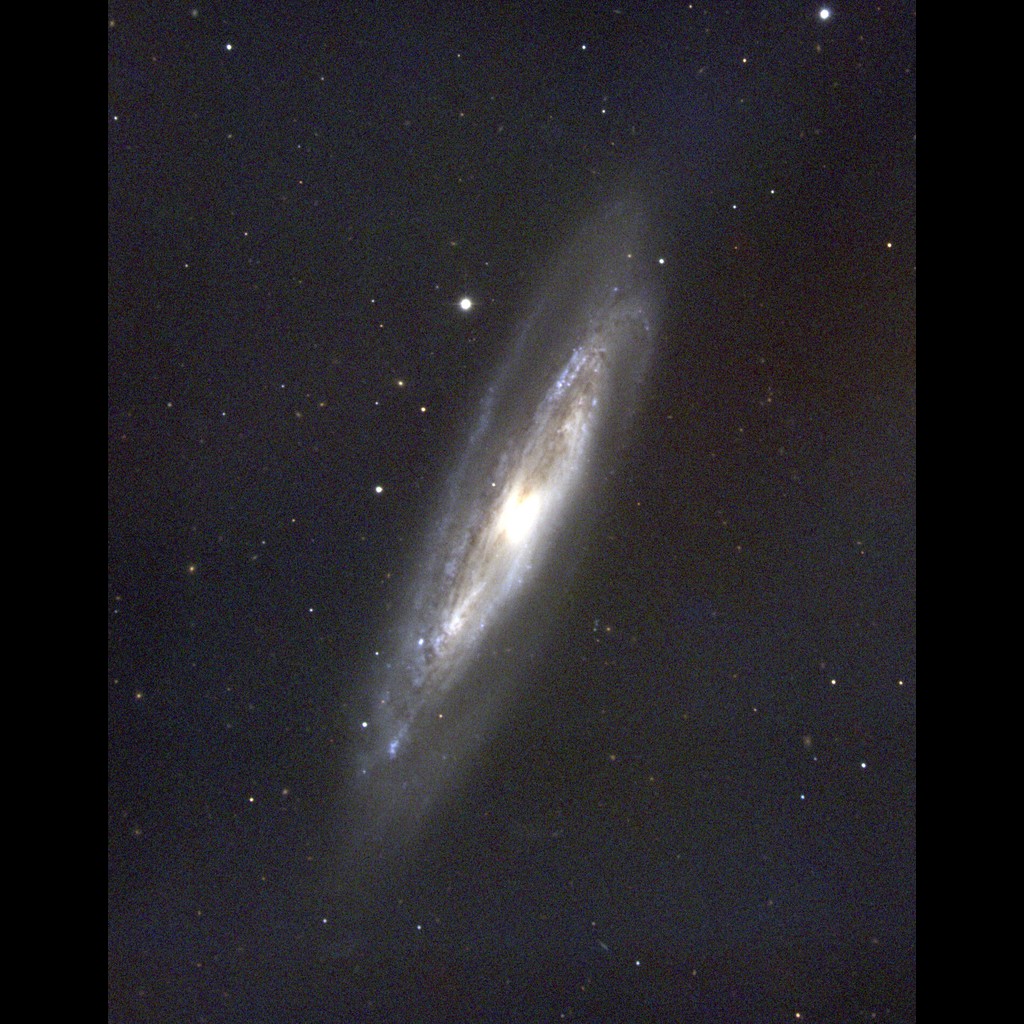
NOIRLab/ NSF /AURA
| Type | Galaxy | Constellation | Com |
|---|---|---|---|
| Magnitude | 10.1 | Size | 9.8′ |
| Distance | 44.0 million light-years | Best Month | May |
| Visibility | Northern | Difficulty | Moderate (level 3/4) |
| Min. Aperture | 3in | RA / Dec | 12h 13m 58.8s · +14° 54' 00" |
| Discovered by | Pierre Méchain, 1781 | ||
NOIRLab/ NSF /AURA
Messier 98 (NGC 4192) is a large, nearly edge-on spiral galaxy of type Sb in the constellation Coma Berenices, approximately 60 million light-years away as a member of the Virgo Cluster of galaxies. It was discovered by Pierre Méchain on March 15, 1781, and catalogued by Charles Messier shortly after. NGC 4192 is seen at a steep angle — nearly edge-on — which reveals its extensive dust lane running along the disk and reddening the light of the central nucleus to a distinctly orange cast, visible even in this image. Star-forming regions glow as blue knots scattered along the arms and disk, contrasting with the warmer colors of the dust-obscured central region.
Like M86 and M90, NGC 4192 is one of the relatively rare galaxies to show a blueshift in its spectrum, meaning it is currently moving toward the Milky Way within the Virgo Cluster's complex velocity field. It is approaching at roughly 140 kilometers per second, on an orbital trajectory that is carrying it through the near side of the cluster in our direction. M98 spans roughly 160,000 light-years end to end, making it one of the larger spirals in the Virgo Cluster. Its nearly edge-on presentation provides a clear cross-section of the galaxy's disk structure — the bright central bulge, the thin disk, and the dust lanes threading through it are all directly visible.
In a small telescope M98 appears as a long, thin, edge-on streak with a brighter nucleus; larger apertures reveal the dust lane and hints of patchy structure along the disk. This image was made in February 1996 at the Kitt Peak National Observatory 0.9-meter telescope.
Navigate from Arcturus toward Coma Berenices. In Coma Berenices near the Virgo border, close to the star 6 Comae Berenices.
| Star | Bayer | Mag | Spectral Type | Distance | Meaning |
|---|---|---|---|---|---|
| Denebola | — | 2.14 | A3 · White main sequence | 36 ly | Arabic Dhanab al-Asad, 'Tail of the Lion' — marks the lion's tail. One of the few stars where infrared excess suggests a debris disk. |
| Zosma | β Leo | 2.56 | A4 · White subgiant | 58 ly | Greek for 'Girdle' — marks the hip of Leo the Lion. An aging star beginning to expand into a subgiant, slowly leaving the main sequence. |
| Vindemiatrix | — | 2.85 | G8 · Yellow giant | 102 ly | Latin for 'The Grape Gatherer' — its heliacal rising in ancient times signaled the grape harvest season in the Mediterranean. |