NOIRLab/ NSF /AURA
| Type | Galaxy | Constellation | Com |
|---|---|---|---|
| Magnitude | 9.9 | Size | 5.4′ |
| Distance | 55.0 million light-years | Best Month | May |
| Visibility | Northern | Difficulty | Moderate (level 3/4) |
| Min. Aperture | 3in | RA / Dec | 12h 18m 46.8s · +14° 25' 12" |
| Discovered by | Pierre Méchain, 1781 | ||
NOIRLab/ NSF /AURA
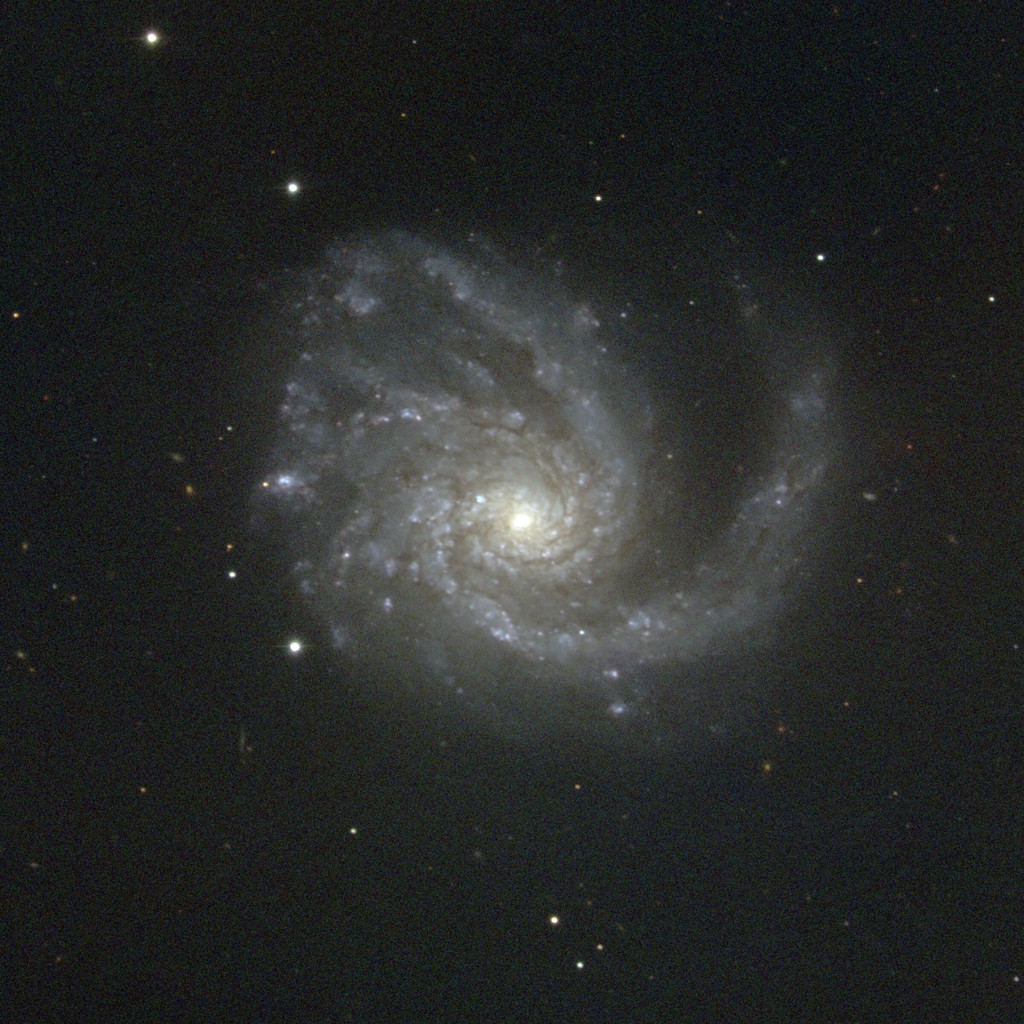
Messier 99 (NGC 4254) is a face-on spiral galaxy of type Sc in the constellation Coma Berenices, approximately 60 million light-years away as a member of the Virgo Cluster of galaxies. It was discovered by Pierre Méchain on March 15, 1781, and catalogued by Charles Messier shortly after. NGC 4254 occupies a significant place in astronomical history: in 1848, the Third Earl of Rosse recognized its spiral structure through his great 72-inch reflecting telescope — making M99 the second galaxy after M51 (observed by Rosse in 1845) to have its spiral structure recognized. This discovery reinforced the realization that many "nebulae" were vast rotating pinwheels of stars.
NGC 4254 is a relatively symmetric, grand-design spiral with multiple well-defined arms that are rich in star-forming regions — clusters of young blue stars and pinkish HII emission nebulae trace the arms clearly in color images. Notably, M99 has an asymmetric outer structure: one of its arms is noticeably more extended and distorted than the others, likely the result of a past gravitational interaction with a companion galaxy or the tidal influence of the Virgo Cluster environment. Like M90, NGC 4254 shows evidence of ram-pressure stripping — the intracluster gas is sweeping away the galaxy's outer HI hydrogen envelope, leaving a tail of stripped material extending away from the cluster core.
In a small telescope M99 appears as a faint, circular glow with a slightly brighter nucleus; medium apertures reveal the face-on disk and a hint of spiral structure in the brighter inner arms. This image was made in February 1996 at the Kitt Peak National Observatory 0.9-meter telescope, with image processing to show arm structure from the nucleus to the outer regions simultaneously.
Navigate from Arcturus toward Coma Berenices. In Coma Berenices near the Virgo border.
| Star | Bayer | Mag | Spectral Type | Distance | Meaning |
|---|---|---|---|---|---|
| Denebola | — | 2.14 | A3 · White main sequence | 36 ly | Arabic Dhanab al-Asad, 'Tail of the Lion' — marks the lion's tail. One of the few stars where infrared excess suggests a debris disk. |
| Zosma | β Leo | 2.56 | A4 · White subgiant | 58 ly | Greek for 'Girdle' — marks the hip of Leo the Lion. An aging star beginning to expand into a subgiant, slowly leaving the main sequence. |
| Vindemiatrix | — | 2.85 | G8 · Yellow giant | 102 ly | Latin for 'The Grape Gatherer' — its heliacal rising in ancient times signaled the grape harvest season in the Mediterranean. |