N.A.Sharp/NOIRLab/ NSF /AURA/
| Type | Galaxy | Constellation | Com |
|---|---|---|---|
| Magnitude | 9.3 | Size | 7.4′ |
| Distance | 55.0 million light-years | Best Month | May |
| Visibility | Northern | Difficulty | Moderate (level 3/4) |
| Min. Aperture | 3in | RA / Dec | 12h 22m 55.2s · +15° 49' 12" |
| Discovered by | Pierre Méchain, 1781 | ||
N.A.Sharp/NOIRLab/ NSF /AURA/
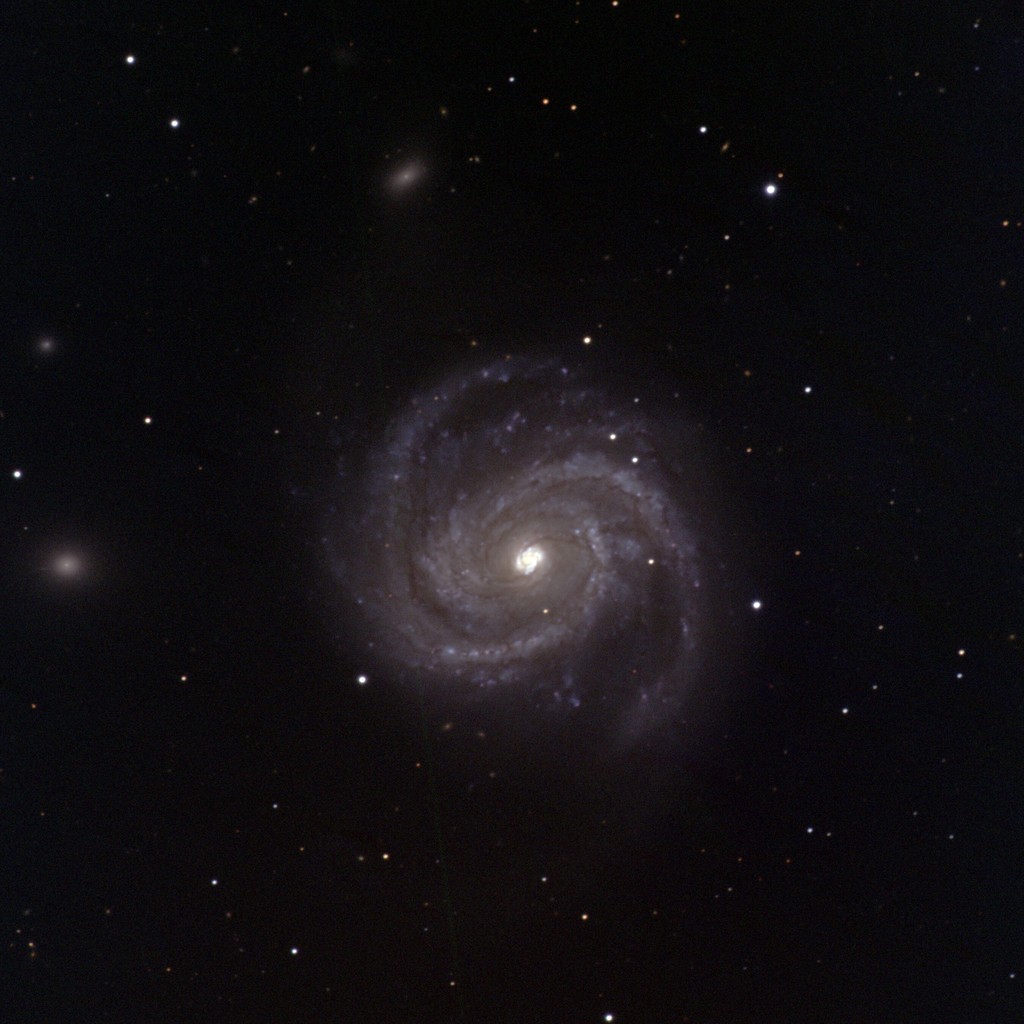
Messier 100 (NGC 4321) is one of the brightest and most photogenic spiral galaxies in the Virgo Cluster, located approximately 55 million light-years away in the constellation Coma Berenices. It was discovered by Pierre Méchain on March 15, 1781, and catalogued by Charles Messier shortly after. NGC 4321 is a face-on Sc spiral with tightly wound, luminous arms rich in young blue stars and active star-forming regions — one of the Virgo Cluster's finest examples of a grand-design spiral. At magnitude 9.3, it is one of the brightest Virgo Cluster members observable through small telescopes.
NGC 4321 gained particular fame in the 1990s when it was observed by the Hubble Space Telescope as part of the Hubble Key Project to measure the Hubble constant — the rate of expansion of the Universe. Astronomers identified Cepheid variable stars within M100 and used them as precise distance indicators to calibrate the cosmic distance ladder, placing the galaxy at a well-determined distance and helping to pin down the value of the Hubble constant to an accuracy then unprecedented. The galaxy's face-on orientation reveals its grand spiral arms and a prominent central bar in detail; two companion dwarf galaxies are also visible in this image.
In a small telescope M100 appears as a round, moderately bright glow with a compact nucleus; moderate apertures (150–200 mm) reveal a hint of the disk's extent and the brighter core. This image was taken with the WIYN 0.9-meter telescope at the Kitt Peak National Observatory on the night of December 20, 2002.
Navigate from Arcturus toward Coma Berenices. In Coma Berenices, in the northern part of the Virgo Cluster.
| Star | Bayer | Mag | Spectral Type | Distance | Meaning |
|---|---|---|---|---|---|
| Denebola | — | 2.14 | A3 · White main sequence | 36 ly | Arabic Dhanab al-Asad, 'Tail of the Lion' — marks the lion's tail. One of the few stars where infrared excess suggests a debris disk. |
| Zosma | β Leo | 2.56 | A4 · White subgiant | 58 ly | Greek for 'Girdle' — marks the hip of Leo the Lion. An aging star beginning to expand into a subgiant, slowly leaving the main sequence. |
| Vindemiatrix | — | 2.85 | G8 · Yellow giant | 102 ly | Latin for 'The Grape Gatherer' — its heliacal rising in ancient times signaled the grape harvest season in the Mediterranean. |