KPNO/NOIRLab/NSF/AURA/Adam Block
| Type | Galaxy | Constellation | UMa |
|---|---|---|---|
| Magnitude | 7.9 | Size | 28.8′ |
| Distance | 21.0 million light-years | Best Month | May |
| Visibility | Northern | Difficulty | Moderate (level 3/4) |
| Min. Aperture | binoculars | RA / Dec | 14h 03m 10.8s · +54° 21' 00" |
| Discovered by | Pierre Méchain, 1781 | ||
KPNO/NOIRLab/NSF/AURA/Adam Block
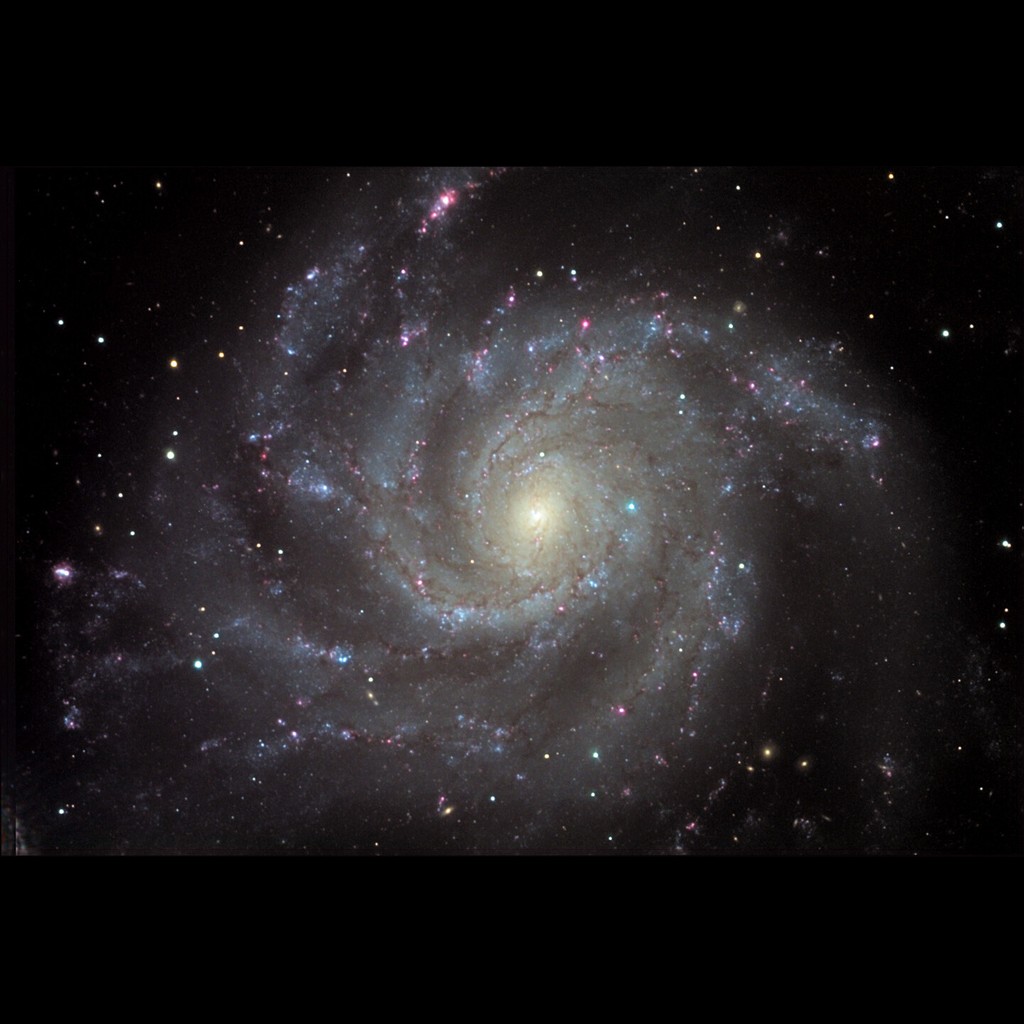
Messier 101 (NGC 5457), the Pinwheel Galaxy, is one of the largest and most luminous spiral galaxies in the Local Universe — a grand-design Sc spiral spanning approximately 170,000 light-years in diameter, nearly twice the width of our Milky Way, located about 27 million light-years away in the constellation Ursa Major. It was discovered by Pierre Méchain on March 27, 1781, and catalogued by Charles Messier shortly after. At magnitude 7.9, it is theoretically visible through binoculars, but its enormous angular size — stretching about 28 arcminutes across, nearly the diameter of the full Moon — spreads its light thinly enough that it requires dark skies and a wide-field, low-power view. This image shows only the central third of the galaxy's full extent.
NGC 5457 is famous for the extraordinary number and diversity of HII regions — star-forming nebulae — scattered through its spiral arms, many of them large and luminous enough to carry their own individual NGC catalog numbers. The asymmetric, slightly lopsided arrangement of its arms is thought to result from past gravitational interactions with companion galaxies in its small local group. The galaxy has been unusually productive in supernovae — with multiple events observed in recent decades — reflecting its high star formation rate. Background galaxies are visible as faint elliptical smudges through the disk where dust does not block the view.
From a dark site M101 requires averted vision and low magnification; a wide-field telescope begins to show the spiral structure, and larger apertures reveal the individual star-forming knots along the arms. This image was taken as part of the Advanced Observing Program (AOP) at the Kitt Peak Visitor Center in 2014.
From Alkaid: From Alkaid (end of the Big Dipper handle), move 5° northeast — forms a nearly equilateral triangle with Alkaid and Mizar.
| Star | Bayer | Mag | Spectral Type | Distance | Meaning |
|---|---|---|---|---|---|
| Alioth | — | 1.76 | A0 · White giant | 83 ly | Arabic origin uncertain, possibly from 'fat tail of a sheep.' The brightest star in Ursa Major and the handle of the Big Dipper. |
| Alkaid | η UMa | 1.85 | B3 · Blue-white main sequence | 101 ly | Arabic Al-Qa'id, 'The Leader of the Daughters of the Bier' — the tip of the Big Dipper's handle, representing the chief mourner in an Arabic funeral procession. |
| Mizar | ζ UMa | 2.23 | A2 · White binary | 83 ly | Arabic Al-Marāq, 'The Groin' — the middle star of the Big Dipper's handle. The first double star discovered through a telescope (1617). |
| Megrez | β UMa | 3.32 | A3 · White main sequence | 81 ly | Arabic Al-Maghriz, 'Root of the Bear's Tail' — the faintest of the seven Big Dipper stars, where the handle meets the bowl. |
| Thuban | λ Dra | 3.67 | A0 · White giant | 303 ly | Arabic Al-Thubbān, 'The Dragon' — served as the North Pole Star around 2700 BCE during the age of the Egyptian pyramid builders. |