NOIRLab/ NSF /AURA
| Type | Galaxy | Constellation | Dra |
|---|---|---|---|
| Magnitude | 9.9 | Size | 6.5′ |
| Distance | 50.0 million light-years | Best Month | June |
| Visibility | Northern | Difficulty | Moderate (level 3/4) |
| Min. Aperture | 3in | RA / Dec | 15h 06m 28.8s · +55° 45' 36" |
| Discovered by | Pierre Méchain, 1781 | ||
NOIRLab/ NSF /AURA
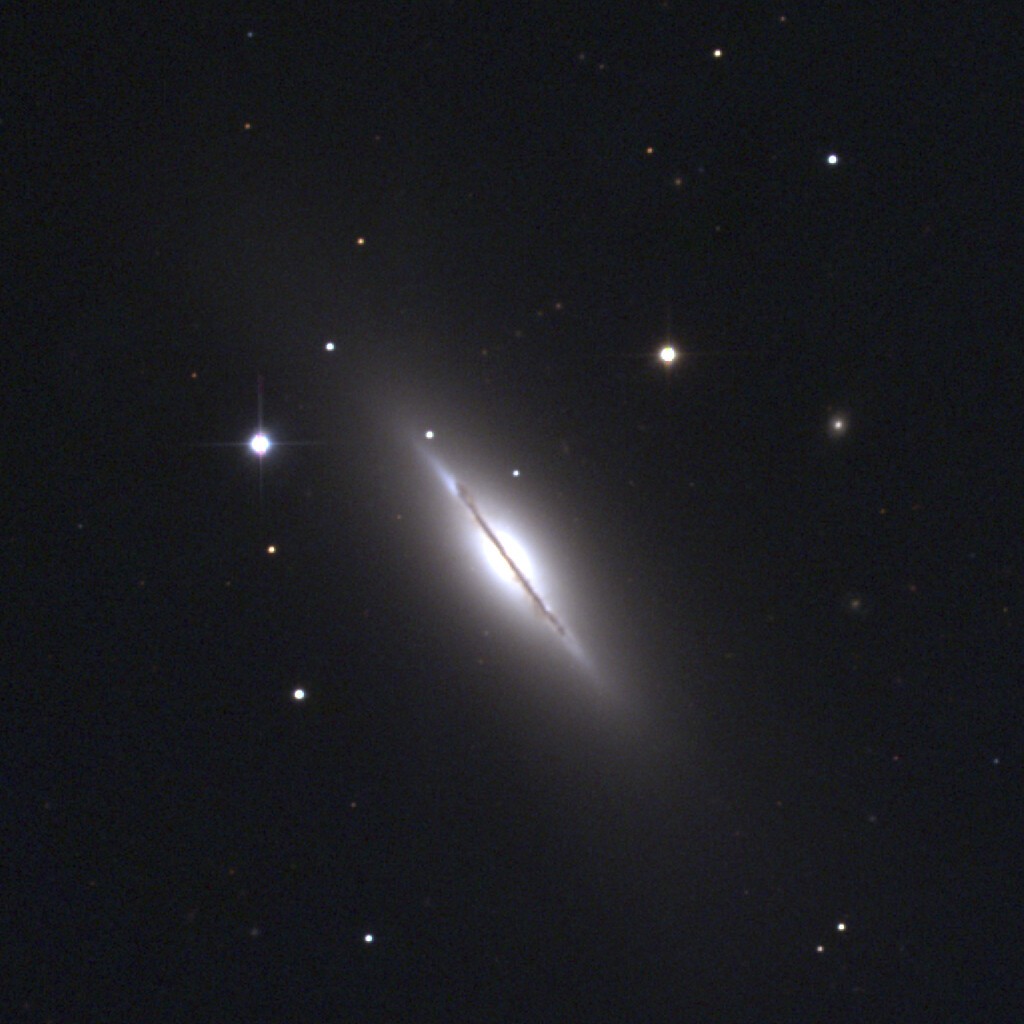
Messier 102 is the only genuinely controversial entry in Messier's catalog — its true identity has been debated for over two centuries. Pierre Méchain, who originally reported it in 1781, later wrote that it was probably an erroneous duplication of his earlier observation of M101, an explanation many astronomers accept. However, a number of careful investigators — comparing Méchain's original positional description with the actual sky — argue persuasively that both Méchain and Messier had actually observed NGC 5866, a lenticular galaxy in the constellation Draco also known as the Spindle Galaxy, and it is NGC 5866 that is shown here.
NGC 5866 is a lenticular galaxy of type S0 — structurally intermediate between ellipticals and spirals. Like an elliptical, it has a smooth, relatively featureless body dominated by an old stellar population with little ongoing star formation; like a spiral, it possesses a disk component, visible here as a dramatically thin, dark dust lane cutting directly across the galaxy's equatorial plane. This edge-on orientation makes NGC 5866 one of the most striking lenticular galaxies in the sky, its perfectly bisecting dust lane creating a sharp two-toned disk that no edge-on spiral could replicate. The galaxy lies approximately 50 million light-years from Earth and spans about 60,000 light-years.
In a small telescope NGC 5866 / M102 appears as a spindle-shaped oval with a slightly brighter nucleus; the dark equatorial dust lane becomes visible in apertures of 150 mm or more under good conditions. This image was made with the T2KA CCD camera at the Kitt Peak National Observatory 0.9-meter telescope in March 1995.
From Alkaid: In Draco, 8° north-northeast of Alkaid (end of the Big Dipper handle).
| Star | Bayer | Mag | Spectral Type | Distance | Meaning |
|---|---|---|---|---|---|
| Alioth | — | 1.76 | A0 · White giant | 83 ly | Arabic origin uncertain, possibly from 'fat tail of a sheep.' The brightest star in Ursa Major and the handle of the Big Dipper. |
| Alkaid | η UMa | 1.85 | B3 · Blue-white main sequence | 101 ly | Arabic Al-Qa'id, 'The Leader of the Daughters of the Bier' — the tip of the Big Dipper's handle, representing the chief mourner in an Arabic funeral procession. |
| Mizar | ζ UMa | 2.23 | A2 · White binary | 83 ly | Arabic Al-Marāq, 'The Groin' — the middle star of the Big Dipper's handle. The first double star discovered through a telescope (1617). |
| Rastaban | β Dra | 2.79 | G2 · Yellow giant | 380 ly | Arabic Ra's al-Thubbān, 'Head of the Dragon' — marks the dragon's eye in Draco, forming a small quadrilateral with Etamin and two fainter stars. |
| Megrez | β UMa | 3.32 | A3 · White main sequence | 81 ly | Arabic Al-Maghriz, 'Root of the Bear's Tail' — the faintest of the seven Big Dipper stars, where the handle meets the bowl. |
| Thuban | λ Dra | 3.67 | A0 · White giant | 303 ly | Arabic Al-Thubbān, 'The Dragon' — served as the North Pole Star around 2700 BCE during the age of the Egyptian pyramid builders. |