Hillary Mathis, N.A.Sharp/NOIRLab/ NSF /AURA
| Type | Open Cluster | Constellation | Cas |
|---|---|---|---|
| Magnitude | 7.4 | Size | 6.0′ |
| Distance | 8,500 light-years | Best Month | November |
| Visibility | Northern | Difficulty | Moderate (level 3/4) |
| Min. Aperture | binoculars | RA / Dec | 01h 33m 28.8s · +60° 38' 60" |
| Discovered by | Pierre Méchain, 1781 | ||
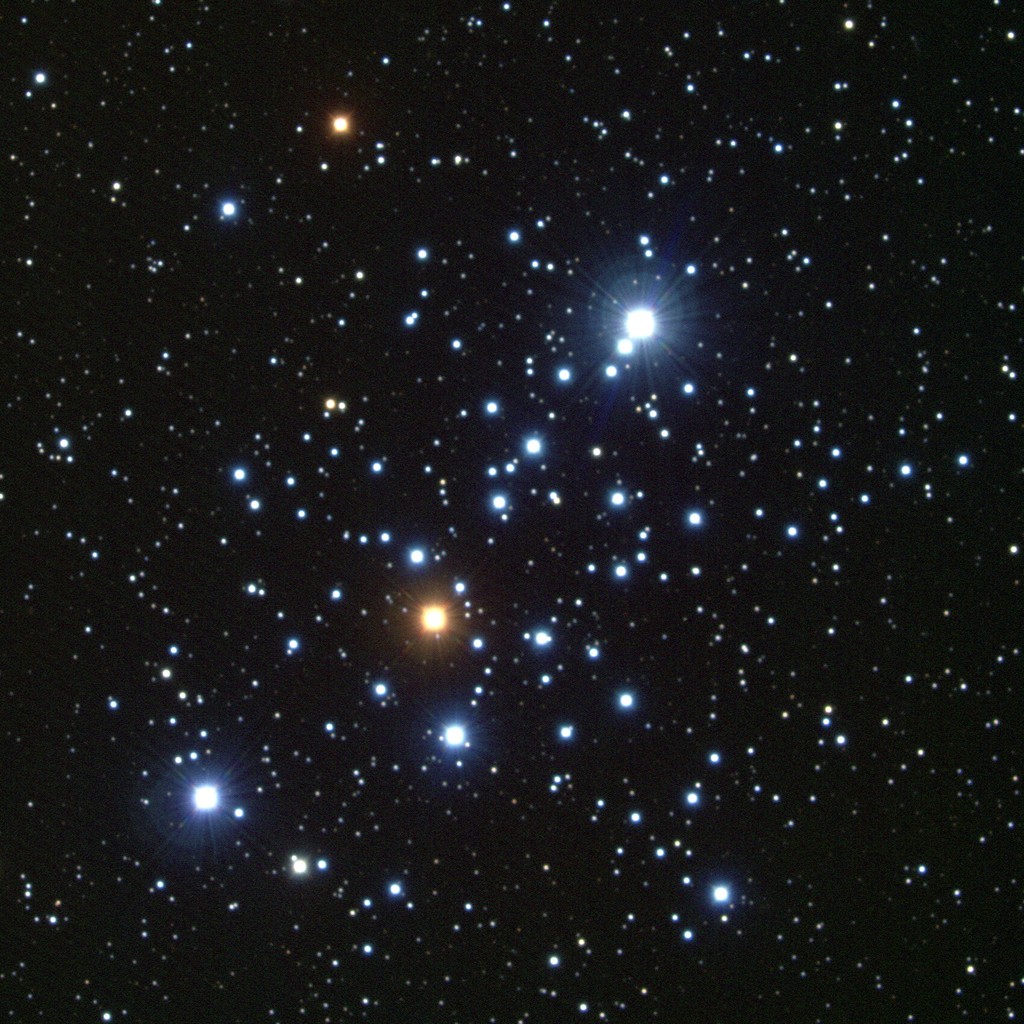
Hillary Mathis, N.A.Sharp/NOIRLab/ NSF /AURA
Messier 103 (NGC 581) is a compact, distant open star cluster in the constellation Cassiopeia, approximately 8,000 light-years from Earth — one of the more remote open clusters in Messier's catalog. It carries an interesting historical footnote: M103 was not actually observed by Messier himself but was added to the catalog from observing notes compiled by Pierre Méchain. Charles Messier included it as entry 103 in the catalog's 1784 edition, making it one of the last objects added. NGC 581 spans about 14 light-years across and is estimated to be somewhere around 20–25 million years old, a young cluster still populated by hot, luminous blue-white stars.
NGC 581 contains roughly 170 confirmed members. The brightest of these are hot B-type stars, the most massive members still on the main sequence at the cluster's young age. A bright visual binary star appears in the upper-right (northwest) portion of this image; it is not a cluster member but a foreground object that happens to lie along the same line of sight. At its distance of 8,000 light-years, M103 is so remote that it appears relatively small in the sky despite its actual physical size — what is visible fits within an image only 8.6 arcminutes across. Its richness and the scatter of stellar brightnesses among its members make it a more rewarding telescopic object than its modest apparent size might suggest.
In a small telescope M103 appears as a compact triangular or fan-shaped grouping of about a dozen brighter stars against a fainter stellar background. This true-color image was assembled from fifteen BVR exposures taken at the Kitt Peak National Observatory 2.1-meter telescope on the night of December 24, 2000.
From Ruchbah: From Ruchbah (Delta Cassiopeiae), just 1° east-northeast — easy to find.
| Star | Bayer | Mag | Spectral Type | Distance | Meaning |
|---|---|---|---|---|---|
| Mirphak | ε Per | 1.79 | F5 · Yellow-white supergiant | 590 ly | Arabic Mirfaq al-Thurayya, 'Elbow near the Pleiades' — the brightest star in Perseus, embedded in a beautiful star cluster visible in binoculars. |
| Cih | α Cas | 2.15 | B0 · Blue-white supergiant | 550 ly | Chinese name meaning 'The Whip' — the middle star of Cassiopeia's W, marking the queen's waist. A luminous blue variable. |
| Shedir | γ Cas | 2.24 | K0 · Orange giant | 229 ly | Arabic Al-Sadr, 'The Breast' — marks the heart of Cassiopeia the Queen on her throne. A slowly varying orange giant. |
| Caph | β Cas | 2.28 | F2 · White giant | 54 ly | Arabic Al-Kaff, 'The Hand' or 'The Palm' — marks the tip of the W-shape of Cassiopeia. A pulsating variable star. |
| Ruchbah | δ Cas | 2.66 | A5 · White giant binary | 99 ly | Arabic Al-Rukbah, 'The Knee' of Cassiopeia — one of the W-shaped stars of the queen, an eclipsing binary that dips in brightness periodically. |