Todd Boroson/NOIRLab/ NSF /AURA/
| Type | Galaxy | Constellation | Vir |
|---|---|---|---|
| Magnitude | 8.0 | Size | 8.7′ |
| Distance | 31.0 million light-years | Best Month | May |
| Visibility | Global | Difficulty | Easy (level 2/4) |
| Min. Aperture | binoculars | RA / Dec | 12h 40m 01.2s · -11° 37' 12" |
| Discovered by | Pierre Méchain, 1781 | ||
Todd Boroson/NOIRLab/ NSF /AURA/
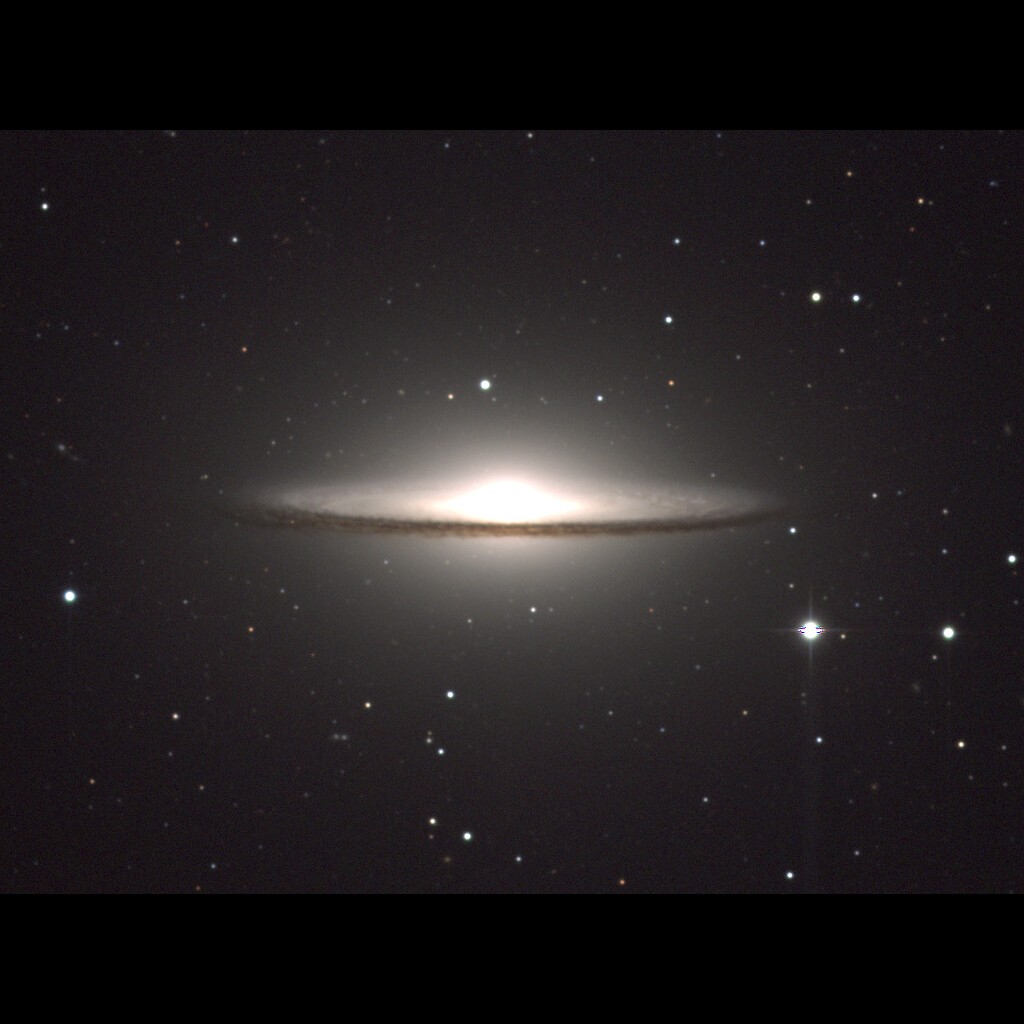
Messier 104 (NGC 4594), the Sombrero Galaxy, is one of the most visually distinctive galaxies in the sky — a massive Sa/Sb spiral in the constellation Virgo whose dark dust lane encircles a brilliant central bulge, creating the unmistakable profile of a wide-brimmed hat. It was discovered by Pierre Méchain on May 11, 1781; Charles Messier added it to the catalog's appendix. NGC 4594 lies approximately 28–31 million light-years from Earth and spans roughly 50,000 light-years across, making it a substantial galaxy but smaller than the Milky Way. At magnitude 8.0, it is one of the brighter Messier galaxies and a favorite target for amateur telescopes worldwide.
The extraordinary prominence of the dust lane in M104 arises from its near-edge-on inclination — about 6 degrees from edge-on — which presents the disk's outer dust ring as a dark, sharp-edged band bisecting the brilliance of the central bulge. The bulge itself is enormous relative to the disk, classifying M104 toward the early end of the spiral sequence. Embedded in the galaxy is one of the most massive central black holes known in a nearby galaxy, estimated at 1 billion solar masses. NGC 4594 is also surrounded by an unusually large system of globular clusters — roughly 2,000, giving it a globular cluster system more typical of a giant elliptical than a spiral galaxy.
In binoculars M104 appears as a bright, elongated streak; a small telescope immediately shows the hat-brim profile, with the dark dust lane visible as a fine line dividing the brilliant nucleus from the disk below. This image was made at Kitt Peak National Observatory, with dynamic range compressed to simultaneously reveal the inner details and the dust lane's warm brown absorption color.
From Spica: In Virgo, near the Corvus-Virgo border — look for a bright star-like nucleus with a dark lane through binoculars.
| Star | Bayer | Mag | Spectral Type | Distance | Meaning |
|---|---|---|---|---|---|
| Spica | α Vir | 0.98 | B1 · Blue-white binary | 250 ly | Latin for 'Ear of Grain' — Virgo holds a sheaf of wheat. One of the four Royal Stars of antiquity, used by Hipparchus to discover the precession of the equinoxes. |
| Gienah Ghurab | γ Crv | 2.58 | B8 · Blue-white giant | 165 ly | Arabic Al-Janāh al-Ghurāb, 'Wing of the Crow' — the brightest star in Corvus, marking the raven's right wing. |
| Kraz | — | 2.65 | G5 · Yellow-white giant | 146 ly | Origin uncertain. Marks the tail of Corvus the Crow, the fainter of the two named stars in this compact southern constellation. |
| Porrima | — | 2.74 | F0 · Yellow-white binary | 38 ly | Named for Porrima, Roman goddess of prophecy. One of the finest equal double stars in the sky — twin yellow-white stars orbiting each other. |
| Algorab | δ Crv | 2.94 | B9 · Blue-white giant | 87 ly | Arabic Al-Ghurāb, 'The Crow' — named for the constellation itself. A wide double star with a faint optical companion. |