NOIRLab/ NSF /AURA
| Type | Galaxy | Constellation | Leo |
|---|---|---|---|
| Magnitude | 9.3 | Size | 5.4′ |
| Distance | 36.0 million light-years | Best Month | April |
| Visibility | Northern | Difficulty | Moderate (level 3/4) |
| Min. Aperture | 3in | RA / Dec | 10h 47m 49.2s · +12° 34' 48" |
| Discovered by | Pierre Méchain, 1781 | ||
NOIRLab/ NSF /AURA
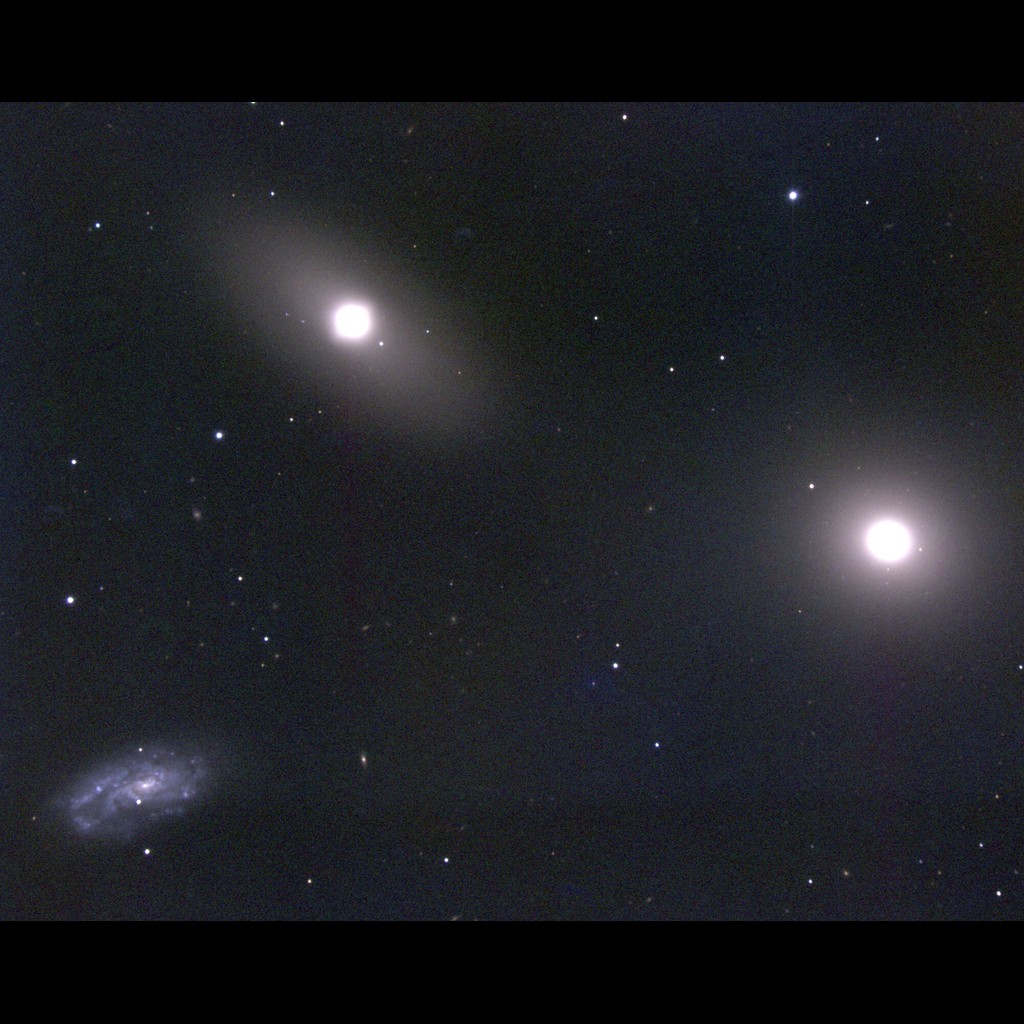
Messier 105 (NGC 3379) is a type E1 elliptical galaxy in the constellation Leo, approximately 40 million light-years away and the brightest member of the Leo I galaxy group, which also includes M95 (NGC 3351) and M96 (NGC 3368). It was discovered by Pierre Méchain on March 24, 1781, and is one of the last objects added to the catalog. NGC 3379 is a classic, nearly spherical elliptical galaxy — smooth, featureless, and dominated by an old red and yellow stellar population with no ongoing star formation. It was long used as a photometric standard for studying surface brightness profiles in elliptical galaxies precisely because of its apparent uniformity; closer investigation has revealed subtle deviations from a pure elliptical profile, as is often the case when any galaxy is studied in sufficient detail.
This image also shows two companion galaxies: NGC 3384, a lenticular galaxy visible above and to the left of center, is a confirmed Leo I Group member at similar distance to M105; and NGC 3379, labeled here at bottom left, is thought by some sources to be a more distant background galaxy rather than a true group member — the labeling in the original source notes reflect this uncertainty. The Leo I group as a whole occupies a volume of space smaller than the distance between the Milky Way and Andromeda, making it a compact and dynamically interesting small galaxy group.
In a small telescope M105 appears as a round, bright glow with a stellar-looking nucleus; NGC 3384 is visible alongside it in the same field, making for an interesting elliptical/lenticular pair. This CCD color composite was made at the Kitt Peak National Observatory 0.9-meter telescope on February 5, 1996.
From Regulus: In Leo, 1° north of M96 — all three visible in same binocular field.
| Star | Bayer | Mag | Spectral Type | Distance | Meaning |
|---|---|---|---|---|---|
| Regulus | α Leo | 1.36 | B7 · Blue-white main sequence | 79 ly | Latin for 'Little King' — one of the four Royal Stars of antiquity, the heart of Leo the Lion. It spins so fast it is noticeably oblate. |
| Algieba | ζ Leo | 2.01 | K0 · Orange giant binary | 130 ly | Arabic Al-Jabhah, 'The Forehead' or 'The Mane' of the Lion. A beautiful golden double star visible in small telescopes. |
| Denebola | — | 2.14 | A3 · White main sequence | 36 ly | Arabic Dhanab al-Asad, 'Tail of the Lion' — marks the lion's tail. One of the few stars where infrared excess suggests a debris disk. |
| Zosma | β Leo | 2.56 | A4 · White subgiant | 58 ly | Greek for 'Girdle' — marks the hip of Leo the Lion. An aging star beginning to expand into a subgiant, slowly leaving the main sequence. |
| Ras Elased Australis | ε Leo | 2.97 | G0 · Orange giant | 247 ly | Arabic Ra's al-Asad al-Janūbī, 'Southern Head of the Lion' — marks the lion's mane, one of the sickle stars that form Leo's head. |