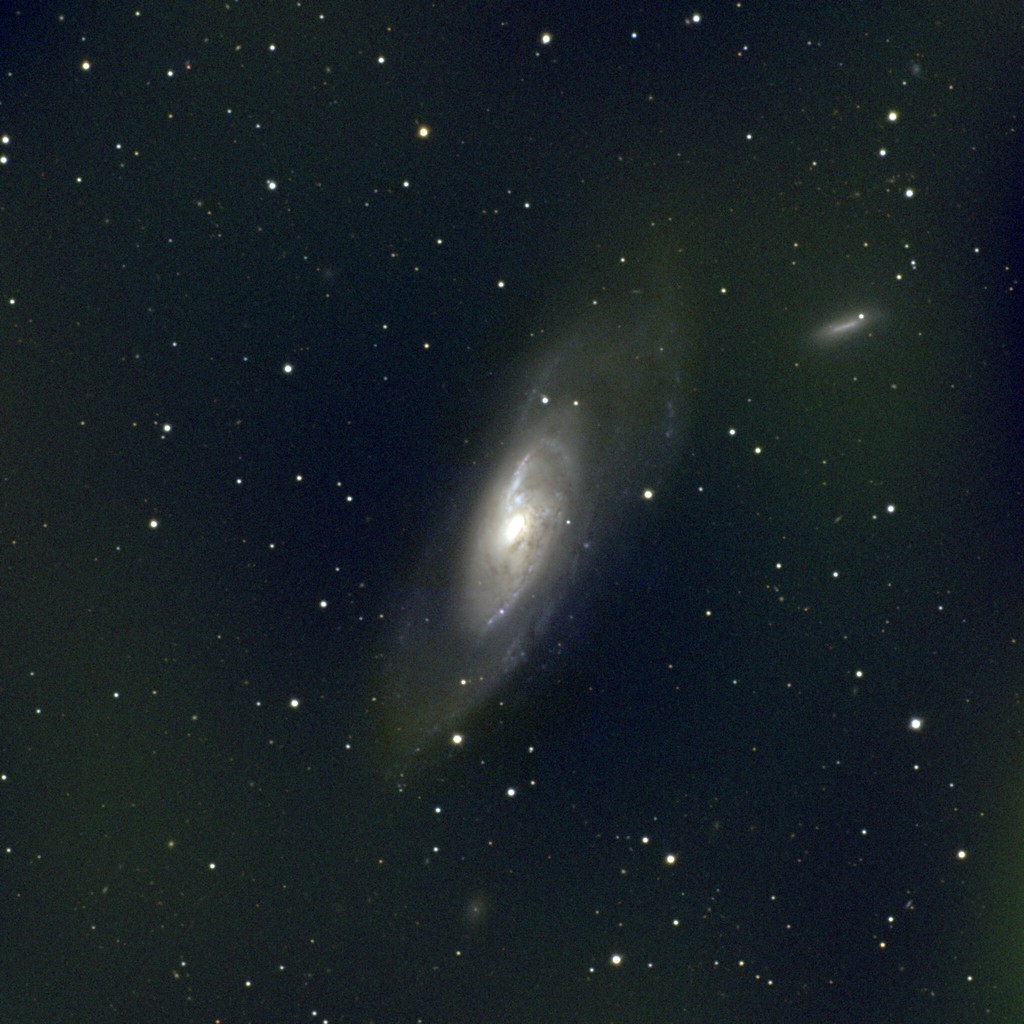
N.A.Sharp, REU program/NOIRLab/ NSF /AURA/
| Type | Galaxy | Constellation | CVn |
|---|---|---|---|
| Magnitude | 8.4 | Size | 18.6′ |
| Distance | 23.7 million light-years | Best Month | April |
| Visibility | Northern | Difficulty | Easy (level 2/4) |
| Min. Aperture | binoculars | RA / Dec | 12h 19m 01.2s · +47° 17' 60" |
| Discovered by | Pierre Méchain, 1781 | ||
N.A.Sharp, REU program/NOIRLab/ NSF /AURA/
Messier 106 (NGC 4258) is a large spiral galaxy of type Sb in the constellation Canes Venatici, approximately 25 million light-years from Earth. It was discovered by Pierre Méchain in 1781. NGC 4258 is inclined at a moderate angle — similar to the Andromeda Galaxy — presenting a view that reveals prominent spiral dust lanes tracing the arms back nearly to the nucleus. It is a somewhat peculiar spiral with hints of a central bar and, more significantly, an active Seyfert nucleus: its core shows strong emission lines in spectroscopic studies, indicating a mildly active galactic nucleus powered by accretion onto a central supermassive black hole. M106 may be a loose member of a galaxy grouping that also includes M108 and M109.
NGC 4258 is one of the galaxies for which the distance has been measured with extraordinary precision using water masers — naturally occurring microwave amplification in rotating molecular gas around the central black hole. By tracking the Keplerian motion of these masers, astronomers determined the galaxy's distance to better than 4% accuracy (7.2 ± 0.3 megaparsecs), one of the most precise extragalactic distance measurements ever made using a single method. This distance served as a critical calibration anchor for the cosmic distance ladder. The galaxy's nucleus is also notable for anomalous spiral arms visible in X-ray and radio observations, driven by jets from the AGN rather than normal density-wave dynamics.
In binoculars M106 is a faint oval glow; a small telescope shows the elongated disk and a brighter nucleus; larger apertures reveal the dust lanes threading through the spiral structure. This full-color image was assembled from nine BVR exposures taken in June 1996 at the Burrell Schmidt telescope of Case Western Reserve University's Warner and Swasey Observatory on Kitt Peak, during the Research Experiences for Undergraduates (REU) program supported by the National Science Foundation.
Navigate from Alkaid toward Canes Venatici. From Alkaid (end of the Big Dipper handle), sweep 7° south-southwest into Canes Venatici.
| Star | Bayer | Mag | Spectral Type | Distance | Meaning |
|---|---|---|---|---|---|
| Alioth | — | 1.76 | A0 · White giant | 83 ly | Arabic origin uncertain, possibly from 'fat tail of a sheep.' The brightest star in Ursa Major and the handle of the Big Dipper. |
| Alkaid | η UMa | 1.85 | B3 · Blue-white main sequence | 101 ly | Arabic Al-Qa'id, 'The Leader of the Daughters of the Bier' — the tip of the Big Dipper's handle, representing the chief mourner in an Arabic funeral procession. |
| Mizar | ζ UMa | 2.23 | A2 · White binary | 83 ly | Arabic Al-Marāq, 'The Groin' — the middle star of the Big Dipper's handle. The first double star discovered through a telescope (1617). |
| Merak | δ UMa | 2.34 | A1 · Blue-white main sequence | 79 ly | Arabic Al-Maraqq, 'The Loins of the Bear' — one of the two pointer stars of the Big Dipper that guide observers to Polaris. |
| Phad | γ UMa | 2.41 | A0 · White main sequence | 84 ly | Arabic Al-Fakhdhah, 'The Thigh of the Bear' — marks the hip of Ursa Major, one of the four bowl stars of the Big Dipper. |
| Cor Caroli | — | 2.89 | A0 · White main sequence | 110 ly | Latin for 'Heart of Charles' — named to honor King Charles II of England. The brightest star in Canes Venatici. |
| Megrez | β UMa | 3.32 | A3 · White main sequence | 81 ly | Arabic Al-Maghriz, 'Root of the Bear's Tail' — the faintest of the seven Big Dipper stars, where the handle meets the bowl. |