NOIRLab/ NSF /AURA
| Type | Globular Cluster | Constellation | Oph |
|---|---|---|---|
| Magnitude | 7.9 | Size | 10.0′ |
| Distance | 20,900 light-years | Best Month | July |
| Visibility | Global | Difficulty | Moderate (level 3/4) |
| Min. Aperture | 3in | RA / Dec | 16h 32m 34.8s · -13° 03' 00" |
| Discovered by | Pierre Méchain, 1782 | ||
NOIRLab/ NSF /AURA
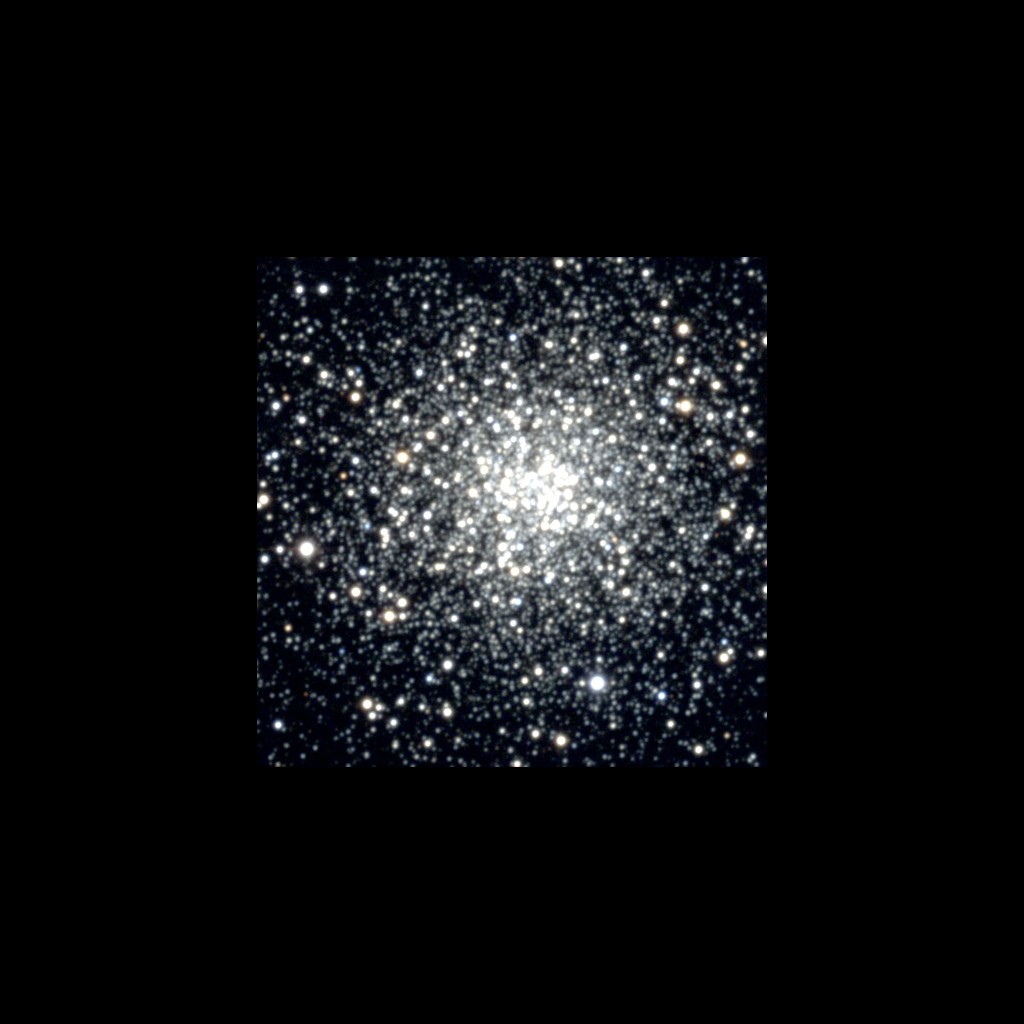
Messier 107 (NGC 6171) is a globular cluster in the constellation Ophiuchus, approximately 10,000 light-years from Earth and spanning about 50 light-years across. It was discovered by Pierre Méchain in April 1782 — after Messier had already published his definitive catalog of 103 objects. M107 was not added to the official Messier list until 1947, when Canadian astronomer Helen Sawyer Hogg proposed its inclusion, and the designation M107 was not widely adopted until that time. NGC 6171 is one of the more loosely structured globular clusters in the Messier catalog, with a low central concentration and a relatively open, spread-out appearance compared with the tightly packed core clusters like M15 or M80.
NGC 6171 contains around 100,000 stars and is estimated to be about 13 billion years old. Its relatively loose structure, low central concentration, and proximity to the galactic plane have exposed it to significant tidal disruption by the Milky Way over its lifetime. Despite this, the cluster has survived intact as a coherent system. A handful of variable stars have been identified within M107, including RR Lyrae pulsators used for distance determination. The cluster lies close enough to the galactic center to be positioned in a rich Milky Way background of field stars, which requires care to separate genuine cluster members from background contamination.
In binoculars M107 is a faint, round haze in a rich star field; a small telescope at moderate power shows a loosely concentrated glow, and 150–200 mm aperture begins to resolve individual stars in the outer regions. This image was made at Kitt Peak National Observatory.
Navigate from Arcturus toward Ophiuchus. In southern Ophiuchus, near the star Zeta Ophiuchi.
| Star | Bayer | Mag | Spectral Type | Distance | Meaning |
|---|---|---|---|---|---|
| Dschubba | λ Sco | 2.29 | B0 · Blue subgiant | 400 ly | Arabic Al-Jabhah, 'The Forehead' — marks the head of Scorpius. A rapidly rotating blue star that has shed a disk of material. |
| Graffias | — | 2.56 | B0 · Blue-white binary | 530 ly | Greek origin meaning 'Claws' — one of several names for the head of Scorpius. A fine double star in small telescopes. |