NOIRLab/ NSF /AURA
| Type | Galaxy | Constellation | UMa |
|---|---|---|---|
| Magnitude | 10.0 | Size | 8.7′ |
| Distance | 46.0 million light-years | Best Month | April |
| Visibility | Northern | Difficulty | Moderate (level 3/4) |
| Min. Aperture | 3in | RA / Dec | 11h 11m 31.2s · +55° 40' 12" |
| Discovered by | Pierre Méchain, 1781 | ||
NOIRLab/ NSF /AURA
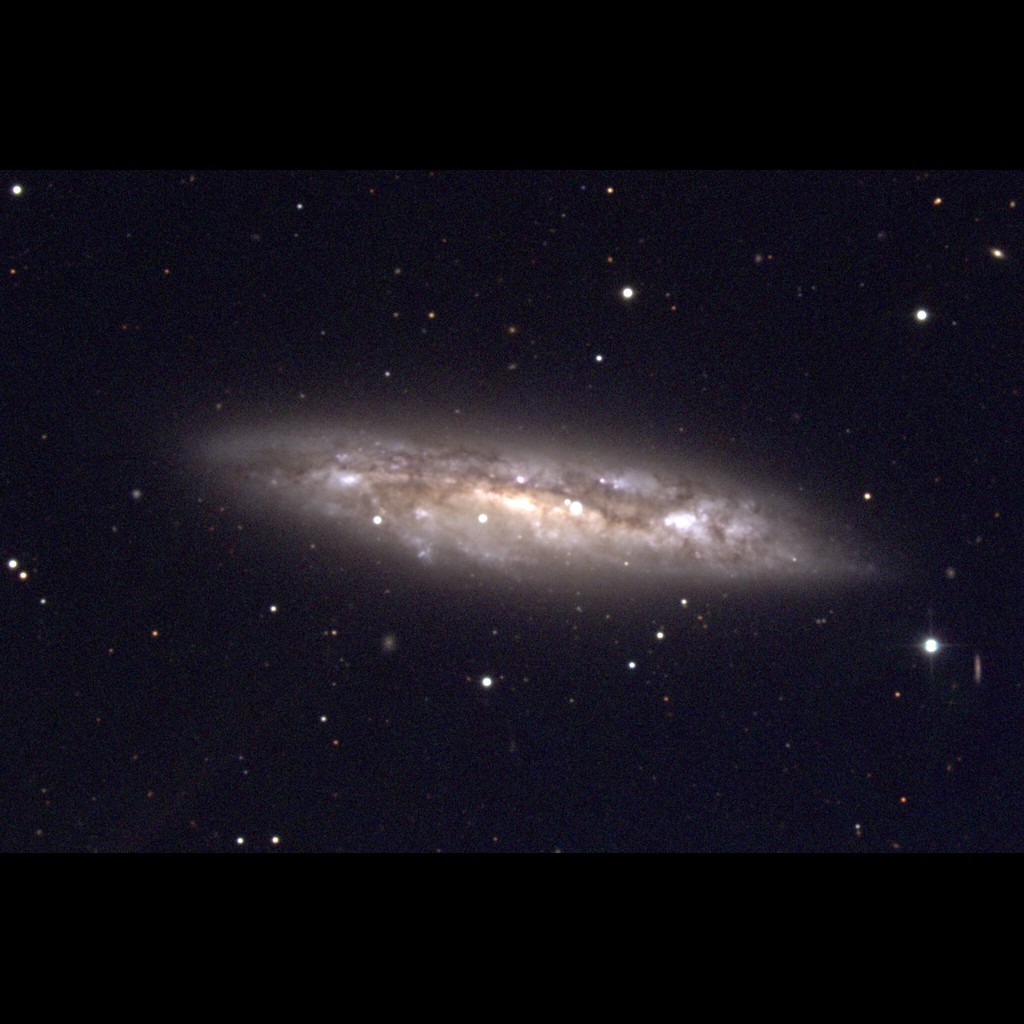
Messier 108 (NGC 3556) is a nearly edge-on spiral galaxy of type Sc in the constellation Ursa Major, approximately 45 million light-years from Earth. It was discovered by Pierre Méchain on February 16, 1781, catalogued by Charles Messier shortly after, and formally added to the Messier list by Owen Gingerich in 1953. NGC 3556 is one of the most strikingly irregular-looking galaxies in the catalog: seen almost exactly edge-on, it shows no prominent central bulge, no clearly delineated spiral structure, and a chaotic, mottled disk dominated by dust clouds and clumpy star-forming regions rather than a smooth, symmetric profile. This "motley collection of features" — as one description aptly puts it — gives M108 a distinctly disheveled appearance compared with its neighbors.
The edge-on inclination of NGC 3556 is both its visual signature and the cause of its complex appearance: the galaxy's disk is thick with dust that absorbs and scatters light unevenly, creating the lumpy, irregular brightness distribution visible in the image. The galaxy is actively forming stars in its disk, as evidenced by blue star-forming knots scattered along the edge-on profile. M108 is thought to be a loosely associated member of the same galaxy group as M109 and possibly M106. The Owl Nebula (M97) lies only about 48 arcminutes away, and the two objects can be seen in the same wide-field view — a pleasing juxtaposition of a galaxy and a planetary nebula.
In binoculars M108 appears as a faint, irregular streak near the Owl Nebula; a small telescope shows a mottled, elongated form with no obvious central concentration. This image was made with the T2KA CCD camera at the Kitt Peak National Observatory 0.9-meter telescope in January 1997.
From Merak: In Ursa Major, 1.5° southeast of Merak — M97 lies just 1° further in the same direction.
| Star | Bayer | Mag | Spectral Type | Distance | Meaning |
|---|---|---|---|---|---|
| Alioth | — | 1.76 | A0 · White giant | 83 ly | Arabic origin uncertain, possibly from 'fat tail of a sheep.' The brightest star in Ursa Major and the handle of the Big Dipper. |
| Dubhe | α UMa | 1.81 | F7 · Orange giant | 124 ly | Arabic Zahr al-Dubb al-Akbar, 'Back of the Greater Bear' — one of the two pointer stars that lead to Polaris, the North Star. |
| Merak | δ UMa | 2.34 | A1 · Blue-white main sequence | 79 ly | Arabic Al-Maraqq, 'The Loins of the Bear' — one of the two pointer stars of the Big Dipper that guide observers to Polaris. |
| Phad | γ UMa | 2.41 | A0 · White main sequence | 84 ly | Arabic Al-Fakhdhah, 'The Thigh of the Bear' — marks the hip of Ursa Major, one of the four bowl stars of the Big Dipper. |
| Megrez | β UMa | 3.32 | A3 · White main sequence | 81 ly | Arabic Al-Maghriz, 'Root of the Bear's Tail' — the faintest of the seven Big Dipper stars, where the handle meets the bowl. |