NOIRLab/ NSF /AURA
| Type | Galaxy | Constellation | UMa |
|---|---|---|---|
| Magnitude | 9.8 | Size | 7.6′ |
| Distance | 83.0 million light-years | Best Month | April |
| Visibility | Northern | Difficulty | Moderate (level 3/4) |
| Min. Aperture | 3in | RA / Dec | 11h 57m 36.0s · +53° 22' 12" |
| Discovered by | Pierre Méchain, 1781 | ||
NOIRLab/ NSF /AURA
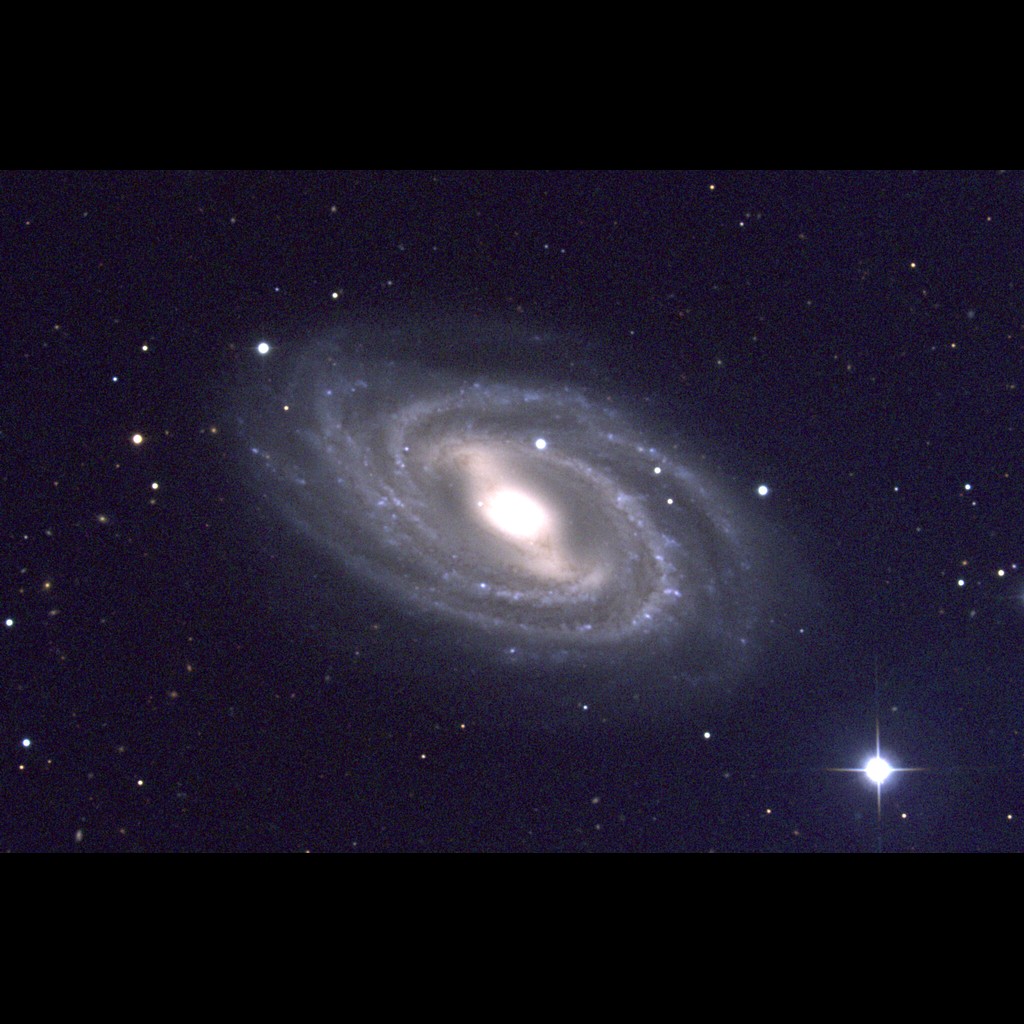
Messier 109 (NGC 3992) is a barred spiral galaxy of type SBc in the constellation Ursa Major, approximately 45–55 million light-years away and one of the most photogenic barred spirals among the later Messier additions. It was discovered by Pierre Méchain on March 12, 1781, observed by Charles Messier, and formally added to the catalog by Owen Gingerich in 1953. NGC 3992 is a moderately inclined barred spiral that shows its central bar clearly, with two main spiral arms extending from the bar ends and curving outward through a disk populated with star-forming regions. It is thought to be a loose member of the same galaxy group as M108 and possibly M106, all lying at similar distances in Ursa Major.
NGC 3992 has a well-defined bar with a bright, elongated central region and moderately wound spiral arms that give it a classic SBc appearance. Several faint companion galaxies are associated with it at similar distances. The bar itself is a gravitational structure driven by collective orbital resonances in the disk, channeling gas toward both the nuclear region (where it can fuel star formation or nuclear activity) and the outer arms (where it feeds the spiral arm star-forming regions). M109 is the most southerly of the Messier objects in Ursa Major — a constellation that contains an unusually rich assortment of Messier galaxies.
In a small telescope M109 appears as a faint, oval glow with a slightly brighter elongated core; moderate apertures begin to show the bar and the disk. This image was made with the T2KA CCD camera at the Kitt Peak National Observatory 0.9-meter telescope in January 1997.
Navigate from Phecda toward Ursa Major. Just 0.5° southeast of Phecda (Gamma Ursae Majoris, bottom of the Big Dipper bowl).
| Star | Bayer | Mag | Spectral Type | Distance | Meaning |
|---|---|---|---|---|---|
| Alioth | — | 1.76 | A0 · White giant | 83 ly | Arabic origin uncertain, possibly from 'fat tail of a sheep.' The brightest star in Ursa Major and the handle of the Big Dipper. |
| Dubhe | α UMa | 1.81 | F7 · Orange giant | 124 ly | Arabic Zahr al-Dubb al-Akbar, 'Back of the Greater Bear' — one of the two pointer stars that lead to Polaris, the North Star. |
| Alkaid | η UMa | 1.85 | B3 · Blue-white main sequence | 101 ly | Arabic Al-Qa'id, 'The Leader of the Daughters of the Bier' — the tip of the Big Dipper's handle, representing the chief mourner in an Arabic funeral procession. |
| Mizar | ζ UMa | 2.23 | A2 · White binary | 83 ly | Arabic Al-Marāq, 'The Groin' — the middle star of the Big Dipper's handle. The first double star discovered through a telescope (1617). |
| Merak | δ UMa | 2.34 | A1 · Blue-white main sequence | 79 ly | Arabic Al-Maraqq, 'The Loins of the Bear' — one of the two pointer stars of the Big Dipper that guide observers to Polaris. |
| Phad | γ UMa | 2.41 | A0 · White main sequence | 84 ly | Arabic Al-Fakhdhah, 'The Thigh of the Bear' — marks the hip of Ursa Major, one of the four bowl stars of the Big Dipper. |
| Megrez | β UMa | 3.32 | A3 · White main sequence | 81 ly | Arabic Al-Maghriz, 'Root of the Bear's Tail' — the faintest of the seven Big Dipper stars, where the handle meets the bowl. |