NOIRLab/ NSF /AURA
| Type | Galaxy | Constellation | And |
|---|---|---|---|
| Magnitude | 8.9 | Size | 21.9′ |
| Distance | 2.69 million light-years | Best Month | November |
| Visibility | Northern | Difficulty | Easy (level 2/4) |
| Min. Aperture | binoculars | RA / Dec | 00h 40m 22.8s · +41° 40' 48" |
| Discovered by | Charles Messier, 1773 | ||
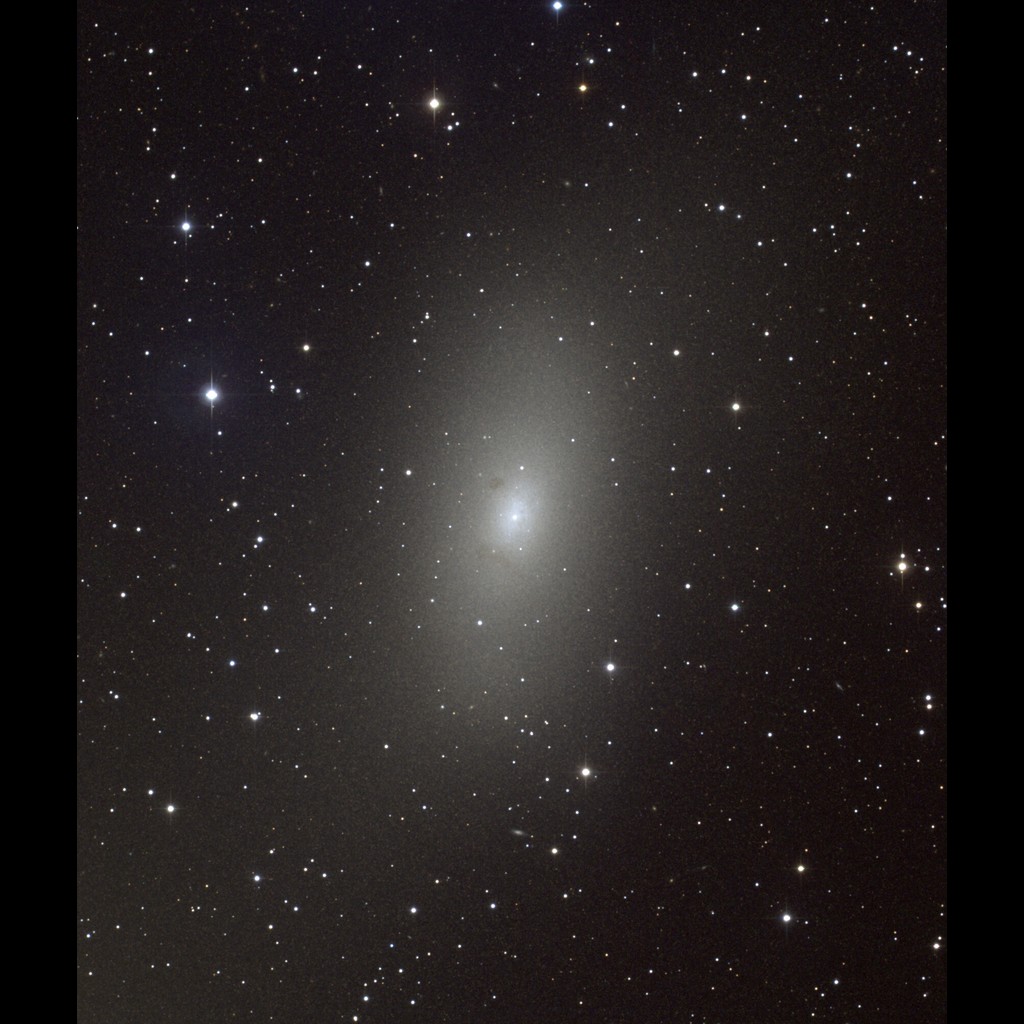
NOIRLab/ NSF /AURA
Messier 110 (NGC 205) is the second-brightest satellite companion of the Andromeda Galaxy (M31), alongside M32, lying approximately 2.2 million light-years away in the constellation Andromeda. It is classified as type E5 or E6 — a moderately flattened elliptical — with the additional designation "p" for peculiar, because careful examination reveals internal structure including patches of interstellar dust that are highly unusual in an elliptical galaxy. Charles Messier actually observed and sketched NGC 205 in 1773, noting it alongside M31 — but through what appears to have been carelessness or oversight, he never included it in his published catalog. It was formally added as the final entry, M110, in 1966 by Kenneth Glyn Jones.
NGC 205 is classified as a dwarf elliptical galaxy by some authors and a dwarf spheroidal by others, reflecting its relatively small size compared with normal ellipticals. Yet it is more luminous and structured than typical dwarf spheroidals: it contains genuine interstellar dust and, remarkably, a population of young blue stars near its center — evidence of relatively recent star formation, which is almost unheard of in elliptical galaxies. These young stars suggest that NGC 205 may have accreted fresh gas from the Andromeda Galaxy's halo during a past close encounter. It is gravitationally bound to M31 and orbits it along with M32 and a menagerie of smaller companions.
M110 is faint and low in surface brightness, but visible in binoculars under dark skies as a faint elongated smear northwest of M31; a small telescope shows it alongside M31 and M32, completing the Andromeda Galaxy's major companions in a single field. This color composite image was made at the Kitt Peak National Observatory 0.9-meter telescope.
From Alpheratz: In the same binocular field as M31 — appears as a large, diffuse glow northwest of M31's nucleus.
| Star | Bayer | Mag | Spectral Type | Distance | Meaning |
|---|---|---|---|---|---|
| Mirach | β And | 2.07 | M0 · Red giant | 197 ly | Arabic Al-Mirāq, 'The Girdle' or 'The Loin' — marks the hip of Andromeda. Nearby sits M31, the Andromeda Galaxy, visible to the naked eye. |
| Alpheratz | α And | 2.07 | B9 · Blue-white subgiant | 97 ly | Arabic Surrat al-Faras, 'Navel of the Mare' — once shared between Andromeda and Pegasus, forming a corner of the Great Square. |
| Alpheratz | α And | 2.07 | B9 · Blue-white subgiant | 97 ly | Arabic Surrat al-Faras, 'Navel of the Mare' — the upper-left corner of the Great Square of Pegasus, now officially assigned to Andromeda. |
| Almaak | γ And | 2.10 | B8 · Orange giant + blue companion | 355 ly | Arabic Al-'Anāq al-Ard, 'The Desert Lynx.' One of the finest double stars in the sky — vivid gold and blue-green pair. |
| Shedir | γ Cas | 2.24 | K0 · Orange giant | 229 ly | Arabic Al-Sadr, 'The Breast' — marks the heart of Cassiopeia the Queen on her throne. A slowly varying orange giant. |