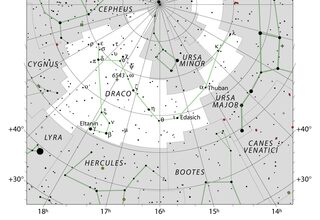
 IAU Chart
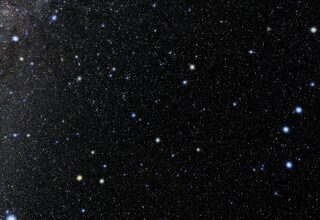 NOIRLab Images
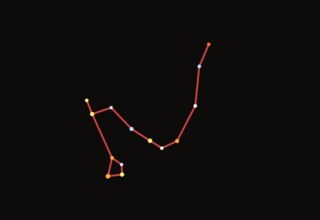 Stars and Sticks
| Abbreviation | Dra |
|---|---|
| Meaning | Dragon |
| Pronunciation Guide is based on “Pronouncing Astronomical Names,” published in 1943 by the American Astronomical Society. | DRAY-ko |
| Genitive The genitive is the Latin possessive form used in star names. For example, Alpha Orionis means “the Alpha of Orion.” | druh-KOH-nis |
| Best Month | July |
| Visibility | Northern |
| Origin | AncientThese figures are rooted in the classical Greek and Mesopotamian traditions cataloged by Ptolemy in the 2nd century AD. |
| Author | PtolemyPtolemy, a 2nd-century Greco-Egyptian astronomer, cataloged the 48 classical constellations in his landmark work, the Almagest. These form the core of the 88 modern constellations recognized today. |
| Type | constellation |
| Difficulty | Moderate |
| Description | The Dragon winds its enormous body around the north celestial pole — a serpent or dragon has occupied this region in virtually every ancient culture. In Greek myth it is Ladon, the sleepless dragon that guarded the tree of golden apples in the garden of the Hesperides; it was slain by Hercules during his eleventh labor. Due to the precession of Earth's axis, the bright star Thuban (Alpha Draconis) was the pole star around 2700 BCE when the great pyramids of Giza were being built — some scholars believe the pyramids' internal shafts were aligned to allow the pharaoh's soul to travel toward it. The constellation also contains several galaxy groups visible in small telescopes. |
| Asterism | The Dragon's Head: A small trapezoid of four stars representing the eyes and snout. |
| Meteor Shower | Draconids |
| Peak Month | October |
Click a thumbnail to view full-size. Plain and Annotated versions available on the image page.
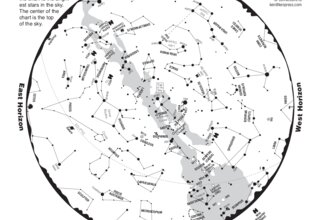
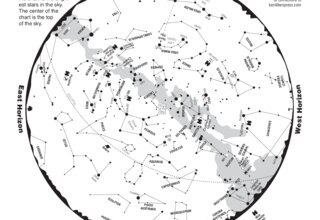
Monthly sky charts courtesy of What's Out Tonight? — Copyright ©2026 Ken Graun. Star charts are optimized for mid-latitudes of the Northern Hemisphere. Click a chart to view or download the PDF. For guidance on using the chart, or to purchase a planisphere and astronomy books, visit kenpress.com.
Images: NOIRLab/NSF/AURA/E. Slawik · IAU and Sky & Telescope · Stellarium — Full credits →