N.A.Sharp/NOIRLab/ NSF /AURA/
| Type | Galaxy | Constellation | UMa |
|---|---|---|---|
| Magnitude | 8.4 | Size | 11.2′ |
| Distance | 11.4 million light-years | Best Month | April |
| Visibility | Northern | Difficulty | Easiest (level 1/4) |
| Min. Aperture | naked eye | RA / Dec | 09h 55m 40.8s · +69° 40' 48" |
| Discovered by | Johann Elert Bode, 1774 | ||
N.A.Sharp/NOIRLab/ NSF /AURA/
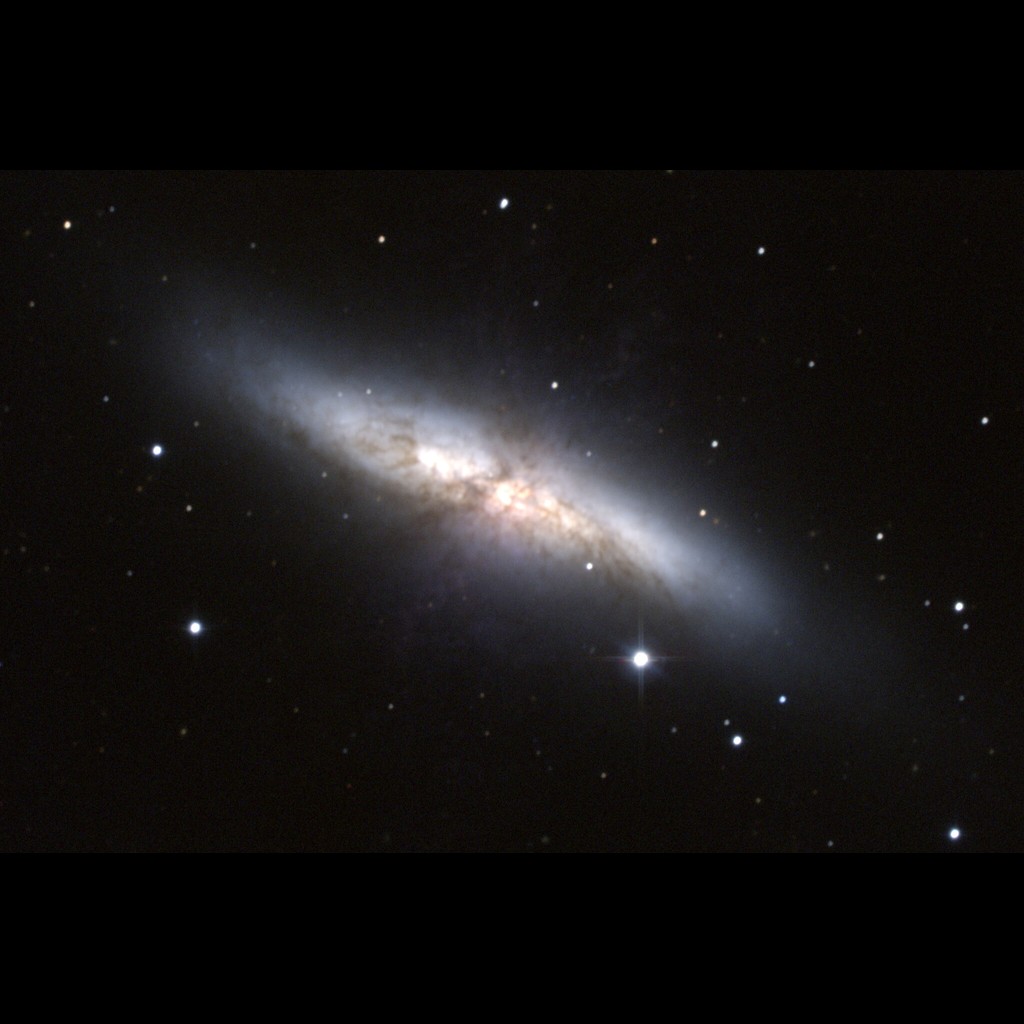
Messier 82 (NGC 3034), the Cigar Galaxy, is a spectacular starburst galaxy in the constellation Ursa Major, lying approximately 12 million light-years away as a close companion to the great spiral M81. It was discovered by Johann Elert Bode on December 31, 1774, and independently recorded by Pierre Méchain; Charles Messier catalogued it on February 9, 1781. Classified as an irregular galaxy, NGC 3034 is anything but ordinary: a gravitational encounter with M81 a few hundred million years ago triggered one of the most intense bursts of star formation in the nearby Universe, causing M82 to form stars roughly ten times faster than the Milky Way. It shines at magnitude 8.4 and is one of the most luminous galaxies within 10 megaparsecs.
The most dramatic feature of NGC 3034 is a vast bipolar superwind: streams of hot gas, energetic particles, and magnetic fields blown out perpendicular to the galaxy's disk by the combined effect of thousands of supernova explosions in the starburst core. This galactic-scale outflow extends tens of thousands of light-years above and below the disk and is visible in long-exposure images as a fan of filamentary red emission (mostly hydrogen-alpha light) erupting from the galaxy's center. M82 is also a powerful emitter of radio waves and infrared radiation, powered by the dense, star-forming core that even optical light cannot fully penetrate. Supernovae have been observed frequently in M82, with several detected in the past century.
In binoculars M82 appears edge-on as an elongated silver streak just north of M81; through a small telescope it shows a bright, elongated, mottled disk with a brighter central region — notably different in character from the spiral M81 beside it. This composite color image was made from CCD observations at the Kitt Peak National Observatory 0.9-meter telescope in late December 1994.
From Dubhe: Just 0.5° north of M81 — both fit in the same binocular field.
| Star | Bayer | Mag | Spectral Type | Distance | Meaning |
|---|---|---|---|---|---|
| Dubhe | α UMa | 1.81 | F7 · Orange giant | 124 ly | Arabic Zahr al-Dubb al-Akbar, 'Back of the Greater Bear' — one of the two pointer stars that lead to Polaris, the North Star. |
| Merak | δ UMa | 2.34 | A1 · Blue-white main sequence | 79 ly | Arabic Al-Maraqq, 'The Loins of the Bear' — one of the two pointer stars of the Big Dipper that guide observers to Polaris. |
| Phad | γ UMa | 2.41 | A0 · White main sequence | 84 ly | Arabic Al-Fakhdhah, 'The Thigh of the Bear' — marks the hip of Ursa Major, one of the four bowl stars of the Big Dipper. |
| Megrez | β UMa | 3.32 | A3 · White main sequence | 81 ly | Arabic Al-Maghriz, 'Root of the Bear's Tail' — the faintest of the seven Big Dipper stars, where the handle meets the bowl. |