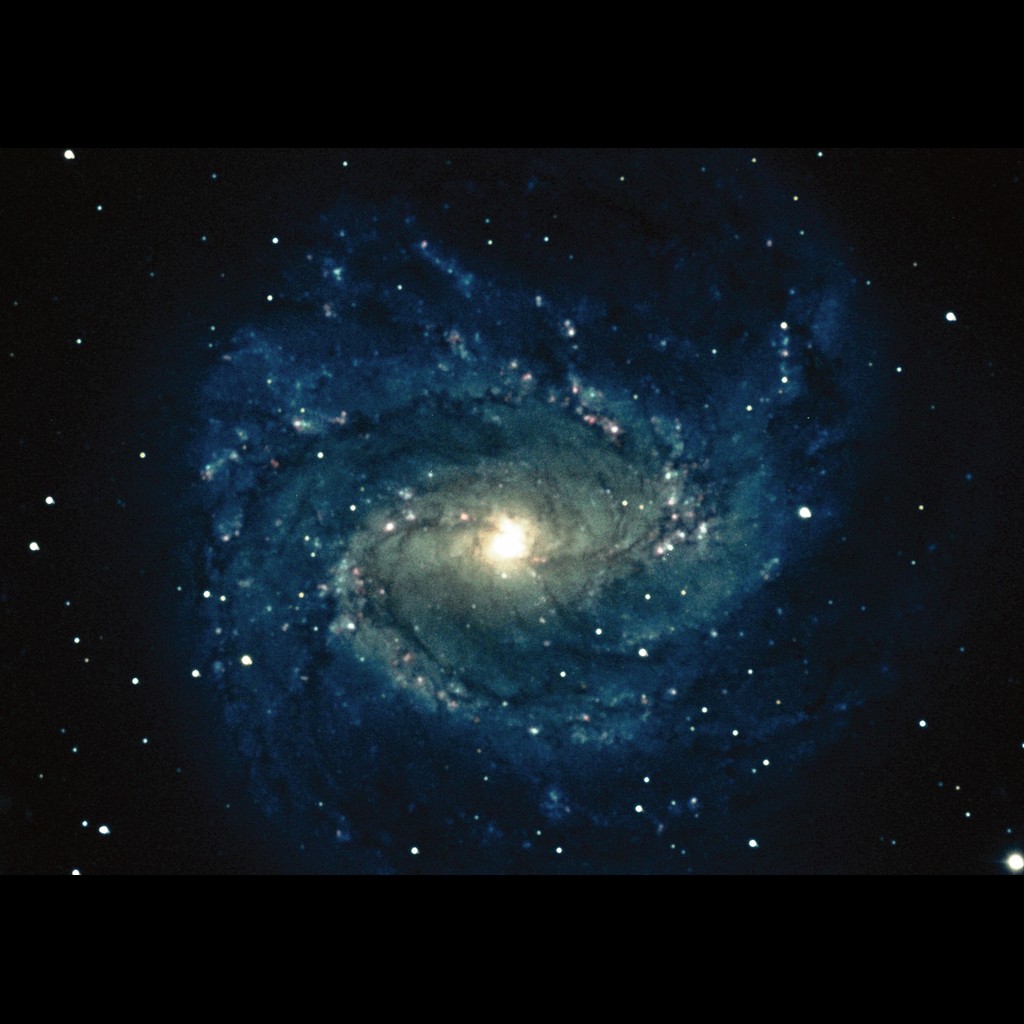
Bill Schoening/NOIRLab/NSF/AURA/
| Type | Galaxy | Constellation | Hya |
|---|---|---|---|
| Magnitude | 7.6 | Size | 12.9′ |
| Distance | 15.0 million light-years | Best Month | May |
| Visibility | Global | Difficulty | Easy (level 2/4) |
| Min. Aperture | binoculars | RA / Dec | 13h 37m 01.2s · -29° 52' 12" |
| Discovered by | Nicolas Louis de Lacaille, 1752 | ||
Bill Schoening/NOIRLab/NSF/AURA/
Messier 83 (NGC 5236), the Southern Pinwheel Galaxy, is one of the nearest and brightest barred spiral galaxies in the sky, located approximately 10 million light-years away in the constellation Hydra. It was discovered by Nicolas Louis de Lacaille in 1752 from the Cape of Good Hope — the first galaxy found from the southern hemisphere — and catalogued by Charles Messier on February 17, 1781. NGC 5236 is a type Sc spiral spanning roughly 30,000 light-years, seen nearly face-on, with two principal spiral arms and a third, fainter one visible in deep images. At magnitude 7.5 it is just within naked-eye range under exceptional conditions, and it is a spectacular sight through any telescope.
NGC 5236 is remarkable for its extraordinary rate of supernovae: at least six confirmed supernovae have been observed within the galaxy since 1923, far exceeding the theoretical average rate of one per several hundred years. This anomalous rate remains an active subject of research; it may reflect an unusually high rate of star formation in the disk, concentration of massive stars in specific regions, or the geometry of M83 being seen face-on — making it easier to detect supernovae that might be obscured in more edge-on galaxies. The galaxy's spiral arms glow with active star-forming knots and HII regions, and its central bar structure is clearly visible in images.
From the southern hemisphere, M83 rivals M31 as a naked-eye galaxy; northern observers can see it only from low latitudes. This image was photographed in true color directly at the Kitt Peak 4-meter telescope in 1973 using color film — an unusual technique; most color images of the period were made by combining separate black-and-white negatives through colored filters.
From Spica: In southern Hydra, near the head of Centaurus — low from northern latitudes.
| Star | Bayer | Mag | Spectral Type | Distance | Meaning |
|---|---|---|---|---|---|
| Spica | α Vir | 0.98 | B1 · Blue-white binary | 250 ly | Latin for 'Ear of Grain' — Virgo holds a sheaf of wheat. One of the four Royal Stars of antiquity, used by Hipparchus to discover the precession of the equinoxes. |
| Menkent | β Cen | 2.06 | K0 · Orange giant | 61 ly | Arabic Mankib Qanṭūris, 'Shoulder of the Centaur' — one of the brightest southern stars, marking the centaur's right shoulder. |
| Kraz | — | 2.65 | G5 · Yellow-white giant | 146 ly | Origin uncertain. Marks the tail of Corvus the Crow, the fainter of the two named stars in this compact southern constellation. |
| Algorab | δ Crv | 2.94 | B9 · Blue-white giant | 87 ly | Arabic Al-Ghurāb, 'The Crow' — named for the constellation itself. A wide double star with a faint optical companion. |