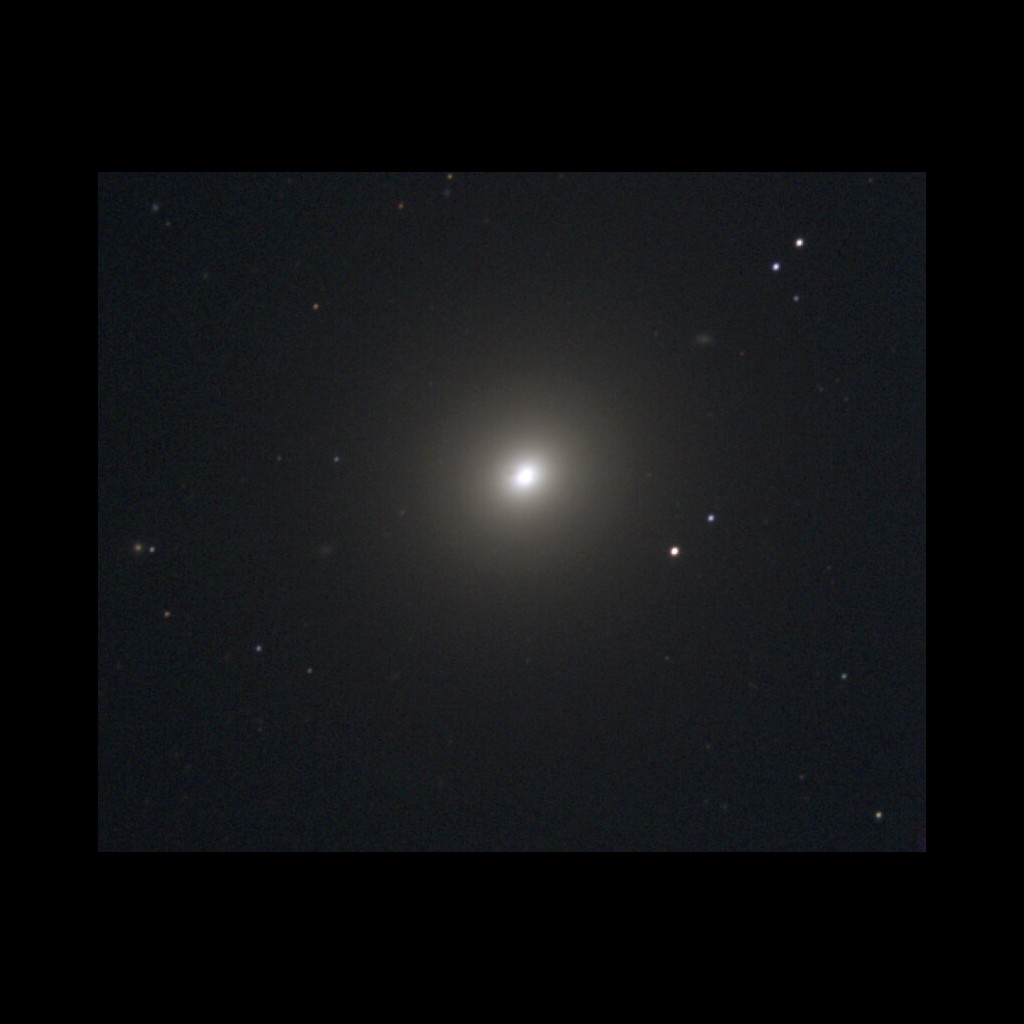
NOIRLab/ NSF /AURA
| Type | Galaxy | Constellation | Vir |
|---|---|---|---|
| Magnitude | 9.3 | Size | 6.5′ |
| Distance | 60.0 million light-years | Best Month | May |
| Visibility | Global | Difficulty | Moderate (level 3/4) |
| Min. Aperture | 3in | RA / Dec | 12h 25m 04.8s · +12° 52' 48" |
| Discovered by | Charles Messier, 1781 | ||
NOIRLab/ NSF /AURA
Messier 84 (NGC 4374) is a large elliptical galaxy in the constellation Virgo and one of the brightest members of the Virgo Cluster of galaxies, approximately 60 million light-years from Earth. Charles Messier discovered it on March 18, 1781. NGC 4374 is classified as type E1 — nearly round — though some astronomers believe it may actually be a face-on lenticular (S0) galaxy, a type intermediate between spirals and ellipticals that retains a disk but lacks prominent spiral arms. M84 lies near the gravitational center of the Virgo Cluster and can be seen in the same wide-field view as M86 and a chain of other Virgo galaxies known as Markarian's Chain.
NGC 4374 harbors an active galactic nucleus: a supermassive black hole estimated at around 1.5 billion solar masses that produces two oppositely directed jets visible at radio wavelengths — a classic signature of a low-luminosity AGN driving outflows into the surrounding galaxy. The main visible body of the galaxy is otherwise smooth and featureless, as expected for a massive elliptical without ongoing star formation. M84 is embedded in a halo of hot X-ray emitting gas that extends far beyond the visible galaxy, a common feature of massive ellipticals in dense cluster environments where supernovae and AGN heating prevent the hot gas from cooling.
In a small telescope M84 appears as a bright, round, featureless glow alongside M86 just half a degree away; the two are best observed together as a pair in a moderate-power field. This image was made at the Kitt Peak National Observatory 0.9-meter telescope in December 1996.
Navigate from Spica toward Virgo. In the core of the Virgo Cluster — M84 and M86 lie just 0.3° apart.
| Star | Bayer | Mag | Spectral Type | Distance | Meaning |
|---|---|---|---|---|---|
| Denebola | — | 2.14 | A3 · White main sequence | 36 ly | Arabic Dhanab al-Asad, 'Tail of the Lion' — marks the lion's tail. One of the few stars where infrared excess suggests a debris disk. |
| Zosma | β Leo | 2.56 | A4 · White subgiant | 58 ly | Greek for 'Girdle' — marks the hip of Leo the Lion. An aging star beginning to expand into a subgiant, slowly leaving the main sequence. |
| Vindemiatrix | — | 2.85 | G8 · Yellow giant | 102 ly | Latin for 'The Grape Gatherer' — its heliacal rising in ancient times signaled the grape harvest season in the Mediterranean. |