N.A.Sharp/NOIRLab/ NSF /AURA/
| Type | Galaxy | Constellation | UMa |
|---|---|---|---|
| Magnitude | 6.9 | Size | 26.9′ |
| Distance | 11.7 million light-years | Best Month | April |
| Visibility | Northern | Difficulty | Easiest (level 1/4) |
| Min. Aperture | naked eye | RA / Dec | 09h 55m 33.6s · +69° 04' 12" |
| Discovered by | Johann Elert Bode, 1774 | ||
N.A.Sharp/NOIRLab/ NSF /AURA/
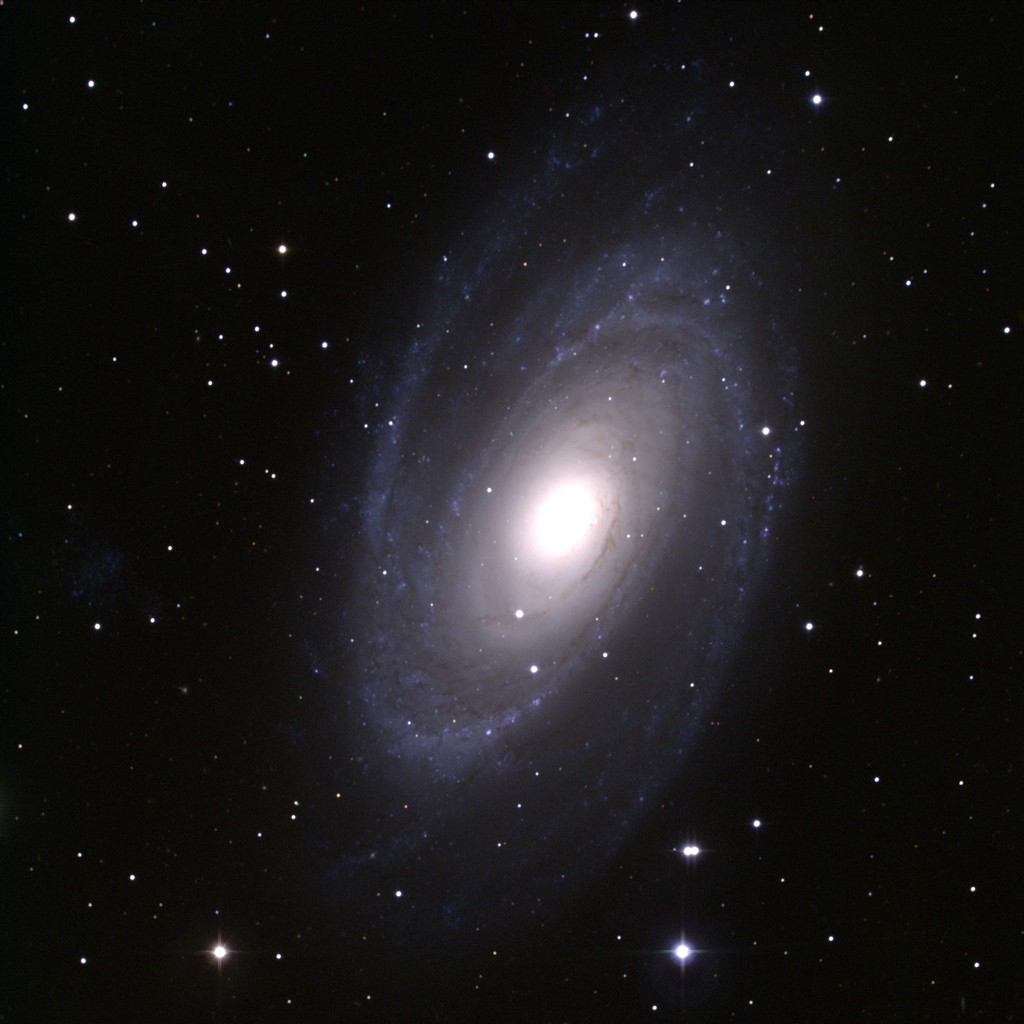
Messier 81 (NGC 3031), known as Bode's Galaxy, is one of the finest and most studied spiral galaxies in the sky — a quintessential "grand design" spiral located approximately 12 million light-years away in the constellation Ursa Major. It was discovered by Johann Elert Bode on December 31, 1774, and independently found by Pierre Méchain; Charles Messier catalogued it on February 9, 1781. At magnitude 6.9, NGC 3031 is one of the brightest galaxies visible from Earth and can be detected with the naked eye under exceptional dark-sky conditions. As the dominant member of the M81 Group — the nearest galaxy group beyond the Local Group — it gravitationally influences more than three dozen companion galaxies including M82 and NGC 3077.
NGC 3031 is a textbook example of a massive spiral galaxy, with a brilliant yellow-white core populated by an ancient concentration of stars and a supermassive black hole 70 million times the mass of the Sun. Extending from the nucleus are elegant, well-defined spiral arms laced with dark dust lanes and punctuated by brilliant blue clusters of young, massive stars — regions where ongoing star formation lights up the outer disk. The arms are unusually symmetric and well-ordered, suggesting NGC 3031 has not undergone a major merger in the recent past despite its gravitational interactions with M82. The latter interaction is thought to have triggered the intense starburst currently underway in M82.
From a dark site, NGC 3031 is just visible to the unaided eye; binoculars show an obvious oval glow, and a small telescope reveals the central concentration and a hint of the disk. This composite color image was made from CCD observations at the Kitt Peak National Observatory 0.9-meter telescope in late December 1994.
From Dubhe: From Dubhe (Alpha Ursae Majoris), sweep 10° northwest — M81 and M82 fit in the same binocular field.
| Star | Bayer | Mag | Spectral Type | Distance | Meaning |
|---|---|---|---|---|---|
| Dubhe | α UMa | 1.81 | F7 · Orange giant | 124 ly | Arabic Zahr al-Dubb al-Akbar, 'Back of the Greater Bear' — one of the two pointer stars that lead to Polaris, the North Star. |
| Merak | δ UMa | 2.34 | A1 · Blue-white main sequence | 79 ly | Arabic Al-Maraqq, 'The Loins of the Bear' — one of the two pointer stars of the Big Dipper that guide observers to Polaris. |
| Phad | γ UMa | 2.41 | A0 · White main sequence | 84 ly | Arabic Al-Fakhdhah, 'The Thigh of the Bear' — marks the hip of Ursa Major, one of the four bowl stars of the Big Dipper. |
| Megrez | β UMa | 3.32 | A3 · White main sequence | 81 ly | Arabic Al-Maghriz, 'Root of the Bear's Tail' — the faintest of the seven Big Dipper stars, where the handle meets the bowl. |