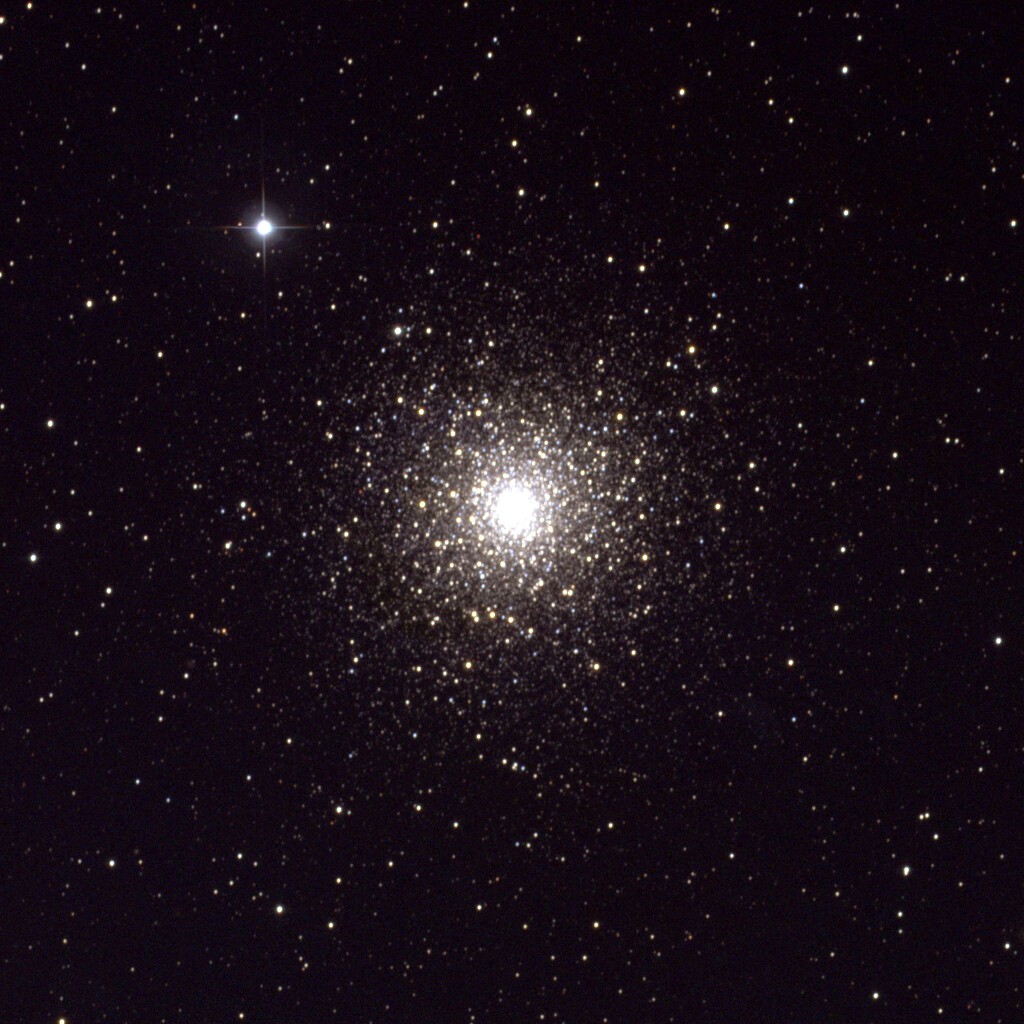
NOIRLab/ NSF /AURA
| Type | Globular Cluster | Constellation | Sco |
|---|---|---|---|
| Magnitude | 7.3 | Size | 8.9′ |
| Distance | 32,600 light-years | Best Month | July |
| Visibility | Global | Difficulty | Moderate (level 3/4) |
| Min. Aperture | 3in | RA / Dec | 16h 17m 06.0s · -22° 58' 12" |
| Discovered by | Charles Messier, 1781 | ||
NOIRLab/ NSF /AURA
Messier 80 (NGC 6093) is one of the densest globular clusters in the Milky Way, located approximately 27,000 light-years away in the constellation Scorpius. Charles Messier discovered it on January 4, 1781, and it was later resolved into stars by William Herschel. NGC 6093 contains several hundred thousand stars packed into a diameter of roughly 70 light-years — a stellar density in its core that rivals any known globular cluster. At magnitude 7.3, it is bright enough to be seen through binoculars as a compact, round haze, and in a telescope it is a beautiful, highly concentrated object with a blazing central core.
NGC 6093 entered astronomical history in May 1860, when a nova — T Scorpii — appeared within the cluster and briefly blazed to naked-eye visibility, temporarily outshining the entire combined light of M80's hundreds of thousands of stars. It was one of the few novae ever directly observed within a globular cluster in the pre-photographic era. In the modern era, Hubble Space Telescope observations have revealed that M80 contains an unusually large number of blue stragglers — stars that appear far younger and bluer than they should given the cluster's ancient age, thought to be the rejuvenated products of stellar collisions or mass-transfer in close binary systems, both of which are greatly facilitated by the extreme crowding in the core.
In binoculars M80 appears as a bright, compact, slightly oval glow; a small telescope at moderate power shows a dazzling, concentrated sphere with a dramatically bright core. This image was made with the T2KA CCD camera at the Kitt Peak National Observatory 0.9-meter telescope in March 1995.
Navigate from Rigel toward Scorpius. In Scorpius, roughly midway between Antares and Graffias (Beta Scorpii).
| Star | Bayer | Mag | Spectral Type | Distance | Meaning |
|---|---|---|---|---|---|
| Antares | α Sco | 1.06 | M1 · Red supergiant | 550 ly | Greek Antares, 'Rival of Mars' — its fiery red color rivals the planet Mars. The blazing heart of Scorpius and one of the largest stars known. |
| Dschubba | λ Sco | 2.29 | B0 · Blue subgiant | 400 ly | Arabic Al-Jabhah, 'The Forehead' — marks the head of Scorpius. A rapidly rotating blue star that has shed a disk of material. |
| Graffias | — | 2.56 | B0 · Blue-white binary | 530 ly | Greek origin meaning 'Claws' — one of several names for the head of Scorpius. A fine double star in small telescopes. |