NOIRLab/ NSF /AURA
| Type | Globular Cluster | Constellation | Lep |
|---|---|---|---|
| Magnitude | 8.0 | Size | 8.7′ |
| Distance | 41,000 light-years | Best Month | January |
| Visibility | Global | Difficulty | Moderate (level 3/4) |
| Min. Aperture | 3in | RA / Dec | 05h 24m 10.8s · -24° 31' 12" |
| Discovered by | Pierre Méchain, 1780 | ||
NOIRLab/ NSF /AURA
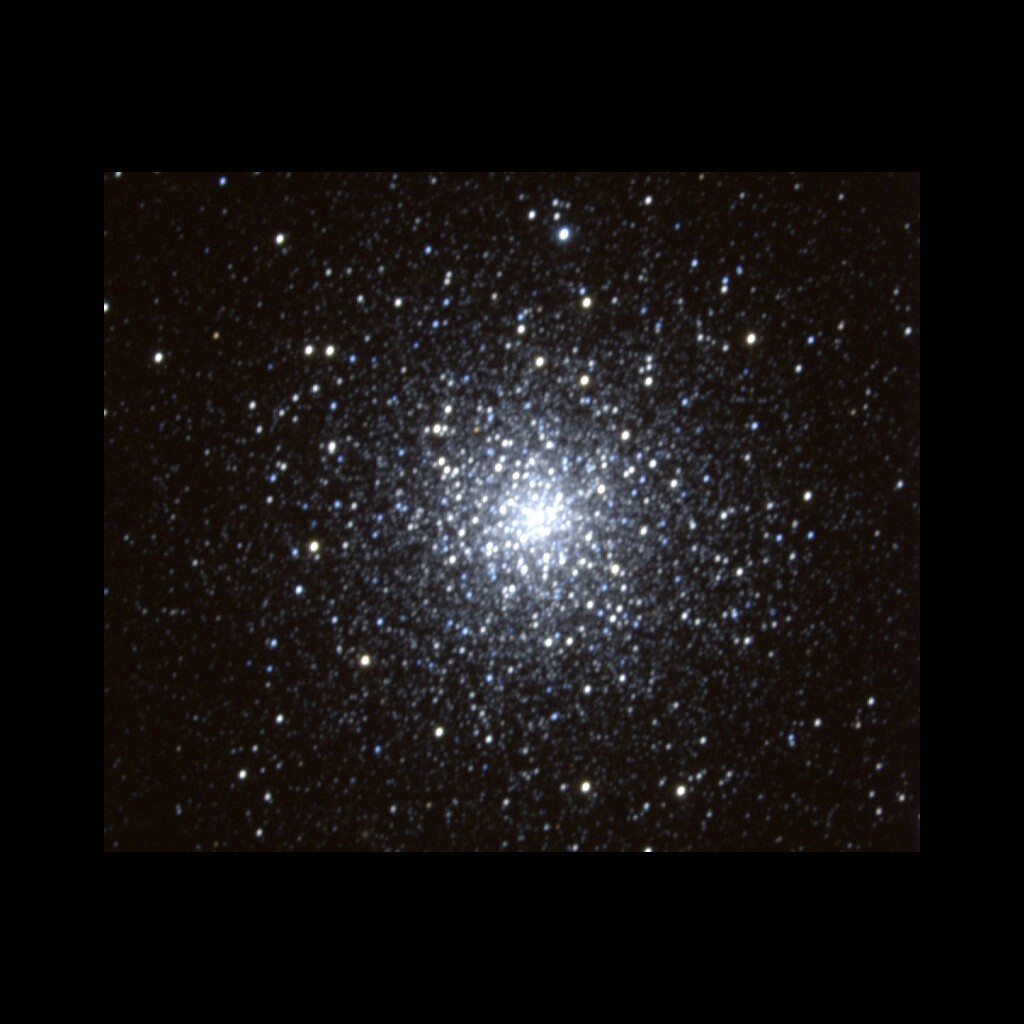
Messier 79 (NGC 1904) is a globular cluster in the constellation Lepus, the Hare, lying approximately 41,000 light-years from Earth. It was discovered by Pierre Méchain in October 1780 and catalogued by Charles Messier on October 26, 1780. NGC 1904 is remarkable for its unusual location: unlike most Milky Way globular clusters, which concentrate toward the galactic center in the southern Sagittarius–Scorpius region of the sky, M79 appears in the opposite direction entirely — in Lepus, south of Orion, in a region of sky relatively sparse in globulars. This positioning has led some astronomers to suggest that M79 may be an immigrant to the Milky Way — possibly a globular cluster originally belonging to the Canis Major Dwarf Galaxy, a disrupted satellite galaxy whose tidal streams pass through this part of the sky.
NGC 1904 is a moderately concentrated globular containing several hundred thousand stars estimated to be around 11.7 billion years old. Its concentration class and density fall in the intermediate range — more compact than a loose globular like M55 but not as extremely dense as core-collapsed systems like M30 or M15. The cluster contains several dozen variable stars, mostly RR Lyrae pulsators useful for distance determination. Its isolation from the main Milky Way globular cluster system makes it particularly interesting to dynamicists studying how external satellite galaxies contributed to the present-day globular cluster population of the Milky Way.
A small telescope shows M79 as a compact, round, concentrated glow with a noticeably brighter center; 150 mm aperture begins to resolve stars in the outer halo. This image was made at the Kitt Peak National Observatory 0.9-meter telescope.
From Rigel: In Lepus, south of Orion — near the star Nihal (Beta Leporis).
| Star | Bayer | Mag | Spectral Type | Distance | Meaning |
|---|---|---|---|---|---|
| Rigel | β Ori | 0.18 | B8 · Blue-white supergiant | 860 ly | Arabic Rijl Jauzā al-Yusrā, 'Left Leg of the Central One' — the left foot of Orion, a blue supergiant among the most luminous stars known. |
| Mirzam | β CMa | 1.98 | B1 · Blue-white giant | 500 ly | Arabic Al-Mirzam, 'The Announcer' — rises just before Sirius, heralding the arrival of the brightest star in the sky. |
| Saiph | κ Ori | 2.07 | B0 · Blue supergiant | 650 ly | Arabic Saif al-Jauzā, 'Sword of the Giant' — Orion's right foot, though nearly as luminous as Rigel, it appears dimmer due to its extreme distance. |
| Arneb | α Lep | 2.58 | F0 · Yellow-white supergiant | 2200 ly | Arabic Al-Arnab, 'The Hare' — named for the constellation itself, the brightest star in Lepus the Hare crouching beneath Orion. |
| Phakt | — | 2.65 | B7 · Blue-white main sequence | 270 ly | Arabic Al-Fākhitah, 'The Ring Dove' or 'The Turtle Dove' — named for the bird constellation Columba, the brightest star in the Dove. |
| Cursa | — | 2.78 | A3 · Blue-white main sequence | 89 ly | Arabic Al-Kursī, 'The Footstool' of Orion — sits at the top of Eridanus just below Orion's feet, the starting point of the river. |
| Nihal | β Lep | 2.81 | G5 · Yellow giant | 160 ly | Arabic Al-Nihāl, 'The Camels Quenching Their Thirst' — the second brightest star in Lepus the Hare, below Orion's feet. |