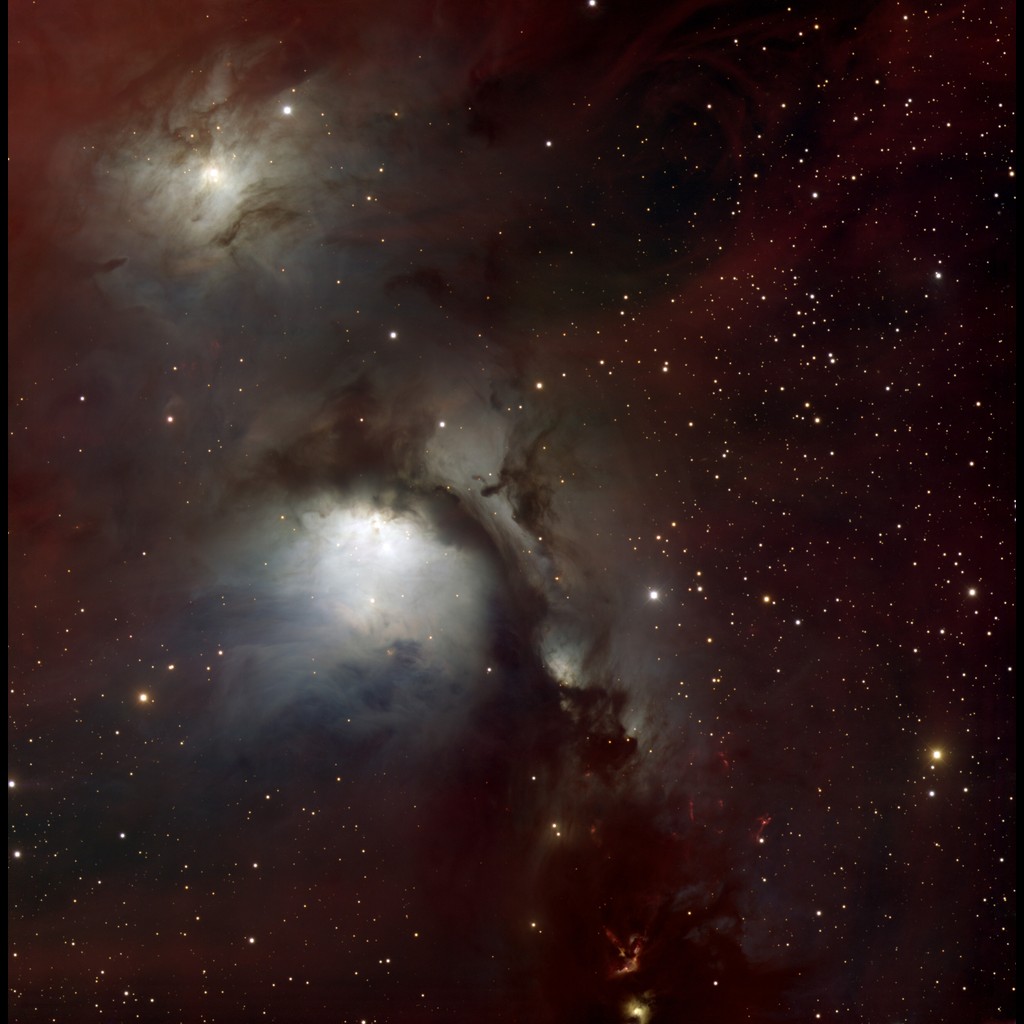
T. A. Rector/University of Alaska Anchorage, H. Schweiker/WIYN and NOIRLab/ NSF /AURA
| Type | Reflection Nebula | Constellation | Ori |
|---|---|---|---|
| Magnitude | 8.3 | Size | 8.0′ |
| Distance | 1,350 light-years | Best Month | January |
| Visibility | Global | Difficulty | Moderate (level 3/4) |
| Min. Aperture | 3in | RA / Dec | 05h 46m 40.8s · +00° 04' 48" |
| Discovered by | Pierre Méchain, 1780 | ||
T. A. Rector/University of Alaska Anchorage, H. Schweiker/WIYN and NOIRLab/ NSF /AURA
Messier 78 (NGC 2068) is the brightest diffuse reflection nebula in the sky, a glowing cloud of dust and gas in the constellation Orion, approximately 1,600 light-years away and about 4 light-years across. It was discovered by Pierre Méchain in January 1780 and catalogued by Charles Messier on December 17, 1780. NGC 2068 is part of the vast Orion molecular cloud complex — the same star-forming region that gives us the Orion Nebula (M42) and numerous other nebulae scattered across the constellation. Unlike the Orion Nebula, which glows by emission (gas ionized by hot stars), M78 shines by reflection: its dust grains scatter the blue light of the embedded stars that illuminate it, giving the nebula its characteristic bluish-white glow.
Two bright blue stars — HD 38563A and HD 38563B — are primarily responsible for illuminating NGC 2068. They are young pre-main-sequence stars, recently formed from the same molecular cloud that M78 is part of and still partially embedded in it. The nebula contains several Herbig-Haro objects — small, shock-lit patches where jets from newly forming stars collide with surrounding gas — as well as a number of T Tauri variable stars, young solar-type stars still in the final stages of gravitational contraction. Several fainter reflection nebulae in the immediate vicinity, including NGC 2071 just to the north, form a small complex of illuminated clouds within the larger Orion star-forming region.
In binoculars M78 appears as a faint, comet-like glow; a small telescope shows a roughly rectangular, bright nebula with two embedded stars clearly visible near its center. This image was taken in 2006 with the Mosaic imager on the Mayall 4-meter telescope on Kitt Peak.
From Alnilam: From Alnilam (centre of Orion's Belt), move 3° north-northeast.
| Star | Bayer | Mag | Spectral Type | Distance | Meaning |
|---|---|---|---|---|---|
| Rigel | β Ori | 0.18 | B8 · Blue-white supergiant | 860 ly | Arabic Rijl Jauzā al-Yusrā, 'Left Leg of the Central One' — the left foot of Orion, a blue supergiant among the most luminous stars known. |
| Betelgeuse | α Ori | 0.45 | M2 · Red supergiant | 700 ly | Arabic Ibt al-Jauzā, 'Armpit of the Central One' — the right shoulder of Orion, a red supergiant expected to explode as a supernova. |
| Bellatrix | γ Ori | 1.64 | B2 · Blue-white giant | 250 ly | Latin for 'Female Warrior' — the left shoulder of Orion. Known in Arabic as Al-Najid, 'The Conqueror.' |
| Alnilam | ε Ori | 1.69 | B0 · Blue-white supergiant | 2000 ly | Arabic Al-Nilam, 'String of Pearls' — the central and brightest of Orion's three belt stars, one of the most luminous stars known. |
| Alnitak | β Tau | 1.74 | O9 · Blue supergiant | 1260 ly | Arabic Al-Nitāq, 'The Girdle' — the easternmost of Orion's three belt stars, near the famous Horsehead Nebula. |
| Saiph | κ Ori | 2.07 | B0 · Blue supergiant | 650 ly | Arabic Saif al-Jauzā, 'Sword of the Giant' — Orion's right foot, though nearly as luminous as Rigel, it appears dimmer due to its extreme distance. |
| Mintaka | — | 2.25 | O9 · Blue-white giant | 900 ly | Arabic Al-Mintaqa, 'The Belt' or 'The Girdle' — the westernmost of Orion's three belt stars, almost exactly on the celestial equator. |
| Cursa | — | 2.78 | A3 · Blue-white main sequence | 89 ly | Arabic Al-Kursī, 'The Footstool' of Orion — sits at the top of Eridanus just below Orion's feet, the starting point of the river. |