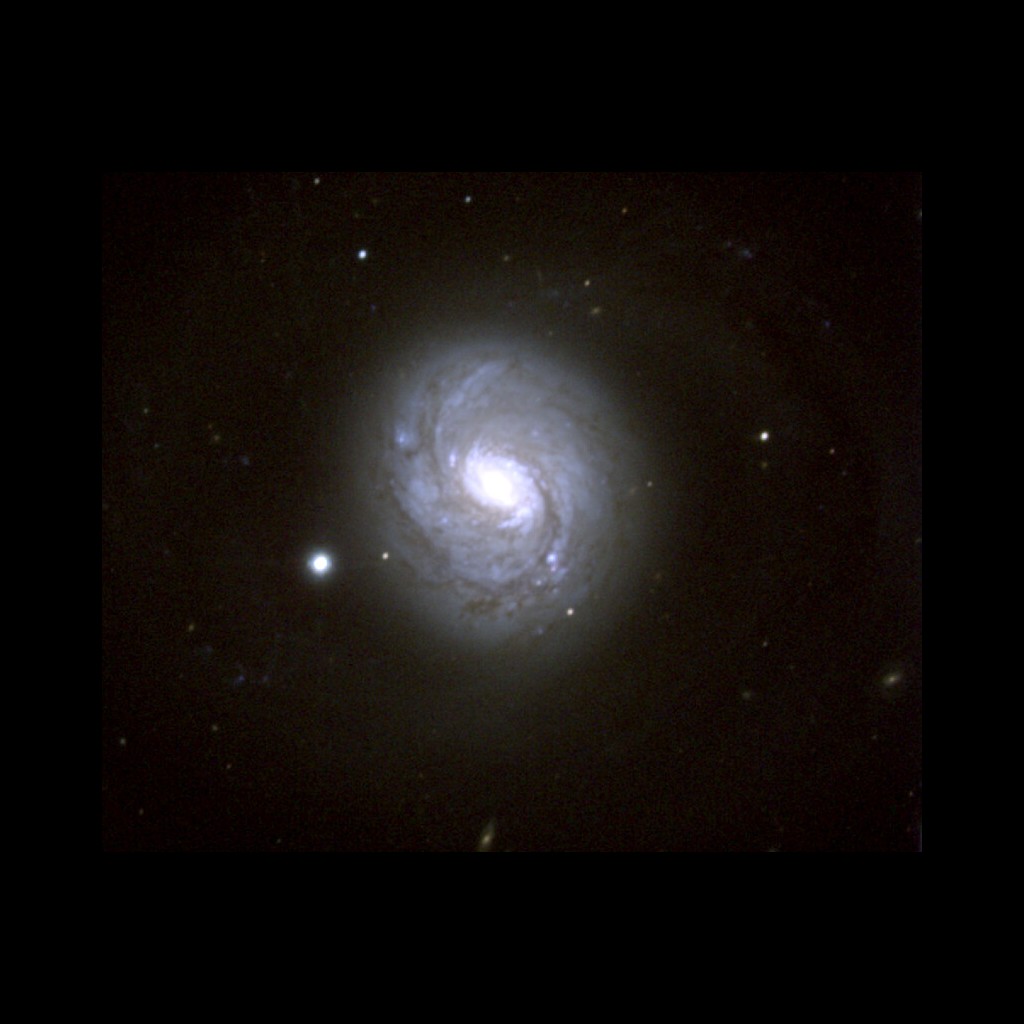
NOIRLab/ NSF /AURA
| Type | Galaxy | Constellation | Cet |
|---|---|---|---|
| Magnitude | 8.9 | Size | 7.1′ |
| Distance | 47.0 million light-years | Best Month | December |
| Visibility | Global | Difficulty | Moderate (level 3/4) |
| Min. Aperture | 3in | RA / Dec | 02h 42m 43.2s · -00° 00' 36" |
| Discovered by | Pierre Méchain, 1780 | ||
NOIRLab/ NSF /AURA
Messier 77 (NGC 1068), also known as Cetus A, is a spiral galaxy of type Sb in the constellation Cetus and one of the most scientifically significant objects in Messier's catalog — it is the nearest and brightest example of a Type II Seyfert galaxy. It was discovered by Pierre Méchain in 1780 and catalogued by Charles Messier on December 17 of the same year, who described it as a "star cluster." NGC 1068 lies approximately 47 million light-years from Earth and, at magnitude 8.9, is moderately bright in a small telescope. While Messier's catalog lists it under its M77 designation, astronomers far more commonly refer to it by its NGC number, reflecting its importance as a prototype for an entire class of active galaxy.
What distinguishes NGC 1068 from ordinary spirals is the intense activity at its nucleus. A Seyfert galaxy contains an active galactic nucleus (AGN) — a supermassive black hole actively accreting surrounding material — that produces powerful radiation and high-velocity gas outflows visible as broad, strong emission lines in the galaxy's spectrum. In M77, the central black hole (estimated at roughly 100 million solar masses) is surrounded by a dusty torus that obscures its direct view but allows energetic radiation to escape along the poles, illuminating and ionizing gas in the surrounding galaxy. A strong radio source, Cetus A, sits at the nucleus and reflects the same accretion activity. NGC 1068 is one of the most-studied AGN in the sky.
A small telescope shows M77 as an oval glow with a bright, star-like nucleus; larger apertures reveal the compact bright core surrounded by a diffuse halo of the underlying galaxy disk. This image was made at Kitt Peak National Observatory.
Navigate from Alnilam toward Cetus. In Cetus, 0.9° east-southeast of the star Delta Ceti.
| Star | Bayer | Mag | Spectral Type | Distance | Meaning |
|---|---|---|---|---|---|
| Menkar | δ Cet | 2.54 | M2 · Red giant | 249 ly | Arabic Al-Mankhir, 'The Nostril' — marks the nose of Cetus the Sea Monster. One of the four Royal Stars of ancient Persia. |
| Mira | — | 6.47 | M5 · Red giant variable | 420 ly | Latin for 'The Wonderful' — the first recognized long-period variable star, fading from naked-eye visibility to near-invisibility over 332 days. |