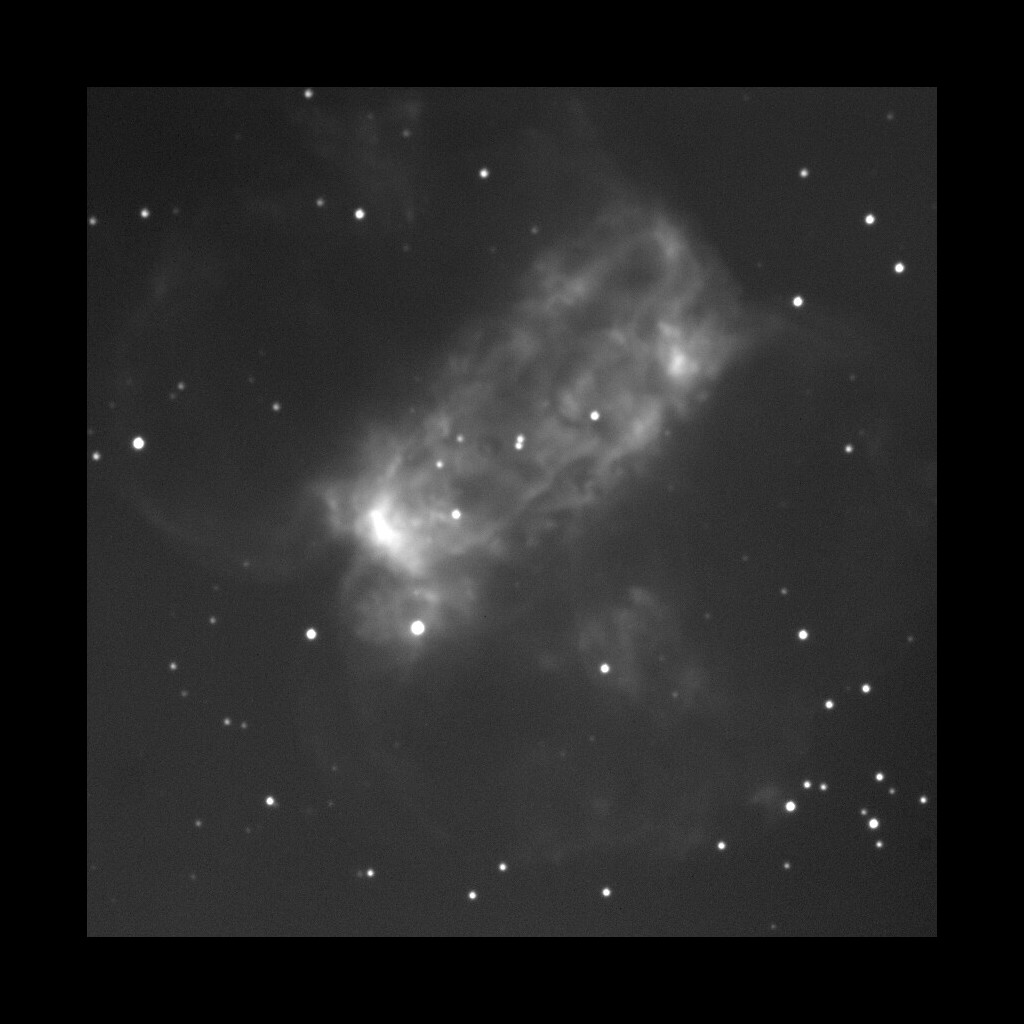
D.Sawyer, A.McDonald/WIYN/NOIRLab/ NSF
| Type | Planetary Nebula | Constellation | Per |
|---|---|---|---|
| Magnitude | 10.1 | Size | 2.7′ |
| Distance | 3,400 light-years | Best Month | December |
| Visibility | Northern | Difficulty | Challenging (level 4/4) |
| Min. Aperture | 6in | RA / Dec | 01h 42m 10.8s · +51° 34' 12" |
| Discovered by | Pierre Méchain, 1780 | ||
D.Sawyer, A.McDonald/WIYN/NOIRLab/ NSF
Messier 76 (NGC 650/651), known as the Little Dumbbell Nebula, is a planetary nebula in the constellation Perseus, approximately 2,500 light-years away and spanning about 0.7 light-years across. It was discovered by Pierre Méchain in 1780 and catalogued by Charles Messier on October 21 of that year. The nebula is one of the faintest objects in the entire Messier catalog, with an integrated visual magnitude fainter than 12. William Herschel, observing M76 independently, believed he was seeing two separate unresolved nebulae and assigned it two NGC numbers — 650 and 651 — a misidentification that persisted for many years before the single planetary nature was recognized.
NGC 650/651 has a distinctive rectangular structure at its center — a dense toroidal ring of gas seen nearly edge-on — flanked by two large, wispy, lower-surface-brightness lobes extending outward to form the "dumbbell" shape. The central star, a white dwarf of photographic magnitude 16.5 and estimated temperature above 100,000 Kelvin, ionizes the surrounding gas and drives the expanding shell. The nebula's morphology is exceptionally complex: the combination of the bright central rectangle and the overlapping wispy extensions has proven difficult to model, with two competing theories — a double coaxial toroid and a distorted conical ejection — each reproducing only some aspects of the observed brightness and velocity structure. How exactly this star shed its outer envelope remains an active research question.
In a small telescope M76 is a faint but identifiable tiny rectangular glow; 150–200 mm aperture reveals the elongated central body and hints at the bipolar lobes extending to each side. This image was taken at the WIYN telescope on the night of September 1, 1994.
Navigate from Mirfak toward Perseus. In Perseus, near the star Phi Persei.
| Star | Bayer | Mag | Spectral Type | Distance | Meaning |
|---|---|---|---|---|---|
| Mirphak | ε Per | 1.79 | F5 · Yellow-white supergiant | 590 ly | Arabic Mirfaq al-Thurayya, 'Elbow near the Pleiades' — the brightest star in Perseus, embedded in a beautiful star cluster visible in binoculars. |
| Algol | β Per | 2.09 | B8 · Eclipsing binary | 93 ly | Arabic Ra's al-Ghūl, 'Head of the Demon' — named for the severed Medusa head held by Perseus. It dims every 2.87 days as a companion eclipses it. |
| Almaak | γ And | 2.10 | B8 · Orange giant + blue companion | 355 ly | Arabic Al-'Anāq al-Ard, 'The Desert Lynx.' One of the finest double stars in the sky — vivid gold and blue-green pair. |
| Cih | α Cas | 2.15 | B0 · Blue-white supergiant | 550 ly | Chinese name meaning 'The Whip' — the middle star of Cassiopeia's W, marking the queen's waist. A luminous blue variable. |
| Shedir | γ Cas | 2.24 | K0 · Orange giant | 229 ly | Arabic Al-Sadr, 'The Breast' — marks the heart of Cassiopeia the Queen on her throne. A slowly varying orange giant. |
| Caph | β Cas | 2.28 | F2 · White giant | 54 ly | Arabic Al-Kaff, 'The Hand' or 'The Palm' — marks the tip of the W-shape of Cassiopeia. A pulsating variable star. |
| Ruchbah | δ Cas | 2.66 | A5 · White giant binary | 99 ly | Arabic Al-Rukbah, 'The Knee' of Cassiopeia — one of the W-shaped stars of the queen, an eclipsing binary that dips in brightness periodically. |