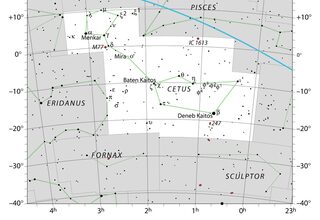
 IAU Chart
 NOIRLab Images
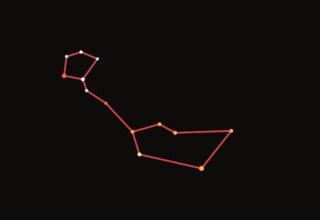 Stars and Sticks
| Abbreviation | Cet |
|---|---|
| Meaning | Whale (Sea Monster) |
| Pronunciation Guide is based on “Pronouncing Astronomical Names,” published in 1943 by the American Astronomical Society. | SEE-tuss |
| Genitive The genitive is the Latin possessive form used in star names. For example, Alpha Orionis means “the Alpha of Orion.” | SEE-tye |
| Best Month | November |
| Visibility | Global |
| Origin | AncientThese figures are rooted in the classical Greek and Mesopotamian traditions cataloged by Ptolemy in the 2nd century AD. |
| Author | PtolemyPtolemy, a 2nd-century Greco-Egyptian astronomer, cataloged the 48 classical constellations in his landmark work, the Almagest. These form the core of the 88 modern constellations recognized today. |
| Type | constellation |
| Difficulty | Moderate |
| Description | The Sea Monster of the ancient world is one of the largest constellations, sprawling across the celestial equator in the watery region of sky occupied by Aquarius and Pisces. In myth it was sent by Poseidon to devastate Ethiopia until Perseus arrived and turned it to stone with Medusa's severed head. The constellation's most celebrated star is Mira ('the wonderful') — a red giant variable that swells and brightens to naked-eye visibility and fades into obscurity over a 332-day cycle, making it the prototype of all long-period variable stars. The star Tau Ceti, just 11.9 light-years away, is one of the nearest Sun-like stars and a prime candidate in the search for exoplanets. |
Click a thumbnail to view full-size. Plain and Annotated versions available on the image page.
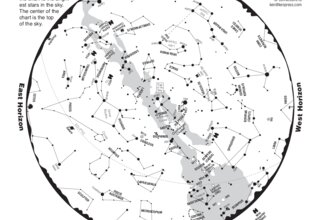
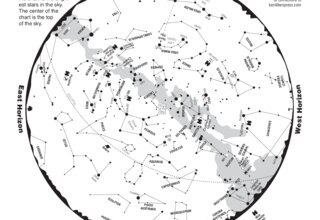
Monthly sky charts courtesy of What's Out Tonight? — Copyright ©2026 Ken Graun. Star charts are optimized for mid-latitudes of the Northern Hemisphere. Click a chart to view or download the PDF. For guidance on using the chart, or to purchase a planisphere and astronomy books, visit kenpress.com.
Images: NOIRLab/NSF/AURA/E. Slawik · IAU and Sky & Telescope · Stellarium — Full credits →