MPG / ESO
| Type | Globular Cluster | Constellation | Pav |
|---|---|---|---|
| Magnitude | 5.4 | Size | 20.4′ |
| Distance | 13,000 light-years | Best Month | August |
| Visibility | Southern | Difficulty | Easiest (level 1/4) |
| Min. Aperture | naked eye | RA / Dec | 19h 10m 58.8s · -59° 58' 48" |
| Discovered by | James Dunlop, 1826 | ||
MPG / ESO
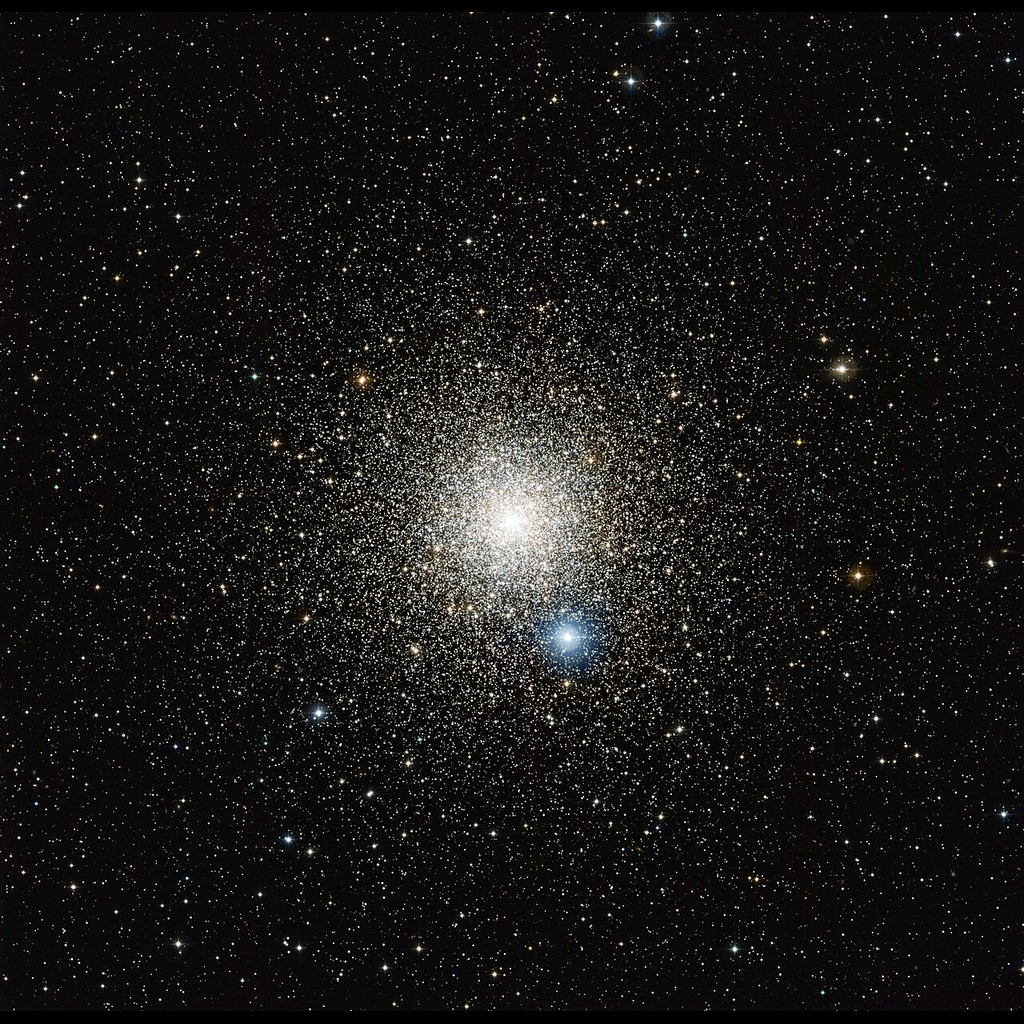
Caldwell 93, or NGC 6752, is a breathtaking globular cluster located approximately 13,000 light-years away in the southern constellation of Pavo, the Peacock. It is the third-brightest globular cluster in the sky, trailing only behind the giants Omega Centauri and 47 Tucanae. Visually, it is a dense, "sparkling" sphere of stars that covers an area of the sky nearly as large as the full moon. Like most globular clusters, NGC 6752 is a relic of the early universe, containing hundreds of thousands of ancient stars that are all bound together by mutual gravity in a tight, symmetrical swarm.
Despite its traditional appearance, this cluster has recently become the center of a major astrophysical mystery. Observations conducted with ESO’s Very Large Telescope (VLT) have challenged our fundamental understanding of how stars die. Typically, as a sun-like star reaches the end of its life, it enters the "Asymptotic Giant Branch" (AGB) phase, where it loses a significant portion of its mass through stellar winds before becoming a white dwarf. However, studies of NGC 6752 have unexpectedly revealed that a vast majority of its stars completely skip this mass-loss stage. This "death-defying" behavior suggests there may be unknown factors—possibly related to a star's chemical "sodium-rich" signature—that dictate whether it will follow the standard evolutionary path or take a shortcut to its final state.
This detailed view was captured by the Wide Field Imager (WFI) on the MPG/ESO 2.2-metre telescope at the La Silla Observatory in Chile. The high-resolution optics of the 2.2-meter telescope allow the cluster to be resolved from its dense, crowded core out to its sparse, sprawling outskirts. The resulting image showcases the intense concentration of stellar light at the center, where stars are packed thousands of times more densely than in our own solar neighborhood. It stands as both a beautiful portrait of a southern gem and a visual map of a cluster that continues to rewrite the rules of stellar evolution.