NOIRLab / NSF / AURA
| Type | Emission Nebula | Constellation | Car |
|---|---|---|---|
| Magnitude | 1.0 | Size | 120.0′ |
| Distance | 7,500 light-years | Best Month | March |
| Visibility | Southern | Difficulty | Easiest (level 1/4) |
| Min. Aperture | naked eye | RA / Dec | 10h 43m 58.8s · -59° 52' 12" |
| Discovered by | Nicolas Louis de Lacaille, 1751 | ||
NOIRLab / NSF / AURA
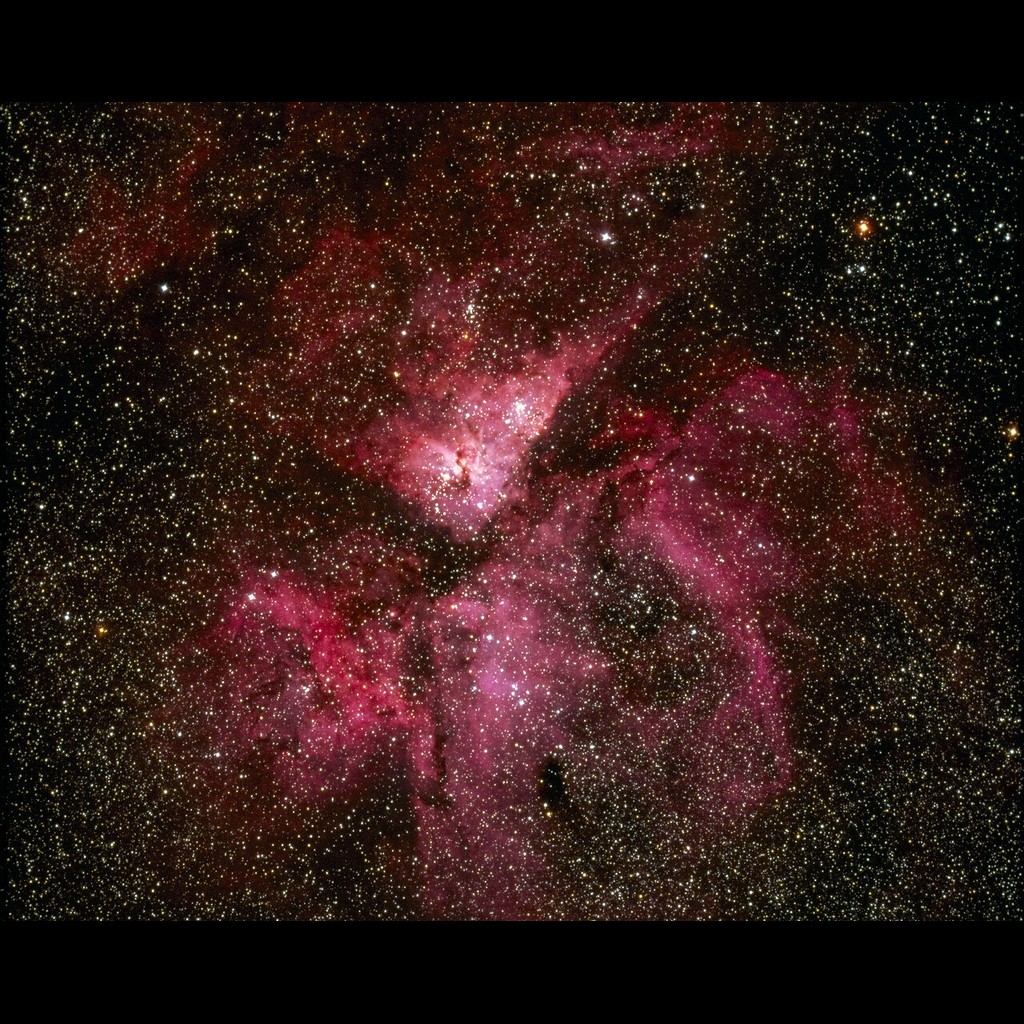
Caldwell 92, famously known as the Carina Nebula (NGC 3372), is one of the most sprawling and complex star-forming regions in the Milky Way. Spanning over 300 light-years, this "Great Nebula in the South" is a violent theater of stellar birth and destruction located approximately 9,000 light-years away. Within its glowing expanse lies the Keyhole Nebula, a distinct, dark silhouette of cold dust and gas that provides a stark contrast to the surrounding brilliance. The entire region is a chaotic landscape of ionized gas clouds and jagged "pillars" of dark material, all being sculpted by the intense radiation and stellar winds of the massive stars residing within.
The nebula’s most famous inhabitant is the peculiar variable star Eta Carinae. This gargantuan star is one of the most massive and luminous in the galaxy, known for its extreme instability and the dramatic "Great Eruption" it underwent in the mid-19th century. The star is surrounded by an expansive shroud of glowing gas and overlying clouds of opaque, dark dust that weave through the nebula’s structure. Because Eta Carinae is nearing the end of its life, it serves as a primary subject for astronomers studying the final stages of massive stellar evolution and the precursor events of supernovae.
This historic view was captured by the Curtis Schmidt telescope at the Cerro Tololo Interamerican Observatory in 1975. Presented with North at the top, the image provides a wide-field perspective that captures the immense scale of the gaseous clouds and the intricate layering of the dark "keyhole" structures. While modern narrowband emission-line images can isolate specific gases like hydrogen and oxygen, this classic photographic plates approach emphasizes the natural, formidable beauty of the nebula. It remains a definitive portrait of the environment surrounding one of the most dangerous and fascinating stars in the celestial catalog.