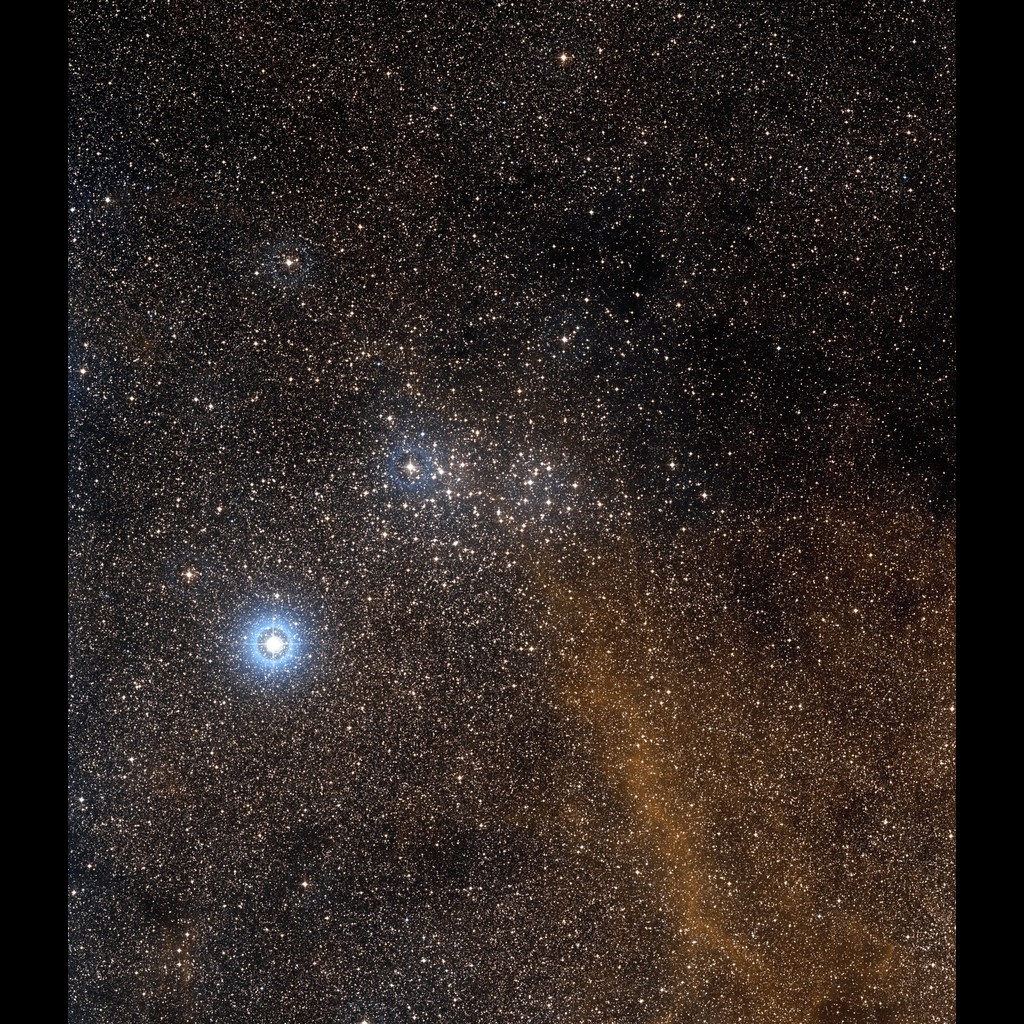
ESO/Digitized Sky Survey 2 / Davide De Martin
| Type | Open Cluster | Constellation | Car |
|---|---|---|---|
| Magnitude | 3.0 | Size | 55.0′ |
| Distance | 1,321 light-years | Best Month | March |
| Visibility | Southern | Difficulty | Easiest (level 1/4) |
| Min. Aperture | naked eye | RA / Dec | 11h 05m 52.8s · -58° 43' 48" |
| Discovered by | Nicolas Louis de Lacaille, 1751 | ||
ESO/Digitized Sky Survey 2 / Davide De Martin
Caldwell 91, popularly known as the Wishing Well Cluster or NGC 3532, is a sprawling open cluster located approximately 1,300 light-years away in the constellation Carina. It is widely considered one of the most beautiful sights in the southern sky, even rivaling the famous Pleiades in its brilliance and complexity. Comprising several hundred stars, the cluster earned its nickname because, through a telescope, its stars resemble a collection of silver coins shimmering at the bottom of a dark well. The population is a rich mix of hot blue stars and several evolved orange giants, creating a diverse palette of colors that indicates the cluster is around 300 million years old—comfortably middle-aged for a stellar group.
While the cluster itself is a magnificent target, the surrounding celestial field is dominated by a remarkable background object: the star x Carinae (V382 Carinae). Visible to the lower left of the cluster in wide-field views, this bright star is a rare yellow hypergiant, one of the most luminous and massive types of stars in existence. Although it appears as a prominent member of the neighborhood, it is actually a distant "photobomber," located roughly five times further from Earth than the Wishing Well Cluster. x Carinae holds the distinction of being one of the most distant stars visible to the unaided human eye, shining with a staggering luminosity hundreds of thousands of times greater than our Sun.
This expansive view of the region was constructed from photographic material that forms part of the Digitized Sky Survey 2 (DSS2). By utilizing this comprehensive survey data, the image provides the necessary context to appreciate the scale of the Wishing Well Cluster relative to its surroundings. The cluster occupies the center of the frame as a dense, "sparkling" concentration of stars, while the golden brilliance of x Carinae serves as a powerful reminder of the incredible distances and scales involved in southern-sky astronomy. The result is a historical and scientific portrait that captures both the delicate beauty of a nearby stellar family and the raw power of a distant cosmic giant.