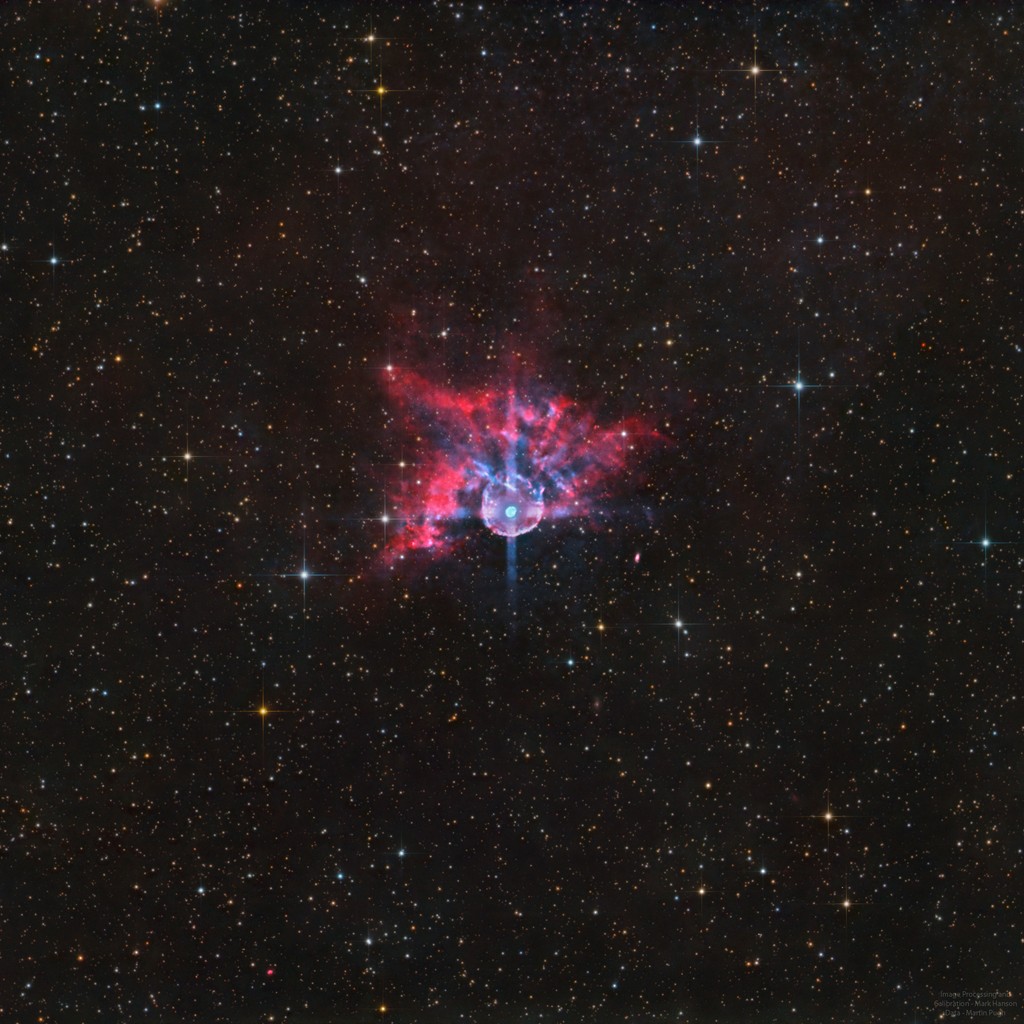
Mark Hanson / Martin Pugh
| Type | Planetary Nebula | Constellation | Car |
|---|---|---|---|
| Magnitude | 9.7 | Size | 0.2′ |
| Distance | 6,000 light-years | Best Month | March |
| Visibility | Southern | Difficulty | Challenging (level 4/4) |
| Min. Aperture | 6in | RA / Dec | 09h 21m 54.0s · -58° 19' 12" |
| Discovered by | John Herschel, 1834 | ||
Mark Hanson / Martin Pugh
Caldwell 90, formally designated as NGC 2867, is a striking planetary nebula located approximately 6,000 light-years away in the constellation Carina. Despite its name, a planetary nebula has nothing to do with planets; rather, it represents the final, dramatic stage of a sun-like star's life. As the central star exhausts its nuclear fuel, it sheds its outer layers into space, creating an expanding shell of ionized gas. Caldwell 90 is particularly notable for its high surface brightness and its central "Wolf-Rayet" type star—an extremely hot, evolved sun that is blowing off its mass at an incredible velocity, illuminating the surrounding nebula with intense ultraviolet radiation.
Visually, this nebula is a masterclass in stellar chemistry and physics. The "eerie shroud" that characterizes Caldwell 90 is composed of different elemental gases that glow when excited by the central star's energy. Specifically, the nebula is rich in Hydrogen-alpha (Ha) and Oxygen III (O3). In high-resolution imaging, these gases often appear as delicate, overlapping shells or "halos" that trace the history of the star's death throes. The Oxygen III emissions typically glow with a ghostly teal or cyan hue, while the Hydrogen-alpha provides a deep, structural red, together forming a complex, multifaceted bubble that appears to float in the vastness of the southern sky.
This rare and detailed view of the nebula was produced through a collaboration between two highly regarded figures in the astrophotography community. The raw data was acquired by Martin Pugh, known for his exceptionally clean and deep data sets, and the intricate image processing was performed by Mark Hanson. Their work successfully isolates the subtle O3 and Ha envelopes that are often lost in shorter exposures or less sophisticated processing. By carefully balancing these narrow bands of light, the image reveals the intricate, textured layers of the nebula’s "shroud," providing a clear look at the violent elegance of a dying star's final signature.