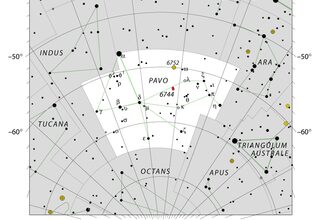
 IAU Chart
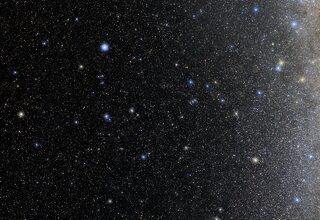 NOIRLab Images
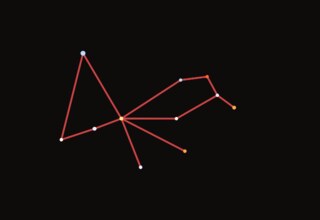 Stars and Sticks
| Abbreviation | Pav |
|---|---|
| Meaning | Peacock |
| Pronunciation Guide is based on “Pronouncing Astronomical Names,” published in 1943 by the American Astronomical Society. | PAY-vo |
| Genitive The genitive is the Latin possessive form used in star names. For example, Alpha Orionis means “the Alpha of Orion.” | puh-VOH-nis |
| Best Month | August |
| Visibility | Southern |
| Origin | ExplorationCreated by 16th-century Dutch navigators (Keyser & de Houtman) to fill the blank spaces of the southern sky during their voyages to the East Indies. |
| Author | Keyser & de HoutmanDutch explorers whose southern star observations during the first Dutch expedition to the East Indies provided the data for 12 new constellations. |
| Type | constellation |
| Difficulty | Moderate |
| Description | The Peacock was created by Dutch navigators Keyser and de Houtman in the 1590s to add the spectacular birds of tropical regions to the southern sky. In Greek myth Hera took the hundred eyes of her faithful watchman Argus Panoptes after he was slain by Hermes and spread them across the peacock's tail in his memory — which is why peacock feathers appear to have 'eyes.' The constellation's brightest star, Peacock (Alpha Pavonis), is one of the few stars to have been given an English name — assigned by the British Air Ministry in the 1930s for use in aerial navigation. It is a hot blue-white binary star about 179 light-years away. |
| Asterism | The Peacock: A fan-shaped arrangement of stars representing a peacock's tail. |
Click a thumbnail to view full-size. Plain and Annotated versions available on the image page.
Images: NOIRLab/NSF/AURA/E. Slawik · IAU and Sky & Telescope · Stellarium — Full credits →