NOIRLab / NSF / AURA
| Type | Open Cluster | Constellation | Cru |
|---|---|---|---|
| Magnitude | 4.2 | Size | 10.0′ |
| Distance | 6,400 light-years | Best Month | May |
| Visibility | Southern | Difficulty | Easiest (level 1/4) |
| Min. Aperture | naked eye | RA / Dec | 12h 53m 34.8s · -60° 21' 00" |
| Discovered by | Nicolas Louis de Lacaille, 1751 | ||
NOIRLab / NSF / AURA
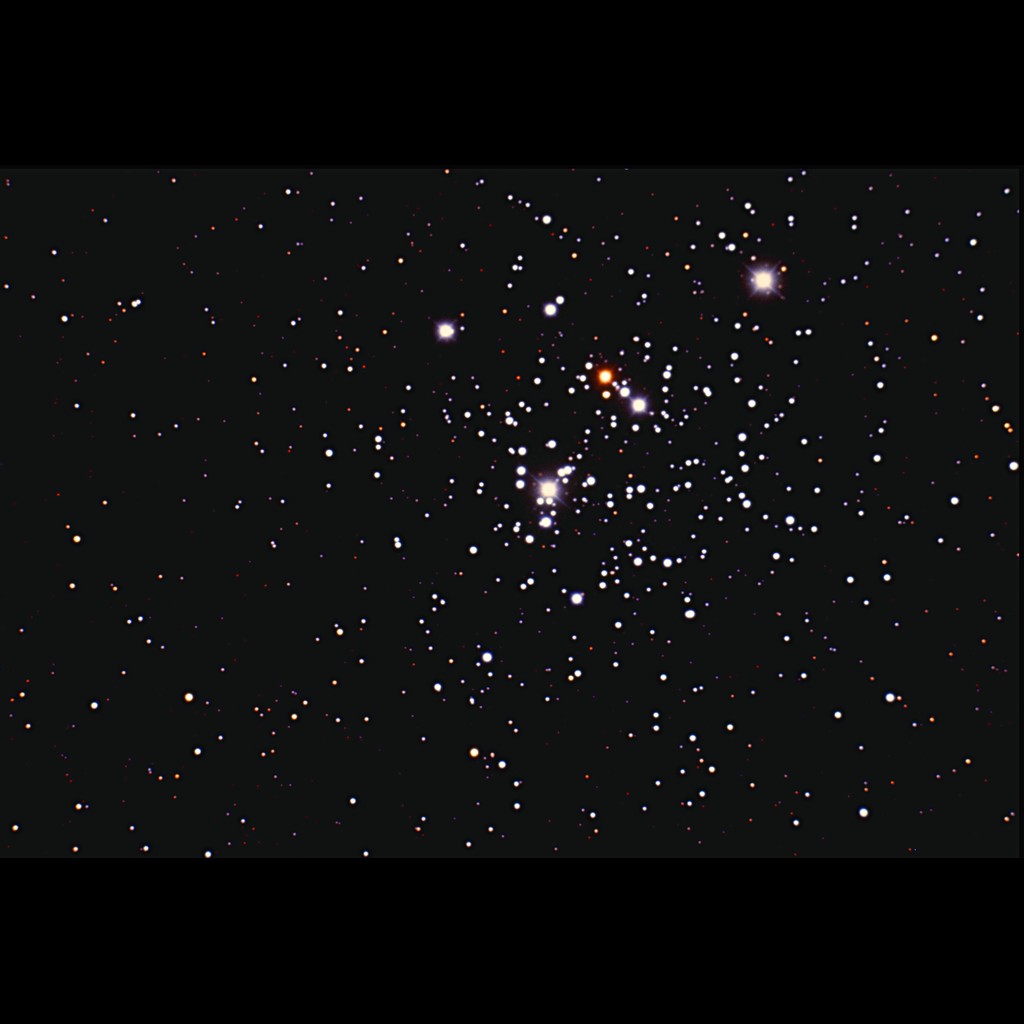
Caldwell 94, or NGC 4755, is one of the most celebrated open star clusters in the night sky. Located approximately 6,400 light-years away in the constellation Crux (the Southern Cross), it is easily visible to the naked eye as a hazy star near the bright giant Mimosa. The cluster earned its popular name, the Jewel Box, from the legendary astronomer Sir John Herschel, who described its glittering array of multicolored stars as a "superb piece of fancy jewelry" when viewed through a telescope. It is one of the youngest known open clusters, with an estimated age of only 7 to 10 million years—making its stars mere infants on the cosmic timescale.
The cluster is renowned for its striking color contrast, which is rare among open clusters. While the majority of its members are brilliant, hot blue-white "B-type" stars, the centerpiece of the Jewel Box is a singular, vivid red supergiant known as DU Crucis. This star stands out sharply against its blue siblings, creating a visual effect often compared to a ruby set among diamonds. Because the stars in an open cluster all form from the same cloud of gas at roughly the same time, the presence of such a diverse range of stellar colors and masses makes the Jewel Box a vital "natural laboratory" for astronomers studying the rapid life cycles of massive stars.
This vibrant photograph was captured using the 0.9-meter telescope at the Cerro Tololo Inter-American Observatory (CTIO) in Chile. The image perfectly illustrates the cluster's many colors, resolving the tight A-shaped arrangement of its brightest members. By utilizing the precise optics of the CTIO 0.9-meter, the portrait captures the intense luminosity of the blue giants while preserving the delicate, deep-orange hue of the central supergiant. The resulting view honors Herschel’s original 19th-century description, presenting the cluster as a glittering hoard of celestial gems scattered against the dark velvet of the southern Milky Way.