Roberto Mura / DSS of STScI
| Type | Open Cluster | Constellation | TrA |
|---|---|---|---|
| Magnitude | 5.1 | Size | 12.0′ |
| Distance | 2,500 light-years | Best Month | June |
| Visibility | Southern | Difficulty | Easiest (level 1/4) |
| Min. Aperture | naked eye | RA / Dec | 16h 03m 36.0s · -60° 30' 00" |
| Discovered by | Nicolas Louis de Lacaille, 1751 | ||
Roberto Mura / DSS of STScI
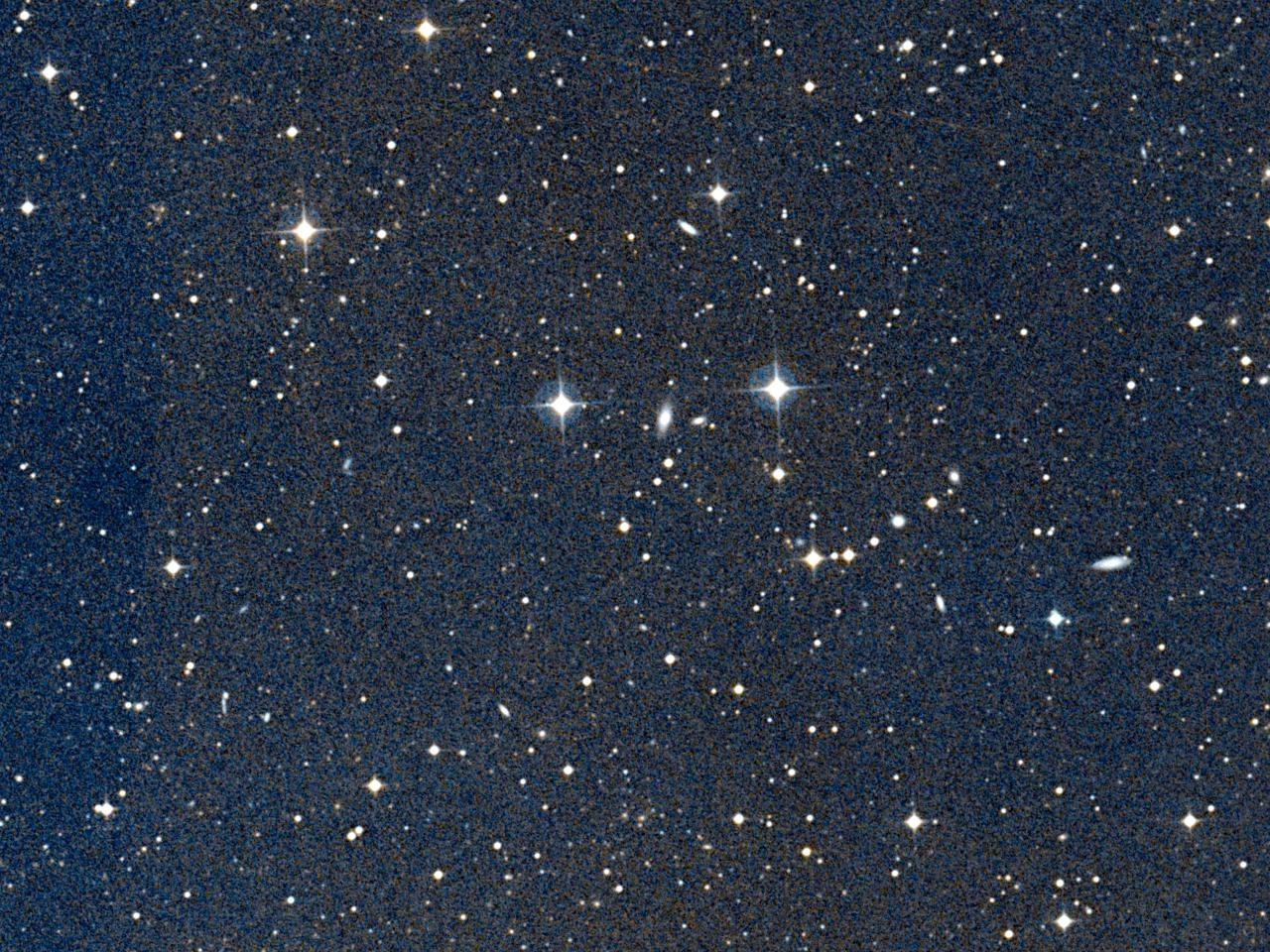
Caldwell 95, also cataloged as NGC 6025, is a bright and elongated open cluster located approximately 2,500 light-years away in the constellation Triangulum Australe, the Southern Triangle. Situated near the border with the constellation Norma, this cluster is a relatively easy target for binoculars, appearing as a compact, "V-shaped" concentration of stars. It contains about 30 bright members, with its most luminous stars reaching the 7th magnitude. The cluster is estimated to be roughly 130 million years old, placing it in a stage of development where its stars have begun to spread out slightly, yet still remain clearly distinct from the background star fields of the Milky Way.
Scientifically, NGC 6025 is valued for its contribution to our understanding of the local galactic neighborhood. Because its distance is well-calculated, it serves as a reliable marker for studying the distribution of gas and dust within the Norma arm of our galaxy. The cluster's population is dominated by white and blue-white main-sequence stars, though some members have begun their transition into more advanced evolutionary stages. Its moderate age and rich stellar density make it a classic example of an open cluster that has successfully navigated its early life without being fully dispersed by the gravitational tides of the galactic disk.
This clean and precise view of the cluster was curated by Roberto Mura using the Aladin Sky Atlas software, developed by the Strasbourg Astronomical Data Center (CDS). The underlying data originates from the Digitized Sky Survey (DSS), a comprehensive program managed by the Space Telescope Science Institute (STScI). By utilizing these professional-grade survey plates, the image provides a standardized and highly accurate representation of the cluster’s morphology. Mura’s presentation highlights the tight central concentration of stars and their "linear" arrangement, offering a perspective that reflects both the historical importance of the DSS program and the modern accessibility of professional astronomical tools.