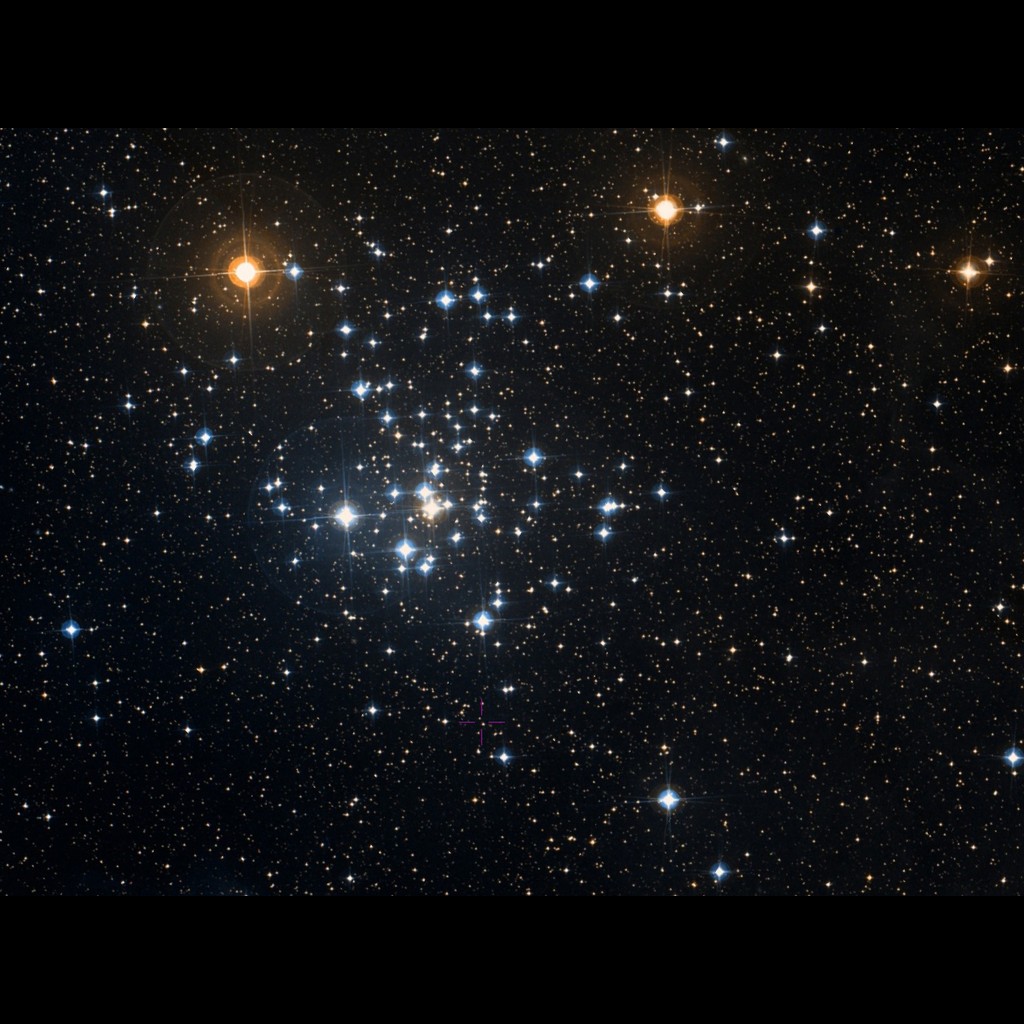
DSS (Digitized Sky Survey)
| Type | Open Cluster | Constellation | Car |
|---|---|---|---|
| Magnitude | 3.8 | Size | 30.0′ |
| Distance | 1,079 light-years | Best Month | February |
| Visibility | Southern | Difficulty | Easiest (level 1/4) |
| Min. Aperture | naked eye | RA / Dec | 07h 58m 37.2s · -60° 52' 12" |
| Discovered by | Nicolas Louis de Lacaille, 1751 | ||
DSS (Digitized Sky Survey)
Caldwell 96, formally designated as NGC 2516, is one of the most brilliant open clusters in the southern sky, located approximately 1,300 light-years away in the constellation Carina. It is frequently referred to as the Southern Beehive Cluster due to its striking resemblance to the famous Beehive Cluster (M44) in Cancer. Discovered by Abbe Lacaille in 1751, it is a magnificent naked-eye object, appearing as a large, hazy patch that resolves into a spectacular field of stars through even small binoculars. With an estimated age of 110 million years, it is a youthful and energetic group, containing over 100 stars that share a common origin and trajectory through the Milky Way.
The cluster is of particular interest to astrophysicists because it contains a remarkably high concentration of "chemically peculiar" stars. Within its bounds, researchers have identified several red giants and a significant number of stars with unusual atmospheric compositions, which are rarer in other clusters of similar age. These stars provide clues into the specific conditions of the molecular cloud from which NGC 2516 formed. Additionally, the cluster serves as a vital laboratory for studying the rotation and magnetic activity of young stars, helping to bridge the gap between newborn stellar nurseries and more mature, stable systems like our own Solar System.
This wide-field rendering of the cluster was produced by the contributor Kovayashi, utilizing the Aladin Sky Atlas software from the Centre de Données astronomiques de Strasbourg (CDS). The image was built from professional FIT format data retrieved from the Digitized Sky Survey (DSS). By processing the raw scientific data through the Aladin interface, Kovayashi has created a portrait that emphasizes the cluster's "hive-like" density and its distinct, bright members. The resulting view showcases the sprawling beauty of this southern centerpiece, highlighting why it is often cited as a more impressive counterpart to its northern namesake.