ESO / La Silla Observatory
| Type | Open Cluster | Constellation | Cen |
|---|---|---|---|
| Magnitude | 5.3 | Size | 12.0′ |
| Distance | 5,550 light-years | Best Month | May |
| Visibility | Southern | Difficulty | Easiest (level 1/4) |
| Min. Aperture | naked eye | RA / Dec | 11h 36m 10.8s · -61° 37' 12" |
| Discovered by | Nicolas Louis de Lacaille, 1751 | ||
ESO / La Silla Observatory
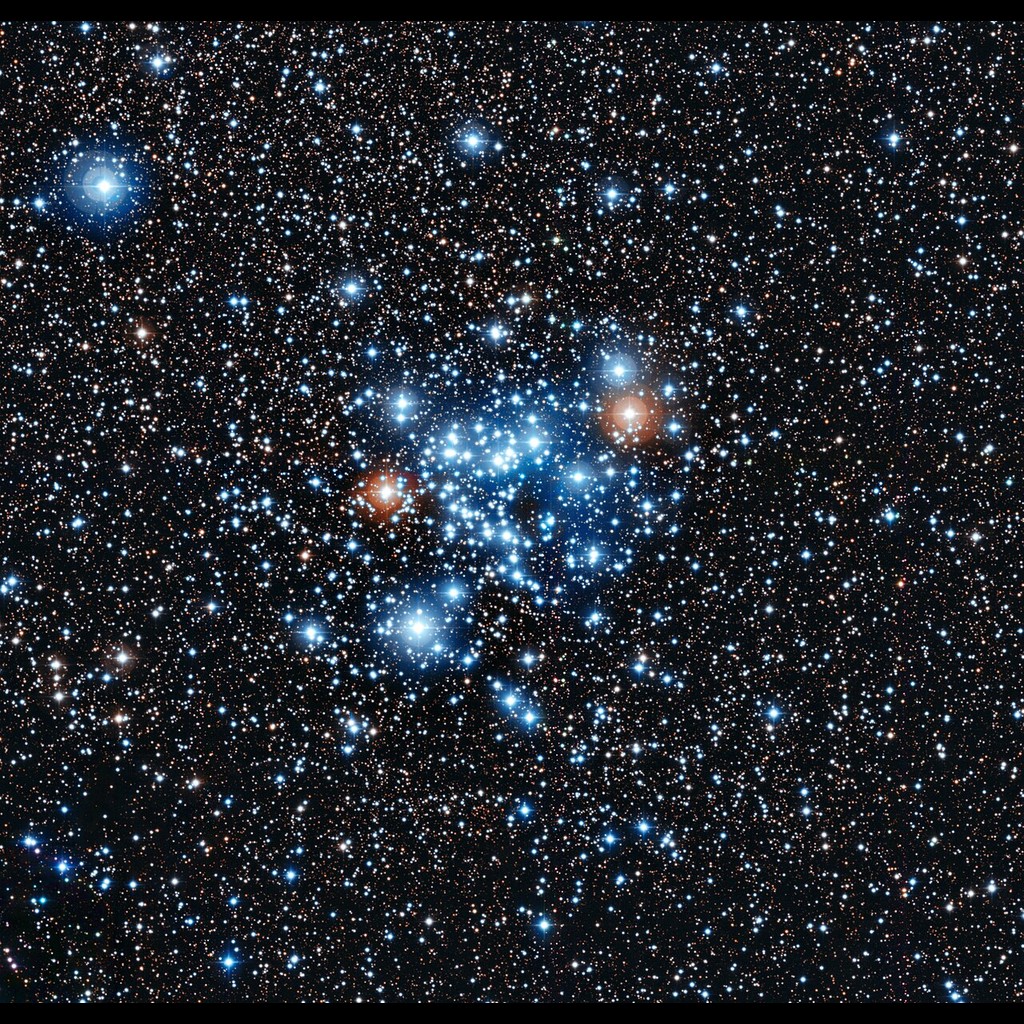
Caldwell 97, or NGC 3766, is a spectacular open cluster located roughly 5,800 light-years away in the constellation Centaurus. Known to many southern observers as the Pearl Cluster, it is famous for its extreme stellar density and the sheer number of bright stars packed into a relatively small area of the sky. Estimated to be around 14 to 20 million years old, it is an exceptionally young and energetic cluster. Its population is dominated by massive, hot blue stars, making it a vivid example of a stellar "nursery" that has recently emerged from its parent molecular cloud.
While the Pearl Cluster has always been a visual favorite, it recently made headlines for a groundbreaking discovery that has puzzled astrophysicists. A team from the Geneva Observatory, using the Swiss 1.2-metre Leonhard Euler Telescope at La Silla, conducted a seven-year study of the cluster's members. They discovered that 36 of its stars belong to a previously unknown class of variable stars. These stars exhibit tiny regular variations in their brightness at a level that had never been detected before. Unlike other variable stars whose pulses are well-understood, these stars do not fit existing theoretical models, suggesting there are still undiscovered mechanisms at work deep within the interiors of massive stars.
This image was captured using the MPG/ESO 2.2-metre telescope at the La Silla Observatory in Chile. The high resolution of this instrument perfectly resolves the "shimmering" quality of the cluster, showcasing the dense concentration of blue-white stars that gives the group its "pearl-like" appearance. The portrait reveals the intricate structure of the cluster against the rich backdrop of the southern Milky Way, serving as a reminder that even well-known celestial objects can harbor scientific secrets that challenge our understanding of the universe.