 IAU Chart
 NOIRLab Images
 Stellarium Images
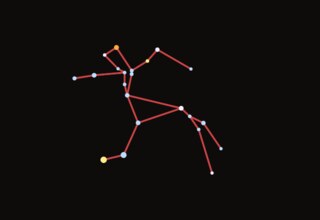 Stars and Sticks
| Abbreviation | Cen |
|---|---|
| Meaning | Centaur |
| Pronunciation Guide is based on “Pronouncing Astronomical Names,” published in 1943 by the American Astronomical Society. | sen-TOR-us |
| Genitive The genitive is the Latin possessive form used in star names. For example, Alpha Orionis means “the Alpha of Orion.” | sen-TOR-eye |
| Best Month | May |
| Visibility | Southern |
| Origin | AncientThese figures are rooted in the classical Greek and Mesopotamian traditions cataloged by Ptolemy in the 2nd century AD. |
| Author | PtolemyPtolemy, a 2nd-century Greco-Egyptian astronomer, cataloged the 48 classical constellations in his landmark work, the Almagest. These form the core of the 88 modern constellations recognized today. |
| Type | constellation |
| Difficulty | Easy |
| Description | The Centaur is one of the largest and most spectacular constellations in the southern sky, representing Chiron — the wisest of all centaurs, who tutored Achilles, Jason, and Asclepius. Unlike other centaurs known for violence, Chiron was gentle and learned in medicine, music, and prophecy; his accidental wounding by one of Hercules's poisoned arrows was so tragic that Zeus placed him among the stars. The constellation contains Alpha Centauri, the closest star system to our Solar System at just 4.37 light-years — the third brightest star in the sky and a triple system whose faint component Proxima Centauri is our absolute nearest stellar neighbor at 4.24 light-years. |
| Asterism | The Centaur: Contains the two 'Pointers' that guide the eye to the Southern Cross. |
Click a thumbnail to view full-size. Plain and Annotated versions available on the image page.
Images: NOIRLab/NSF/AURA/E. Slawik · IAU and Sky & Telescope · Stellarium — Full credits →