Donald Pelletier / 2MASS
| Type | Globular Cluster | Constellation | Hor |
|---|---|---|---|
| Magnitude | 8.4 | Size | 6.9′ |
| Distance | 53,500 light-years | Best Month | December |
| Visibility | Southern | Difficulty | Moderate (level 3/4) |
| Min. Aperture | binoculars | RA / Dec | 03h 12m 07.2s · -55° 13' 12" |
| Discovered by | James Dunlop, 1826 | ||
Donald Pelletier / 2MASS
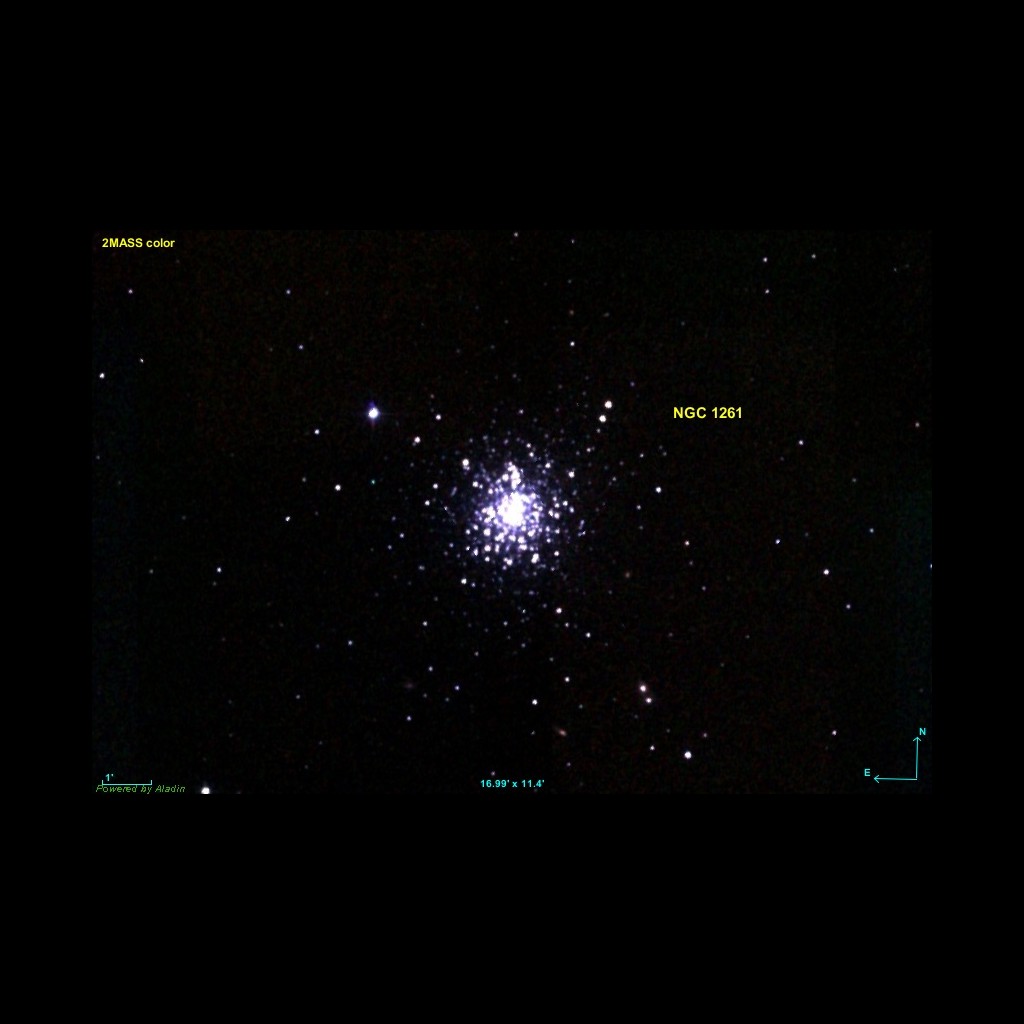
Caldwell 87, also cataloged as NGC 1261, is a distant globular cluster located approximately 53,000 light-years away in the southern constellation of Horologium, the Pendulum Clock. Unlike many clusters that crowd the dense center of our galaxy, Caldwell 87 resides in the "galactic halo," far from the busy spiral arms of the Milky Way. Discovered by James Dunlop in 1826, it appears as a circular, highly condensed concentration of stars. At such a vast distance, the cluster serves as a sentinel of the outer limits of our galaxy, offering a glimpse into the ancient stellar systems that orbit the Milky Way like moths around a flame.
Despite its remote location, Caldwell 87 is a bustling city of stars with a relatively high concentration at its core. It is a moderately "metal-poor" cluster, characteristic of objects that formed in the early stages of galactic evolution before the interstellar medium was heavily enriched by dying stars. Astronomers study clusters like Caldwell 87 to better understand the formation of the galactic halo and the gravitational forces that keep these ancient swarms bound together over billions of years. Its isolation from the gas and dust of the galactic plane allows for a particularly clear view of its stellar population, which consists mostly of old, yellow-red giant stars and fainter main-sequence members.
This image of the cluster was created by Donald Pelletier, utilizing public data from the 2MASS (Two Micron All-Sky Survey) archive. By leveraging the infrared capabilities of the 2MASS survey, the image is able to cut through any minor foreground extinction, revealing the true density of the cluster’s core. Pelletier’s presentation of the data highlights the spherical symmetry of the cluster and its "sparkling" transition from a dense central hub to the sparse, outlying members. The result is a clean, scientific portrait that underscores the lonely majesty of this deep-space wanderer.