ESO - CC 4.0
| Type | Globular Cluster | Constellation | Ara |
|---|---|---|---|
| Magnitude | 5.7 | Size | 26.0′ |
| Distance | 7,200 light-years | Best Month | July |
| Visibility | Southern | Difficulty | Easiest (level 1/4) |
| Min. Aperture | naked eye | RA / Dec | 17h 40m 37.2s · -53° 40' 12" |
| Discovered by | Nicolas Louis de Lacaille, 1751 | ||
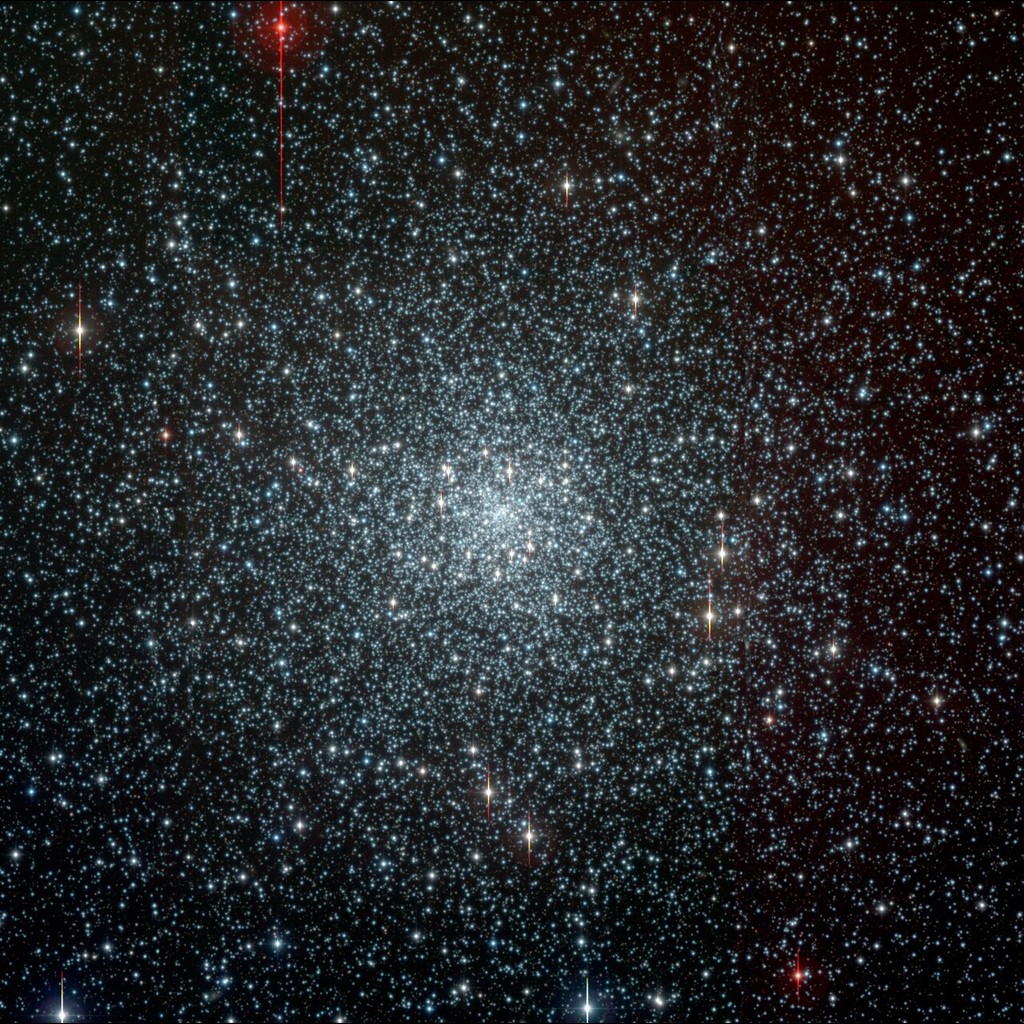
ESO - CC 4.0
Caldwell 86, formally designated as NGC 6397, is one of the most remarkable globular clusters in the southern sky. Located approximately 7,200 light-years away in the constellation Ara, it holds the distinction of being one of the two closest globular clusters to Earth. It is a "core-collapse" cluster, meaning that over billions of years, the stars at its center have migrated inward to create an incredibly dense and luminous nucleus. Within its spherical boundary reside roughly 400,000 stars, packed so tightly at the core that they frequently interact, providing astronomers with a unique laboratory to study the complex dynamics of stellar evolution in a high-density environment.
As one of the oldest known objects in the Milky Way, Caldwell 86 serves as a pristine "stellar fossil" from the early universe. Evolutionary models estimate its age at approximately 13.4 billion years (with a margin of error of 800 million years), meaning it formed shortly after the Big Bang and predates the formation of our galaxy's spiral disk. Its stars are notably "metal-poor," containing very few elements heavier than hydrogen and helium. By studying the faintest white dwarfs within this ancient swarm, researchers have been able to establish a firm lower limit on the age of the universe, making this cluster a cornerstone of modern cosmological dating.
This image is a detailed composite created from exposures in the B-, V-, and I-bands, captured as part of the Pilot Stellar Survey. The data was obtained using the Wide-Field-Imager (WFI) camera mounted on the 2.2-meter ESO/MPI telescope at the ESO La Silla Observatory in Chile. By combining these specific spectral bands, the photograph reveals the vibrant color temperature of the cluster's members—from the cool, aging red giants to the hot, blue stars concentrated toward the center. The high resolution of the WFI camera successfully resolves the "crowded" central region, conveying the immense scale and ancient beauty of this dense stellar city.