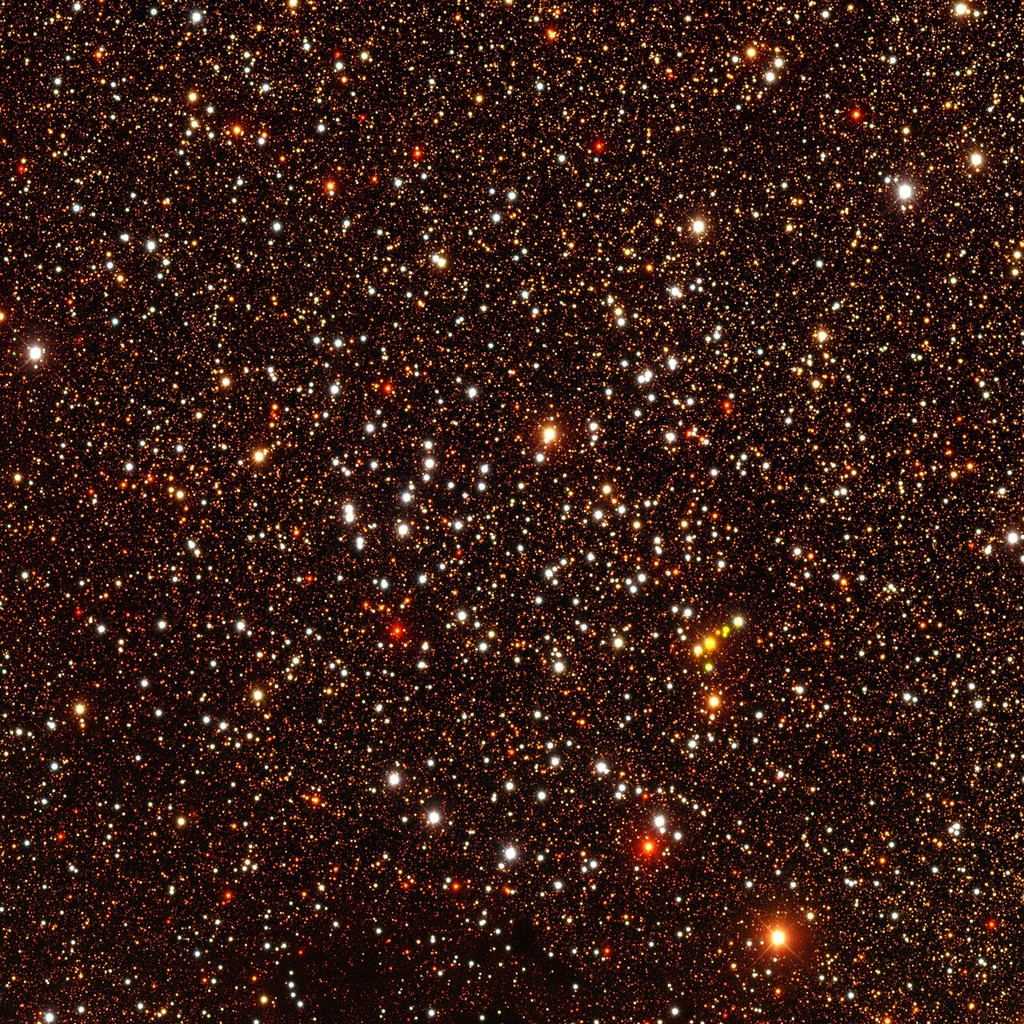
Donald Pelletier / 2MASSLegacy Surveys / D.Lang (Perimeter Institute) & Meli thev
| Type | Open Cluster | Constellation | Cir |
|---|---|---|---|
| Magnitude | 7.9 | Size | 10.0′ |
| Distance | 3,500 light-years | Best Month | June |
| Visibility | Southern | Difficulty | Moderate (level 3/4) |
| Min. Aperture | 3in | RA / Dec | 15h 05m 52.8s · -55° 36' 00" |
| Discovered by | James Dunlop, 1826 | ||
Donald Pelletier / 2MASSLegacy Surveys / D.Lang (Perimeter Institute) & Meli thev
Caldwell 88, formally known as NGC 5823, is an expansive open cluster located approximately 3,500 light-years away on the border of the constellations Circinus and Lupus. Discovered by James Dunlop in 1826, it is a relatively old member of its class, with an estimated age of around 800 million years. Unlike younger open clusters that are still shrouded in the colorful gas of their birth nebulae, Caldwell 88 has long since drifted away from its nursery. It now appears as a "subtle" grouping of roughly 80 to 100 stars spread across a wide field of view, blending gracefully into the rich, crowded star fields of the southern Milky Way.
The cluster is of significant interest to astronomers because its age and position in the galaxy provide a benchmark for studying the long-term evolution of stellar groups. Over hundreds of millions of years, gravitational interactions with the galactic disk and passing molecular clouds tend to "evaporate" open clusters, causing their members to disperse. The fact that Caldwell 88 remains a distinct, identifiable group suggests it was originally quite massive. To the visual observer, it lacks a singular, blazing central star, instead presenting a delicate "tapestry" of stars of similar brightness, which makes it a challenging but rewarding target to distinguish from the dense background of the galactic plane.
This wide-field view was produced using data from the DECaPS (Dark Energy Camera Plane Survey) and the Legacy Surveys. The image processing was spearheaded by D. Lang of the Perimeter Institute, utilizing the high-performance computing resources of NERSC (National Energy Research Scientific Computing Center). By leveraging the immense light-gathering power of the Dark Energy Camera (DECam), this rendering captures the cluster with incredible depth, revealing faint members that are often lost in smaller telescope views. The resulting composite showcases the "sparkling" clarity of the cluster stars while maintaining the intricate, textured details of the surrounding interstellar dust and background star clouds.