Roberto Mura
| Type | Globular Cluster | Constellation | Cen |
|---|---|---|---|
| Magnitude | 7.6 | Size | 9.1′ |
| Distance | 35,900 light-years | Best Month | May |
| Visibility | Southern | Difficulty | Easy (level 2/4) |
| Min. Aperture | binoculars | RA / Dec | 13h 46m 22.8s · -51° 22' 12" |
| Discovered by | James Dunlop, 1826 | ||
Roberto Mura
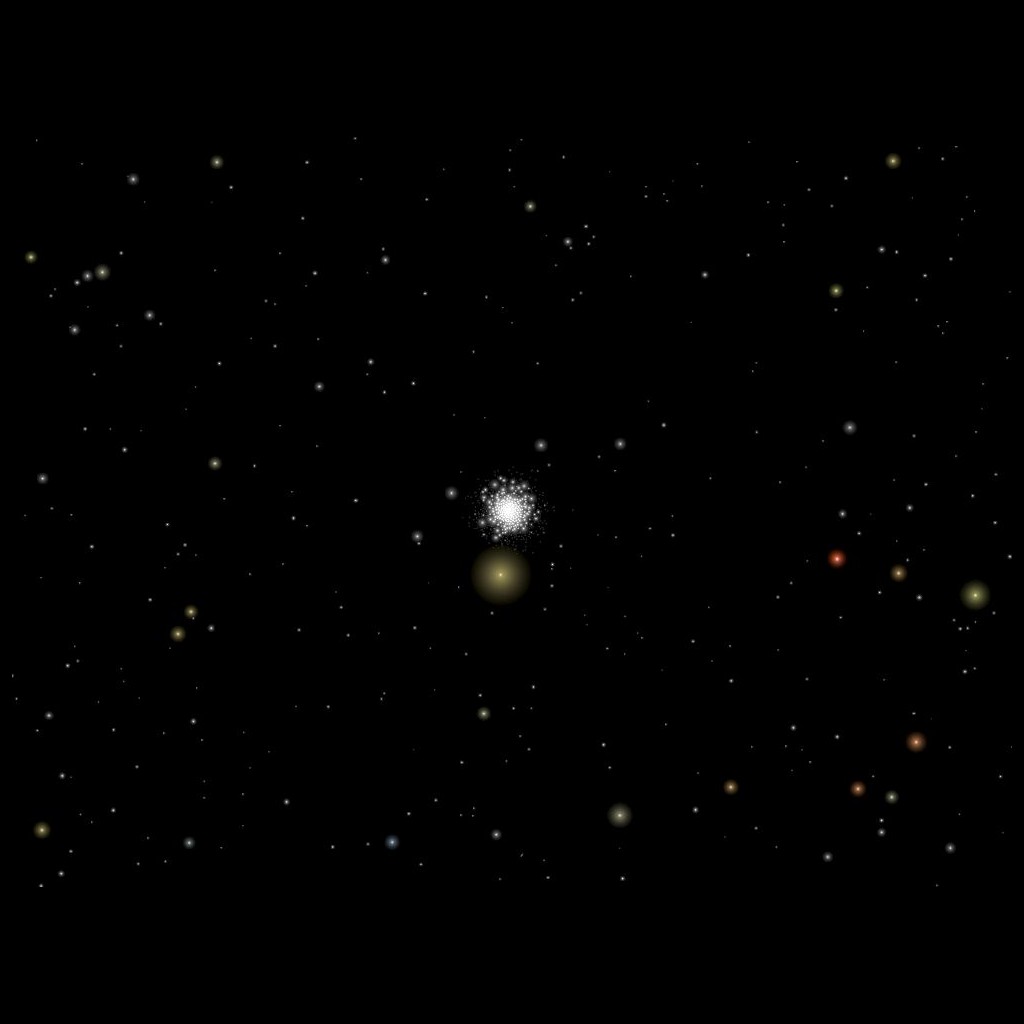
Caldwell 84, also known as **NGC 5286**, is a brilliant globular cluster located approximately 35,900 light-years away in the constellation Centaurus. It is one of the oldest known stellar systems in the Milky Way, with an estimated age of over 12.5 billion years. While it often sits in the shadow of its gargantuan neighbor, Omega Centauri, Caldwell 84 is a powerhouse in its own right, appearing as a highly condensed "snowball" of ancient stars. Its position in the sky is famously marked by the bright 4.6-magnitude star **M Centauri**, which sits just 4 arc-minutes away. While this star serves as a perfect guidepost for observers, its intense glare presents a significant challenge for astrophotographers attempting to resolve the cluster’s delicate outer members.
Beyond its visual appeal, Caldwell 84 is a key piece in the puzzle of our galaxy’s violent history. Astronomers believe the cluster is a survivor of the **"Gaia Sausage"** (or Gaia-Enceladus), the remains of a dwarf galaxy that collided and merged with the Milky Way roughly 10 billion years ago. This origin story is supported by the cluster’s unusual retrograde orbit and unique chemical composition, suggesting it was once a prominent feature of a satellite galaxy before being "swallowed" by our own. Modern studies of the stellar motions at its core even suggest the presence of an **intermediate-mass black hole**, a rare feature that further hints at its former life as a galactic nucleus.
This specific rendering of the cluster was captured by amateur astrophotographer **Roberto Mura**. Mura’s work is characterized by a "natural" aesthetic that balances the intense luminosity of the cluster’s core with the individual pinpoints of its peripheral stars. By carefully managing the dynamic range, the image successfully navigates the "photobombing" presence of M Centauri, allowing the viewer to appreciate the cluster's dense, sparkling center without it being overwhelmed by the nearby star's diffraction spikes. The result is a crisp, high-contrast portrait that honors both the technical skill required for southern sky imaging and the ancient majesty of this stellar fossil.