ESO - CCA 4.0
| Type | Galaxy | Constellation | Cen |
|---|---|---|---|
| Magnitude | 8.7 | Size | 20.0′ |
| Distance | 13.0 million light-years | Best Month | May |
| Visibility | Southern | Difficulty | Easy (level 2/4) |
| Min. Aperture | binoculars | RA / Dec | 13h 05m 31.2s · -49° 28' 12" |
| Discovered by | James Dunlop, 1826 | ||
ESO - CCA 4.0
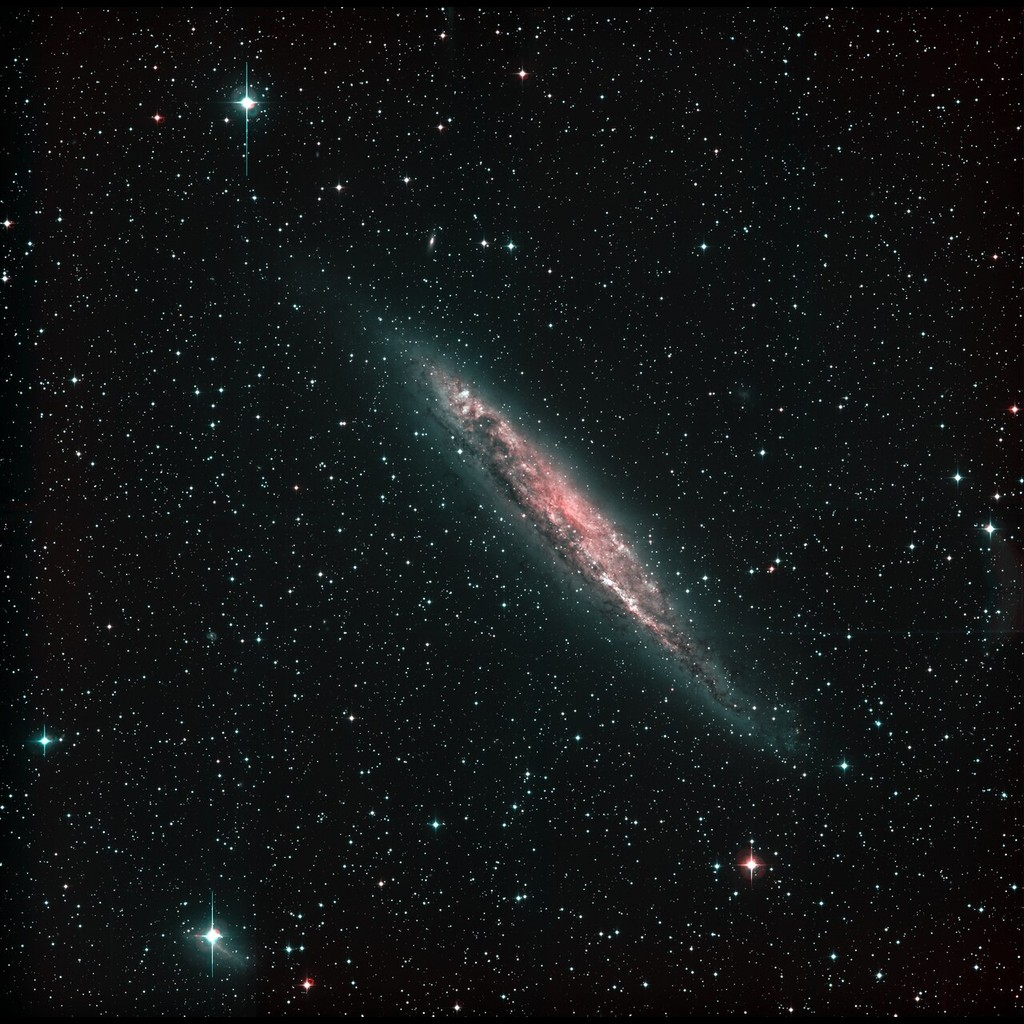
Caldwell 83, also known as NGC 4945, is a stunning barred spiral galaxy located approximately 11 to 13 million light-years away in the constellation Centaurus. From our vantage point on Earth, the galaxy is seen nearly edge-on, appearing as a long, slender "cigar" of light that stretches across the sky. Astronomers often refer to it as a cosmic twin to our own Milky Way, as it possesses a similar bar-shaped central region and swirling spiral arms. However, despite these structural similarities, Caldwell 83 harbors a much more turbulent secret: its center is classified as a Seyfert 2 nucleus, indicating an exceptionally active galactic core that is far more energetic than the relatively quiet center of our own galaxy.
The intense activity at the heart of Caldwell 83 is fueled by a supermassive black hole that is actively devouring surrounding matter. This process triggers massive bursts of star formation, creating "starburst" regions where new suns are born at an incredible rate. These regions are often obscured by thick lanes of interstellar dust, but they reveal themselves through powerful emissions of infrared, X-ray, and ultraviolet light. The interplay between the dark, silhouetted dust lanes and the brilliant pockets of ionized hydrogen gives the galaxy a rugged, textured appearance, marking it as one of the most dynamic members of the Centaurus A/M83 Group of galaxies.
This photograph was captured using the Wide-Field-Imager (WFI) mounted on the MPG/ESO 2.2-meter telescope at the La Silla Observatory in Chile. Assembled from data obtained in January 1999 during the telescope's Science Verification phase, the image is a composite of five 15-minute Red-narrowband exposures, four 5-minute Blue-band exposures, and five 1000-second Ultraviolet-band exposures. By combining these specific wavelengths, the image successfully highlights the various physical components of the galaxy: the red narrowband reveals the glowing gas of star-forming regions, while the blue and ultraviolet bands emphasize the hot, young stars and the energetic heart of this distant "island universe."