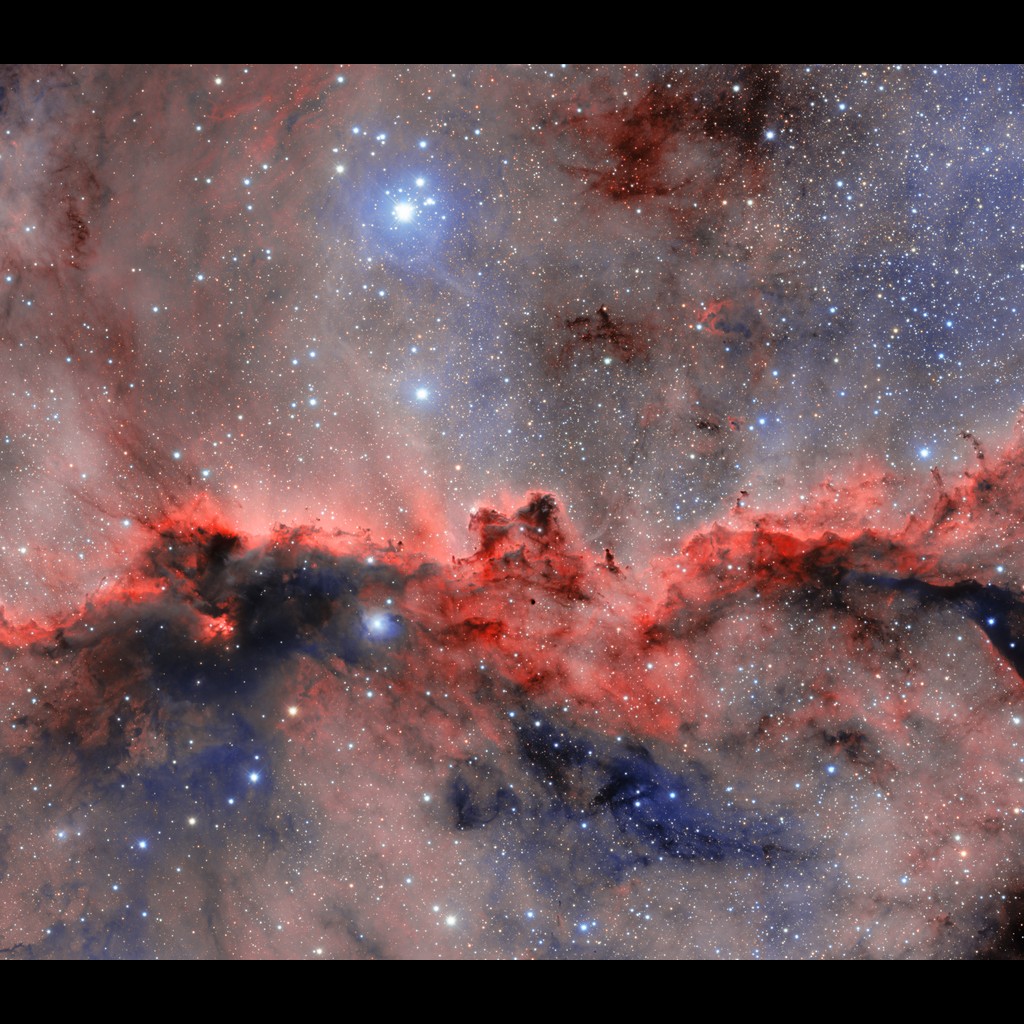
Dark Energy Survey/DOE/FNAL/DECam/CTIO/NOIRLab/NSF/AURA
| Type | Open Cluster | Constellation | Ara |
|---|---|---|---|
| Magnitude | 5.2 | Size | 15.0′ |
| Distance | 4,300 light-years | Best Month | June |
| Visibility | Southern | Difficulty | Easiest (level 1/4) |
| Min. Aperture | naked eye | RA / Dec | 16h 41m 16.8s · -48° 46' 12" |
| Discovered by | Nicolas Louis de Lacaille, 1751 | ||
Dark Energy Survey/DOE/FNAL/DECam/CTIO/NOIRLab/NSF/AURA
Caldwell 82, formally designated as the open cluster NGC 6193, serves as the brilliant heart of the larger NGC 6188 emission nebula, famously known as the Fighting Dragons of Ara. Located approximately 4,000 light-years away in the southern constellation of Ara, this cluster and its associated nebula create one of the most dramatic visual narratives in the night sky. The "dragons" themselves are towering silhouettes of cold, dark molecular dust that appear to emerge from the surrounding gas to face one another in a celestial standoff. While the nebula provides the stage, it is the Caldwell 82 cluster that provides the light, casting the profiles of these mythical beasts in stark relief against a backdrop of glowing hydrogen.
The 27 bright, young stars that comprise NGC 6193 are the primary architects of this region. These stars, only a few million years old, emit a fierce torrent of ultraviolet radiation and powerful stellar winds that have physically sculpted the surrounding clouds. This process of "feedback" ionizes the hydrogen gas, creating the characteristic reddish glow that outlines the dragons' backs and illuminates the cavernous spaces between them. Without the immense energy output from these massive stars, the dark dust clouds would remain invisible; instead, they are transformed into a vivid display of cosmic erosion and star formation.
This image was obtained by the NOIRLab Communications, Education & Engagement team as part of the NOIRLab Legacy Imaging Program. The data was captured using the Department of Energy-built Dark Energy Camera (DECam), which is mounted on the Víctor M. Blanco 4-meter Telescope at the Cerro Tololo Inter-American Observatory in Chile. By utilizing this advanced instrumentation, the image reveals the intricate "sparkling" details of the cluster alongside the dense, "ominous" textures of the dust clouds. The result is a high-resolution window into a turbulent molecular cloud where the birth of new stars continues to reshape the face of the galaxy.